


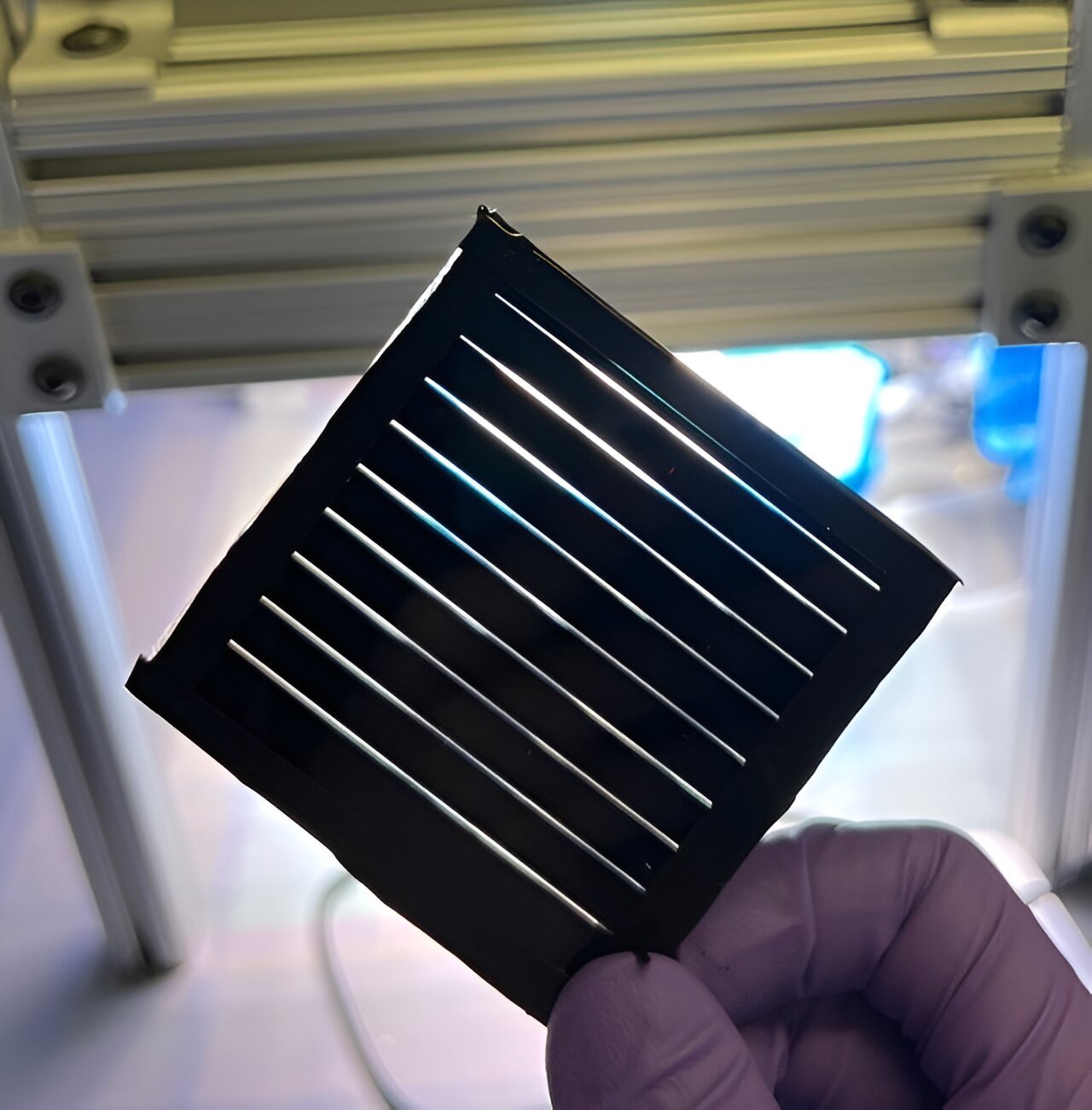
Solar panels and photovoltaics (PVs) are becoming increasingly widespread, contributing to ongoing efforts aimed at decarbonizing electricity production. Solar cells based on perovskites, a class of minerals that can leverage parts of the solar spectrum, have recently achieved highly promising energy conversion efficiencies and stabilities.
Despite these encouraging results, scaling up perovskite solar cells has, so far, proved to be challenging. Typically, their efficiency appears to significantly decline as their surface area increases.
Researchers at Northwestern University, the Institute of Chemical Sciences and Engineering (EPFL) and other institutes worldwide recently introduced a new design strategy that could help to improve the efficiency and stability of perovskite solar modules. Their proposed method, outlined in Nature Energy, entails the addition of thermotropic liquid crystals that protect solar cells from environmental stress factors and improves their stability.
“Our recent paper stemmed from the growing need for efficient and stable perovskite solar modules,” Drs Yi Yang and Mohammad Khaja Nazeeruddin, co-authors of the paper, told Tech Xplore.
“We aimed to address challenges faced by previous research efforts, drawing on insights from advancements in materials science and photovoltaics. Our primary objective was to develop a fabrication approach that enhances efficiency and stability, pushing the boundaries of perovskite solar technology.”
Previous studies that explored the use of liquid crystals to protect perovskite solar cells typically employed them as routine passivating and hole-transporting materials. These studies overlooked the thermotropic properties of these crystals, or in other words their motions in response to heat and temperature changes.
Dr. Yang, Dr. Nazeeruddin and their colleagues set out to develop a new additive that leverages these thermotropic properties. Their proposed strategy prevents the evaporative crystallization typical of conventional additives and the consequent accumulation of crystals at interfaces, ultimately ensuring the uniform passivation of large-area perovskite films.
“Prior additives tend to aggregate within the perovskite film during co-precipitation in the course of solvent evaporation, preventing the movement of charge carriers,” Dr. Yang and Dr. Nazeeruddin said. “This led us to formulate a hypothesis: exploring alternative processing methods beyond the commonly used evaporative precipitation and crystallization could potentially decrease defects and the presence of insulating inclusions.”
The recent study by the researchers suggests that due to their heat-induced phase transition, thermotropic liquid crystals could avoid the aggregation associated with other previously proposed liquid crystal additives. Essentially, they would remain liquid even when perovskites solidify, thus facilitating the movement of charge carriers in solar modules for longer periods of time.
“The efficient diffusion within a mixed liquid-solid system enabled liquid crystal molecules to distribute uniformly throughout the film for homogenous passivation of defects,” the researchers explained.
More information:
Yi Yang et al, A thermotropic liquid crystal enables efficient and stable perovskite solar modules, Nature Energy (2024). DOI: 10.1038/s41560-023-01444-z.
© 2024 Science X Network
Read the full article here


