


Xanthan gum, derived from plants like cabbage and known for its carbohydrate content, serves as a natural protective barrier in cosmetics to retain their benefits on the skin. In a recent development, this remarkable substance has been harnessed to create a protective shield for battery electrodes, rather than for the skin.
Professor Changshin Jo from the Graduate Institute of Ferrous & Eco Materials Technology and the Department of Chemical Engineering and Jooyoung Jang, a Ph.D. candidate, from the Department of Chemical Engineering at Pohang University of Science and Technology (POSTECH), have crafted a protective film by blending polymers. This film enhances the durability of battery electrodes, and their research findings have been featured in the journal Energy Storage Materials.
With renewable energy sources like solar power being inherently intermittent, the importance of energy storage systems (ESS) is steadily growing. ESS technology enables the capture and efficient use of electricity when needed, making it a crucial element in harnessing renewable energy. While lithium-ion (Li-ion) batteries have traditionally been employed for ESS applications, their high cost and concerns about lithium depletion have prompted ongoing research into alternative solutions.
One promising alternative to lithium is zinc (Zn), an abundant element on Earth. Zinc-ion batteries have the capacity to store significant amounts of energy and are safer in terms of fire risks compared to lithium-ion batteries. Nonetheless, achieving a consistent deposition of zinc on the electrodes in ESS batteries is a challenging task, and the repeated charging and discharging cycles tend to lead to the formation of twig-like crystals on the zinc surface, reducing the battery’s longevity.
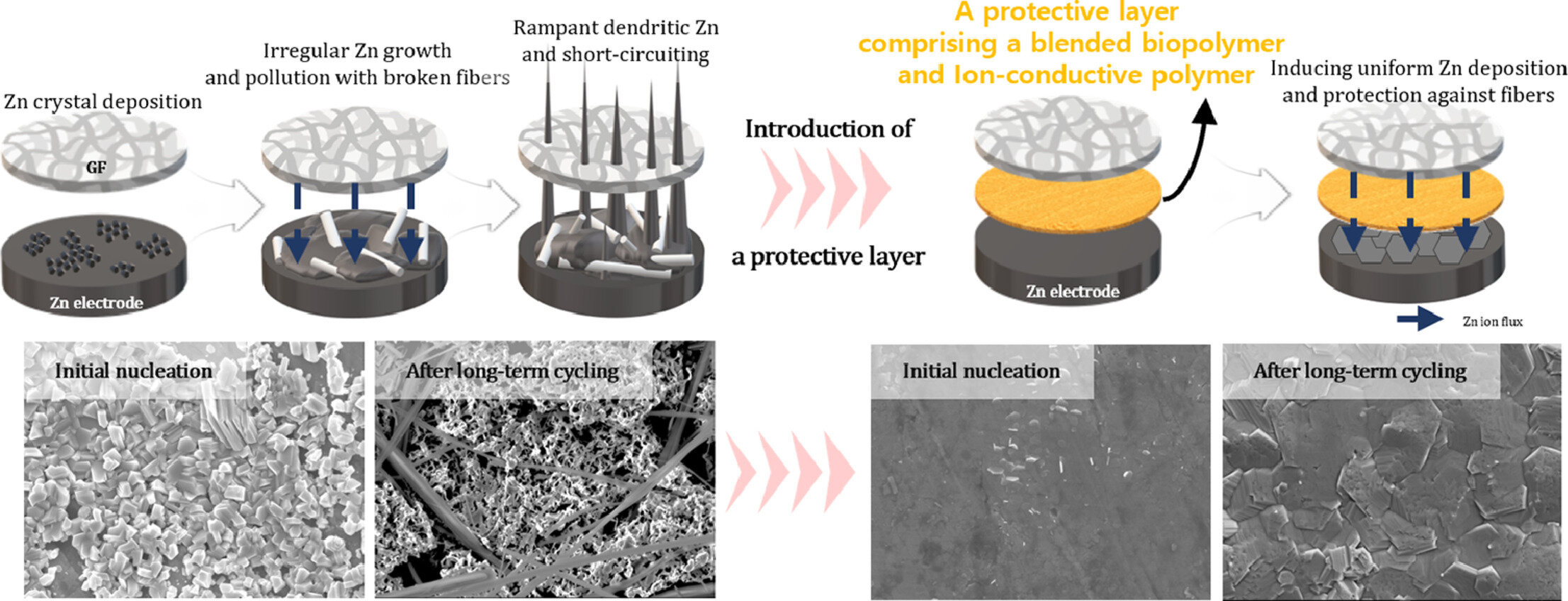
In this investigation, the research team employed the biopolymer xanthan gum in combination with an ionically conductive polymer to fashion a protective film for the battery electrode.
The interaction between these two polymers yielded a smooth protective layer on the electrode’s surface, effectively shielding it from physical impacts and chemical contaminants. Furthermore, this protective film was rich in oxygen functional groups, which played a crucial role in facilitating the uniform nucleation of zinc, resulting in the efficient deposition of zinc on the electrode surface.
Consequently, the formation of twig-like crystals on the zinc surface was significantly mitigated, and the film demonstrated remarkable stability even after enduring 200 days of repeated charging and discharging.
Professor Changshin Jo stated, “I hope this research will contribute to the advancement of ESS technology for sustainable green energy production.”
More information:
Jooyoung Jang et al, Biopolymer-blended protective layer for use in stabilizing the zinc anode in metal battery applications, Energy Storage Materials (2023). DOI: 10.1016/j.ensm.2023.102948
Pohang University of Science and Technology
Read the full article here


