


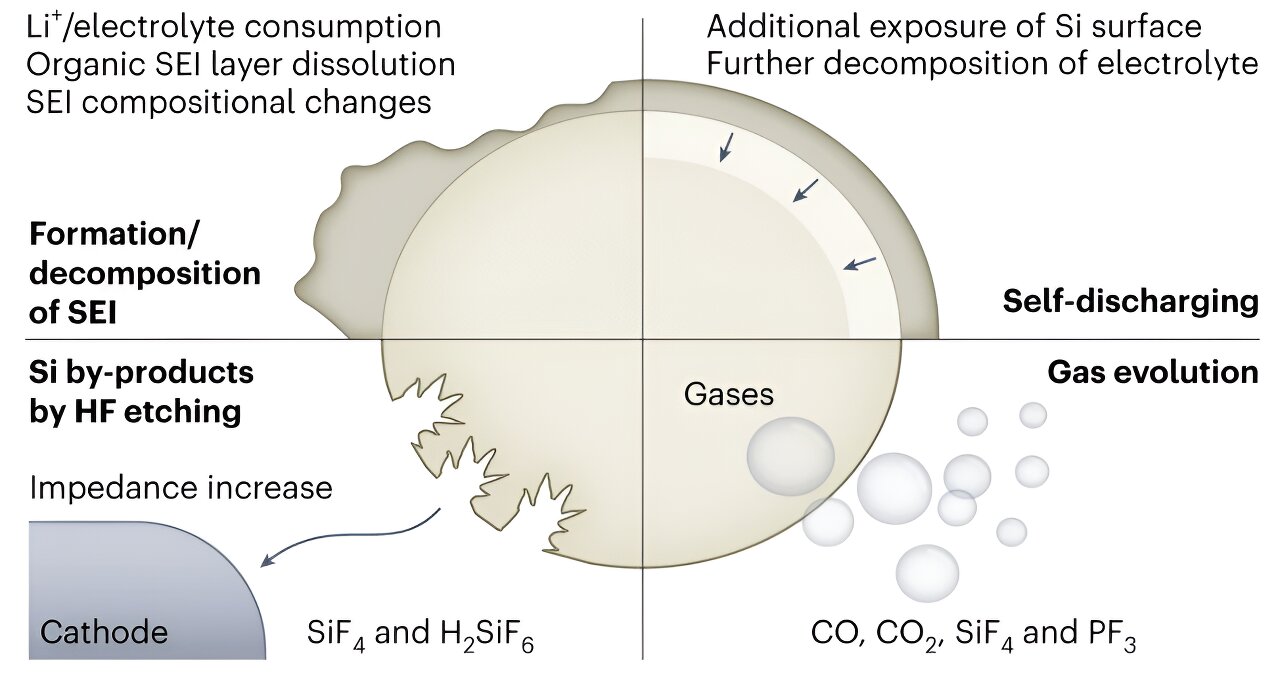
In a review published in Nature Energy, Professor Jaephil Cho from the School of Energy and Chemical Engineering at UNIST presents an analysis protocol to evaluate silicon cathode materials applicable to commercialized batteries. The study delves deep into the characteristics and challenges surrounding silicon anode materials—the focus of significant attention as secondary battery components.
Silicon has emerged as a promising alternative to conventional graphite anodes in high-energy lithium-ion batteries due to its exceptional gravimetric capacity. However, intrinsic issues such as severe volume expansion during cycling have hindered the widespread use of Si anodes in battery development. While laboratories have made tremendous progress in addressing these issues, most Si-containing batteries used in industry—where Si anodes are composed of Si suboxides or Si-C composites—are only able to incorporate limited amounts of silicon.
The research team’s comprehensive analysis explores crucial factors that influence the practical energy density of silicon-containing batteries. It examines phenomena such as electrode swelling and cut-off voltage during cell operation while considering calendar life, safety concerns, and cost implications—all essential aspects that significantly impact practical cell design.
Furthermore, the paper proposes testing protocols aimed at evaluating the feasibility and viability of newly developed silicon anodes. These protocols offer valuable insights into ensuring optimal performance, efficiency, durability, and safety when incorporating these advanced materials into commercial battery applications.
One key finding highlighted by Professor Cho’s team is that reducing the size of silicon particles to less than 5 nm while uniformly dispersing them within conductive carbon particles holds great promise for overcoming existing limitations. Recent advancements reported by researchers involved depositing raw materials on carbon composite particles through gas deposition—a synthesis technology capable of reducing particle sizes below 1 nm. This innovative approach demonstrated initial efficiencies exceeding 90% with significantly improved lifespan characteristics.
“The evaluation methods currently reported in specialized journals for silicon anode materials are somewhat limited, making it challenging to determine their commercial viability,” stated Professor Cho. The proposed analysis protocol aims to bridge this gap and provide a comprehensive framework for assessing the practical potential of these materials in commercialized batteries.
This review paper, invited by Nature Energy—an authoritative journal in the field of energy—was co-authored by Professor Jaekyung Sung from Gyeongsang National University. Released on August 28, this publication marks a significant contribution to advancing battery technology and propelling us closer towards achieving efficient and commercially viable silicon-based anodes.
More information:
Namhyung Kim et al, Issues impeding the commercialization of laboratory innovations for energy-dense Si-containing lithium-ion batteries, Nature Energy (2023). DOI: 10.1038/s41560-023-01333-5
Ulsan National Institute of Science and Technology
Read the full article here


