


Lithium-ion batteries are widely used in various applications but need improved binders to enhance their performance to meet evolving demands. This is because silicon oxide (SiO), a promising anode material due to its high capacity and low cost, faces several challenges. These include poor conductivity, which leads to slower charging rates, and significant expansion during charging. Effective binders are thus essential to address these issues and ensure enhanced performance and prolonged durability for lithium-ion battery systems.
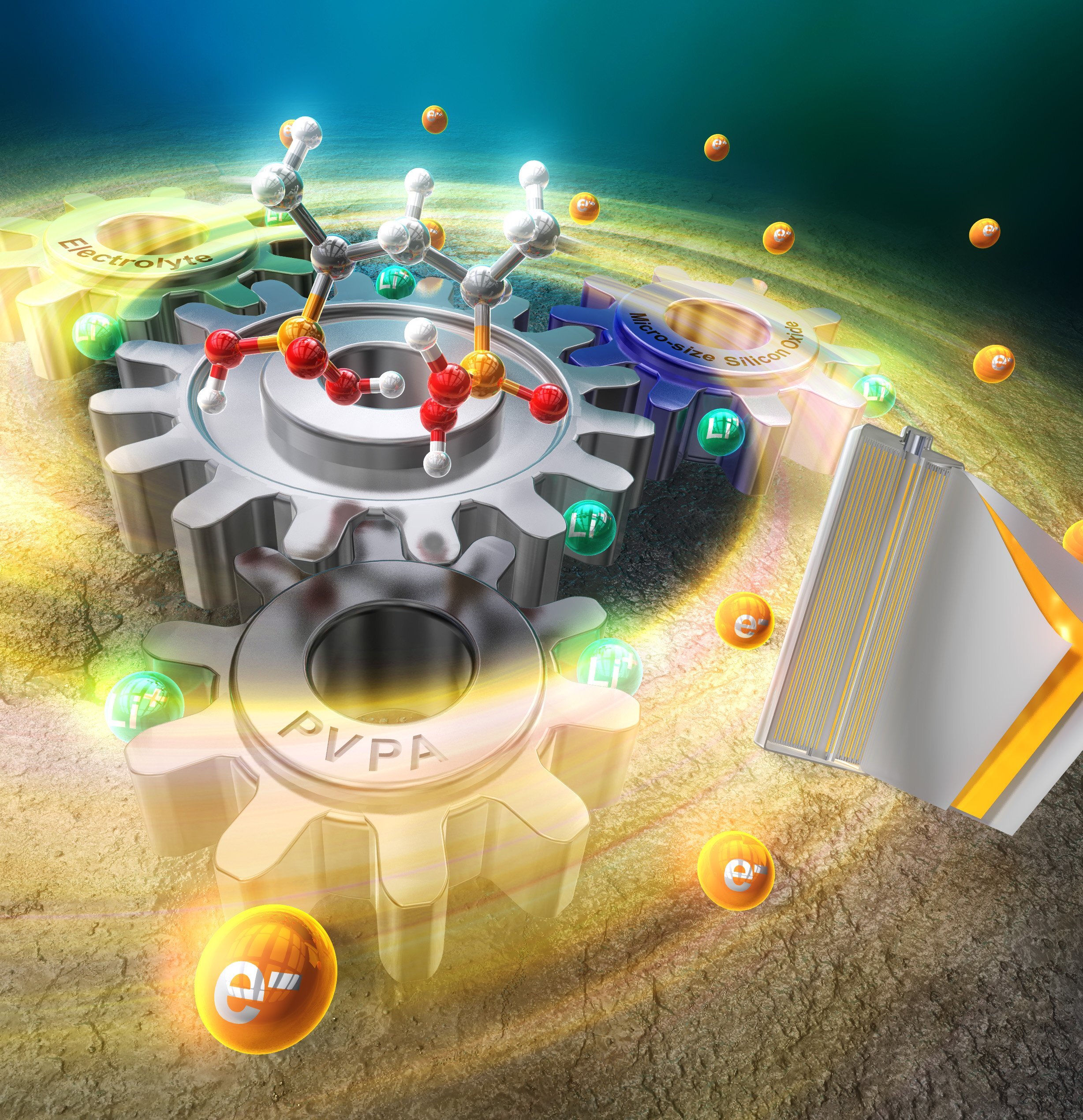
In a study published in the journal ACS Applied Energy Materials Professor Noriyoshi Matsumi from the Japan Advanced Institute of Science and Technology (JAIST), and researchers from Maruzen Petrochemical Company Ltd., have utilized poly(vinylphosphonic acid) (PVPA) as a binder for a micro-SiO electrodes, achieving superior performance compared to conventional cells.
According to Prof. Matsumi, “The PVPA binder should prove to be very useful in extending the life of high-performing lithium-ion secondary batteries. Particularly in the application of electric vehicles, there has been intense interest in enabling long life for lithium-ion secondary batteries. The use of PVPA will offer improved alternatives to commercially available binders, such as poly(acrylic acid) (PAA) and poly(vinylidene fluoride) (PVDF).”
The study involved fabricating electrodes containing PVPA, PAA, and PVDF as binders, and their performance was assessed through electrochemical experiments and density functional theory. PVPA demonstrated notably stronger adhesion (3.44 N/m) to a copper support compared to conventional PAA (2.03 N/m), leading to significantly enhanced durability in lithium-ion batteries.
The PVPA-based cell also delivered almost twice the discharging capacity compared to the PAA-based cell after 200 cycles, with the PVPA-based half-cell achieving 1,300 mAhg-1SiO after the same cycle count. Even after 200 cycles of charge-discharge, exfoliation from the current collector was not observed in scanning electron microscopy, unlike with PVDF or PAA binders.
Furthermore, the stronger adhesion of PVPA helps stabilize the SiO-based anode, preventing its exfoliation even with significant volume expansion.
Additionally, Maruzen Petrochemical Company Ltd., whose researchers were part of the study, has established an industrial production process for PVPA. Continuous collaboration between JAIST and Maruzen Petrochemical Company Ltd., along with the inclusion of additional battery production expertise from the company, may further accelerate the process toward real-life applications. Patents for this technology have been submitted both domestically (Japan) and internationally as a joint application by JAIST and Maruzen Petrochemical Company Ltd.
“An industrially feasible, high-performing binder like this will aid in the development of technology for highly durable and high-energy-density batteries. This will result in the wider adoption of EVs worldwide without concerns about performance degradation over a longer period. These materials can also be applicable to a variety of electric vehicles such as trains, ships, aircraft, etc., in the future,” said Prof. Matsumi.
More information:
Noriyuki Takamori et al, Facile Stabilization of Microsilicon Oxide Based Li-Ion Battery Anode Using Poly(vinylphosphonic acid), ACS Applied Energy Materials (2024). DOI: 10.1021/acsaem.3c02127
Japan Advanced Institute of Science and Technology
Read the full article here


