


A research team led by scientists from Central South University, Changsha, Hunan, China, has used the Australian Synchrotron in developing a novel strategy for the scalable production of high-performance, thin, and free-standing lithium anodes for lithium-ion batteries with enhanced cycling stability and electrochemical properties.
The work was undertaken to meet the growing demand for high-performance lithium-ion batteries. Solid-state lithium metal has a high energy density and high capacity theoretically, making it an ideal replacement for traditional graphite anodes.
In a paper published in Nature Communications, the team reported that a special zinc additive dialkyl dithiophosphate (ZDDP) enhanced the performance of thin lithium metal strips.
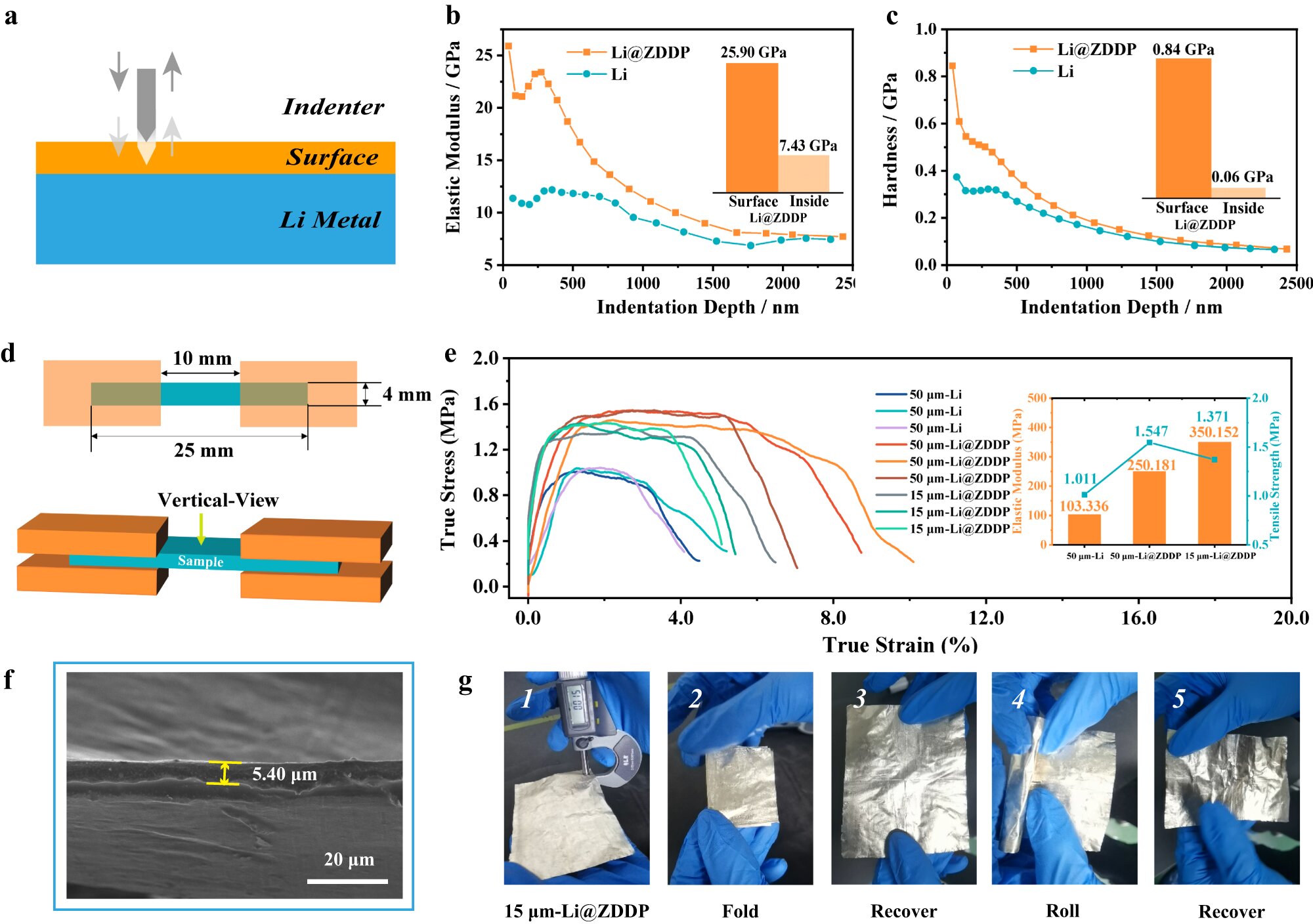
The research demonstrated that the additive increased hardness at the interface, prevented structural degradation (growth of lithium dendrites), controlled the deposition of lithium during plating/stripping, and the lithium anode could be plated and stripped faster than other materials.
The team produced thin lithium strips with thicknesses ranging from 5 to 50 micrometers, with better mechanical strength, electrochemical performance and impressive cycling stability compared to untreated lithium strips.
A cycle lifetime of up to 2,800 hours was maintained even at a high area capacity. Additionally, a symmetrical cell based on ultrathin lithium strips with 15 micrometers thickness lasted for more than 800 hours.
The study also included a full cell configuration using LiFePO4(LFP) and ZDDP-coated lithium, showing excellent cycling life with over 83.2% capacity retention after 350 cycles. In comparison, a cell without ZDDP degraded rapidly.
The improved electrochemical characteristics of the ZDDP-coated lithium anode were attributed to the creation of a high-strength artificial solid electrolyte interface (SEI) layer with a high affinity for lithium.
Instrument scientist Dr. Bernt Johannessen said this was an example of innovative work in the development of ultra-thin lithium, only microns thick that is manufactured for solid-state batteries.
For this study, a zinc-based oil was developed and used during the production process, in which the lithium is rolled out thinner and thinner, similar to how you roll dough through a pasta machine.
Samples were mailed to the synchrotron, and Dr. Johannessen undertook the measurements of the lithium anodes using the X-ray absorption spectroscopy beamline, which has proved particularly useful in investigating energy materials and catalysis.
So much so that the beamline has produced nearly twice the number of publications through 2023 as compared to the previous year.
“On that note, we owe our user community a debt of gratitude; they are being wonderfully productive and taking full advantage of recent developments, such as fast scanning techniques, at the beamline,” said Dr. Johannessen.
More information:
Shaozhen Huang et al, Interfacial friction enabling ≤ 20 μm thin free-standing lithium strips for lithium metal batteries, Nature Communications (2023). DOI: 10.1038/s41467-023-41514-0
Australian Nuclear Science and Technology Organisation (ANSTO)
Read the full article here


