


Two teams of solar-power engineers, one led by a large group at Helmholtz-Zentrum Berlin für Materialien und Energie GmbH, the other led by a group at École Polytechnique Fédérale de Lausanne, has found two ways to improve the efficiency of solar cells by getting silicon and perovskite to work together better. Both teams have published papers in the journal Science outlining the details of their work and the results of their testing. Stefaan De Wolf and Erkan Aydin, with the King Abdullah University of Science and Technology, have published a Perspectives piece in the same journal issue outlining the work done by both teams.
Prior research has shown that due to silicon limitations, only a narrow part of the sunlight frequency band can be converted into electricity—this limits its theoretical efficiency to 29.4%. To get around this limit, solar engineers have tried adding other materials as a separate layer that can be used to convert light in other frequencies into electricity.
One such material is perovskite—a crystal grown from a titanium and calcium mix. While it has shown promise, it has limited utility due to its tendency to allow some electrons to be reabsorbed into the crystal before they can be used to make electricity. In these two new efforts, both teams have found a way around this problem, each using a different approach.
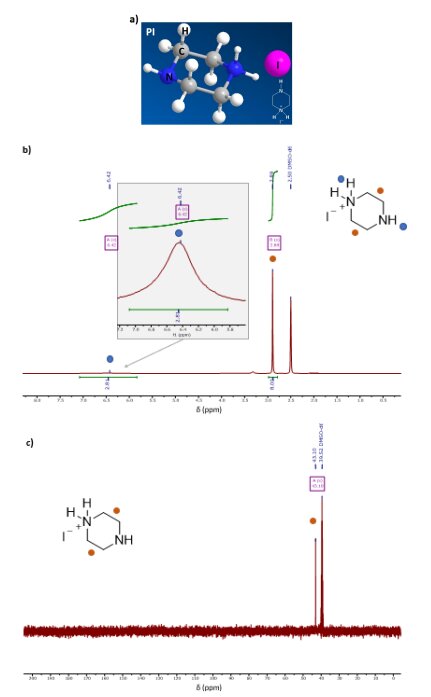
In the first effort, the engineers injected liquid piperazinium iodide into a layer of perovskite that had already been applied to a layer of silicon. Their technique proved to be 32.5% efficient during testing.
In the second effort, the team developed a process that involved coating a layer of silicon with precursor chemicals and then adding a second chemical that set off a reaction that led to the formation of a perovskite coating. The result was a coating with reduced defects that allowed fewer electrons to wander back into the crystal. Testing showed the two-step process could be used to produce solar cells that were 31.2% efficient.
Both teams acknowledge that their techniques were applied to solar cells much smaller than those used commercially; thus, a means for scaling them up is required before either could be used for traditional solar-cell applications.
More information:
Xin Yu Chin et al, Interface passivation for 31.25%-efficient perovskite/silicon tandem solar cells, Science (2023). DOI: 10.1126/science.adg0091
Silvia Mariotti et al, Interface engineering for high-performance, triple-halide perovskite–silicon tandem solar cells, Science (2023). DOI: 10.1126/science.adf5872
Stefaan De Wolf et al, Tandems have the power, Science (2023). DOI: 10.1126/science.adi6278
© 2023 Science X Network
Read the full article here


