


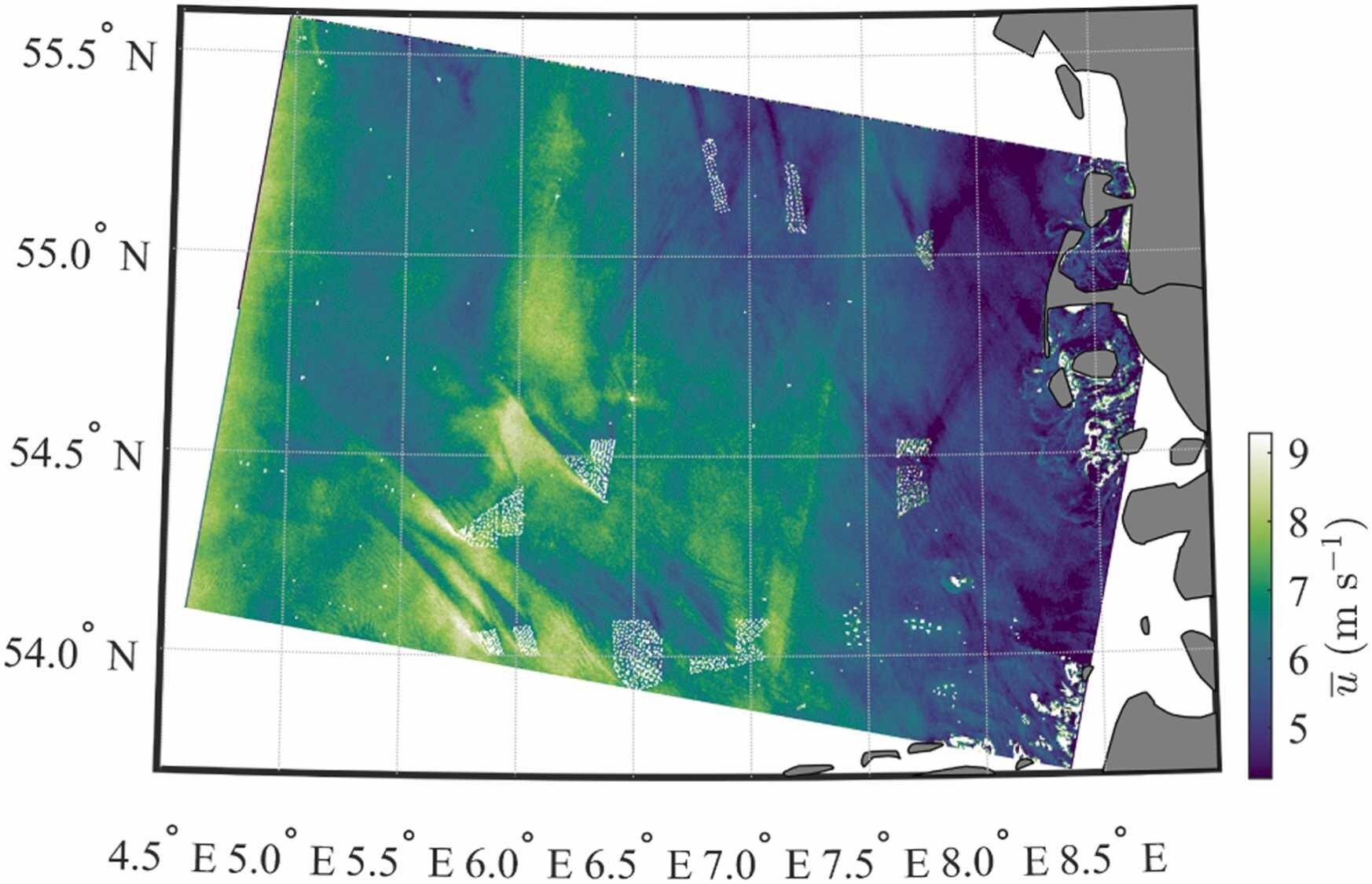
Offshore wind farms can reduce the availability of downstream wind resources of other farms by as much as 20% within 50 kilometers, due to so-called wake effects. “Wake effect” is the turbulence that occurs in the wake of a wind turbine when the wind passes through it. This turbulence will reduce production for affected turbines in the wake. This result been shown by interdisciplinary research from the University of Bergen (UiB).
“The incentive to develop an offshore wind farm can diminish with just a 5% reduction in capacity, based on economic considerations,” says Ph.D. candidate Eirik Finserås at the Faculty of Law, University of Bergen (UiB).
Finserås recently published the article “Gone With the Wind? Wind Farm-Induced Wakes and Regulatory Gaps” in Marine Policy, which examines Norway’s planned offshore wind farm development in “Sørlige Nordsjø II” in the North Sea, in collaboration with researchers from the Bergen Offshore Wind Center (BOW).
Stealing wind from the Danes
The Norwegian government is currently planning the development of offshore wind farms in “Sørlige Nordsjø II”. The field is located approximately 22 kilometers southeast of the planned Danish offshore wind park, Nordsren III, in Danish waters.
“The Norwegian offshore wind farm in Sørlige Nordsjø II will likely ‘steal’ wind from the proximate Danish planned offshore wind farms. Whether this will have any legal consequences for the Norwegian plans is difficult to say,” Finserås points out.
Poorly regulated
According to Finserås, the extraction of offshore wind resources is poorly regulated and only loosely mentioned in the Law of the Sea Convention. The UN Law of the Sea Convention states that states have sovereign rights to extract wind energy.
“Beyond the recognition of this right, the Law of the Sea Convention does not impose any explicit limitations on the extraction of wind energy and its likely cross-border wake effects,” says Finserås.
“More implicitly, however, one could interpret one potential limitation as meaning that you need to notify and consult other States that your offshore wind farm may have transboundary wake effects.”
Beyond being a good neighbor by consulting other States, there is no obligation to enter into agreements with them or to take other steps to limit likely transboundary wake effects.
“As far as I know, Norwegian authorities have not consulted the Danes with regards to the likely transboundary wake effects resulting from offshore wind development in Sørlige Nordsjø II,” Finserås says.
More political cooperation is needed
To ensure an efficient energy transition, authorities in States should collaborate and find appropriate solutions to avoid wake losses, according to Finserås.
It is possible to establish binding agreements between States at different levels, through the EU, and through other international laws that directly concern two or more States.
“In any case, regulatory frameworks need to be developed and made clearer regarding the regulation of offshore wind farms and the challenges related related to wake effects, such that the green energy transition is carried out as smoothly and effectively as possible,” says Eirik Finserås.
More information:
Eirik Finserås et al, Gone with the wind? Wind farm-induced wakes and regulatory gaps, Marine Policy (2023). DOI: 10.1016/j.marpol.2023.105897
University of Bergen
Read the full article here


