


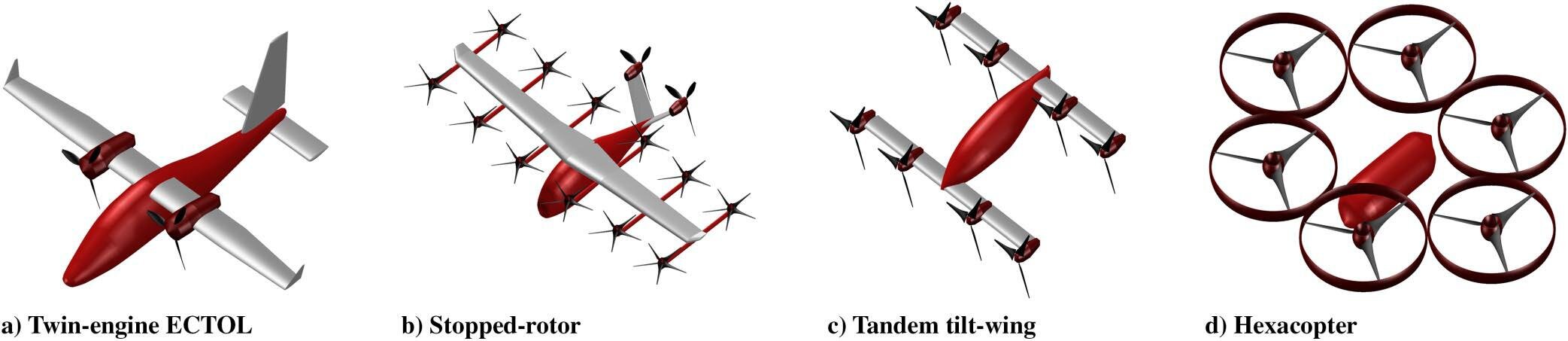
Rechargeable batteries have a lifespan of utility—losing their ability to hold a charge over time. As battery-powered aircraft are being developed for commuter flights in urban environments, the rate of degradation will be an important consideration. University of Illinois Urbana-Champaign aerospace engineer Matthew Clarke developed a model of battery degradation, then used the model to simulate four different electric vehicles in real metropolitan scenarios.
To make accurate comparisons, all four of the aircraft in the simulation were designed to carry six passengers or an equivalent payload of 925 pounds.
“Depending on the specific design of the aircraft, its range, and battery size, its utility can fall by as much as 45% when operating continuously for one year,” Clarke said.
Because most of the degradation occurs when cruising, Clarke suggests the performance of the aircraft can be extended by modifying the routes over time.
“So, say an aircraft can fly 100 nautical miles for 80 days before the battery is no longer viable. But if you flew a shorter distance, say 80 nautical miles, you could fly for about 200 days. We can change the operational envelope by changing the routes before it’s necessary to completely swap out the battery. This maximizes the utility of the aircraft.”
Clarke simulated commuter routes between airports in four metropolitan areas: New York, Dallas-Fort Worth, the San Francisco Bay area, and Los Angeles.
“An aircraft could fly between JFK and Washington D.C. for the first 100 days, then switch to flying from JFK to Philadelphia for the next 100 days or so before the aircraft needs to undergo maintenance and a new battery installed.”
The study’s time-dependent aircraft performance over operational lifetime diagram is different from most performance diagrams because it captures the fact that the energy degrades over time.
“Conventional fuel degrades per flight,” Clarke said. “If you put new fuel in it at the end of the flight the aircraft will perform as if it was day zero. There’s no time dependency.”
While running the simulation, Clarke discovered an angle he hadn’t considered until he observed something odd happening at a specific spot each time.
“We use atmospheric air to cool batteries—something you don’t have to think about with jet fuel. I hadn’t considered that if the model is simulating an entire year, the atmospheric temperature will change with the seasons. That means the operating heat dissipation systems have to change, too. I used a model for the atmospheric temperature variation that changes every day of the year depending upon where you are in the world.”
Clarke said the next step is to do further study on optimal battery and electro-mechanical device thermal management systems.
“Now that we have an understanding of the battery degradation and the thermal effects, we are working to design heat exchangers and mechanisms for cooling batteries on board electric aircraft to keep them operating in a safe temperature range.”
The study is published in the Journal of Aircraft.
More information:
Matthew A. Clarke et al, Forecasting the Operational Lifetime of Battery-Powered Electric Aircraft, Journal of Aircraft (2022). DOI: 10.2514/1.C036851
University of Illinois at Urbana-Champaign
Read the full article here


