


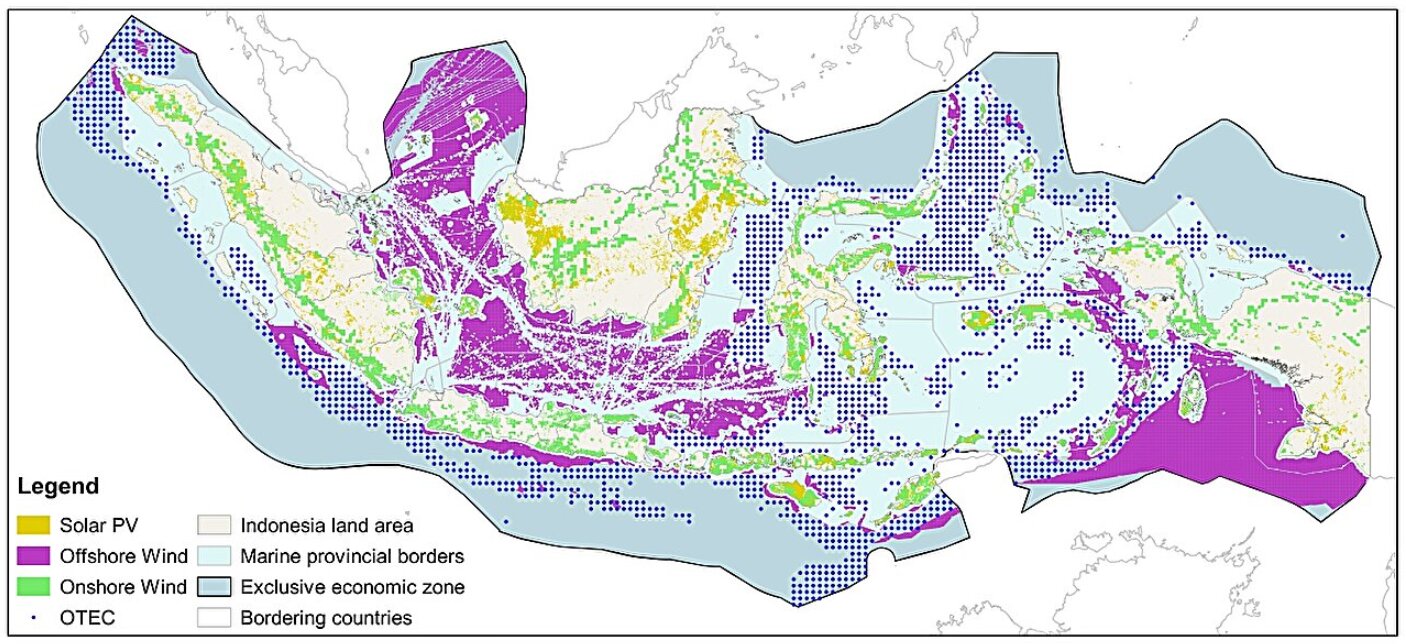
Indonesia is a country with huge renewable energy potential, essentially to enable the Net Zero 2060 ambition. The figure summarizes three years of research by Ph.D. candidate Jannis Langer on renewable resource mapping in Indonesia. His research has been published in a series of articles appearing in Energy, Renewable Energy, and iScience.
The map shows the technical potential in Indonesia for four renewable energy technologies, namely solar photovoltaics, onshore and offshore wind, as well as Ocean Thermal Energy Conversion (OTEC), a promising early-stage technology that uses the heat of ocean water to produce electricity.
The resources are mapped considering constraints from nature conservation zones, areas prone to natural catastrophes (e.g., earthquakes), urban environment, and many others. Despite these constraints, Indonesia’s renewable energy resources are still massive and amount to roughly 20,000 TWh per year. This is roughly 75% of the electricity consumed by the entire world in 2019, and can meet Indonesia’s projected electricity demand in 2050 5–21 times.
However, most of these resources are not located at places where electricity demand is high. One way to address this could be to connect Indonesia’s islands via sub-sea power transmission cables. With these cables, the renewable electricity can be transported to the locations where it is needed.
More information:
Jannis Langer et al, Geospatial analysis of Indonesia’s bankable utility-scale solar PV potential using elements of project finance, Energy (2023). DOI: 10.1016/j.energy.2023.128555
Jannis Langer et al, Introducing site selection flexibility to technical and economic onshore wind potential assessments: New method with application to Indonesia, Renewable Energy (2022). DOI: 10.1016/j.renene.2022.11.084
Jannis Langer et al, How offshore wind could become economically attractive in low-resource regions like Indonesia, iScience (2022). DOI: 10.1016/j.isci.2022.104945
Jannis Langer et al, Plant siting and economic potential of ocean thermal energy conversion in Indonesia a novel GIS-based methodology, Energy (2021). DOI: 10.1016/j.energy.2021.120121
Delft University of Technology
Read the full article here


