


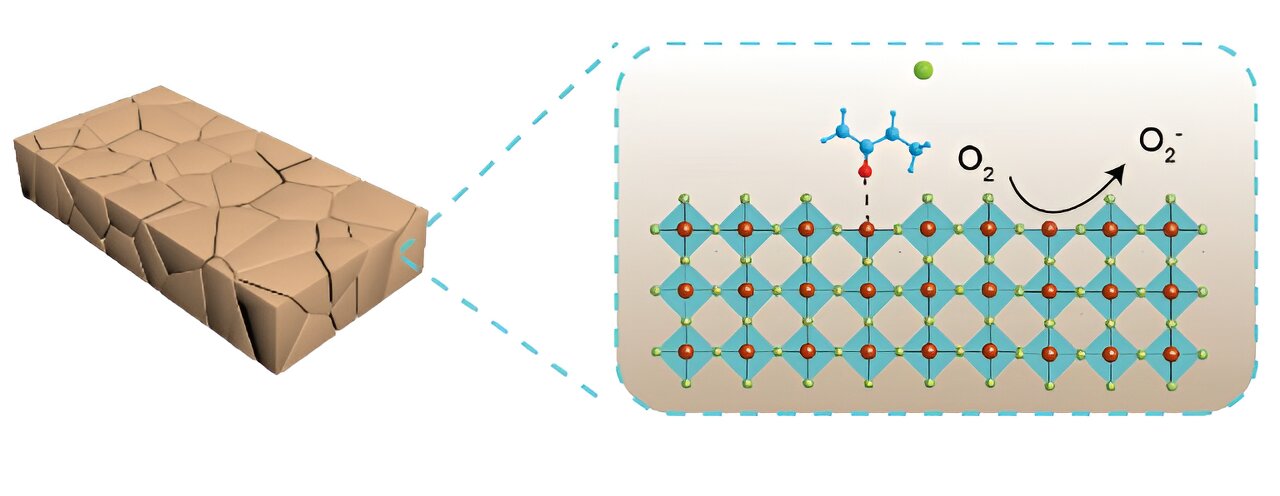
Tin perovskites have gained tremendous attention in lead-free perovskite solar cells. However, Sn vacancies and undercoordinated Sn ions on the tin perovskite surfaces can create deep-level traps, leading to non-radiative recombination and absorption nucleophilic O2 molecules, impeding further device efficiency and stability.
Researchers led by Prof. Ligang Xu at Nanjing University of Posts & Telecommunications, China, are interested in lead-free perovskite solar cells, where the deep-level traps lead to inferior efficiency and stability. The work, titled “Suppression of deep-level traps via semicarbazide hydrochloride additives for high-performance tin-based perovskite solar cells,” was published in Frontiers of Optoelectronics .
The work first introduced semicarbazide hydrochloride (SEM-HCl) into tin perovskite precursor to fabricate high-quality perovskite films with a low concentration of deep-level traps. The SEM-HCl not only diminishes the quantity of uncoordinated Sn2+ on the surface, but it also modulates the intrinsic Sn deep-level defects.
Such comprehensive modulation culminates in enhanced device performance. The O=C-N functional group in SEM-HCl can form coordination interactions with charge defects of the tin perovskites, thereby intensifying the electron cloud density surrounding the defects and enlarging vacancy formation energies.
Crucially, this approach aids in the reduction of the deep-level trap state density, originating from undercoordinated Sn2+ ions and Sn4+ oxidation, which effectively reduces nonradiative recombination and extends the charge lifetime.
Therefore, the TPSCs achieve a champion PCE approaching 11% with significant working stability, and the unencapsulated device maintains almost 100% of their initial efficiencies after working for 100 h under AM1.5 illumination conditions.
More information:
Wenbo Jia et al, Suppression of deep-level traps via semicarbazide hydrochloride additives for high-performance tin-based perovskite solar cells, Frontiers of Optoelectronics (2023). DOI: 10.1007/s12200-023-00103-1
Provided by
Higher Education Press
Read the full article here


