


Lithium-ion (Li-ion) batteries are among the most widespread battery technologies worldwide, due to their light weight, high energy densities, easy fabrication process, rapid charging times and other advantageous properties. Identifying strategies that could boost their performance further or facilitate their future upscaling has been the focus of numerous recent studies.
One of the proposed approaches for improving the performance of Li-ion batteries entails identifying new promising cathode materials that can be made from metals that are abundant in nature. So far, Li-ion cathodes have been found to be in some ways ineffective, as phase transitions inside them can elicit what is known as voltage hysteresis, which adversely impacts battery capacity.
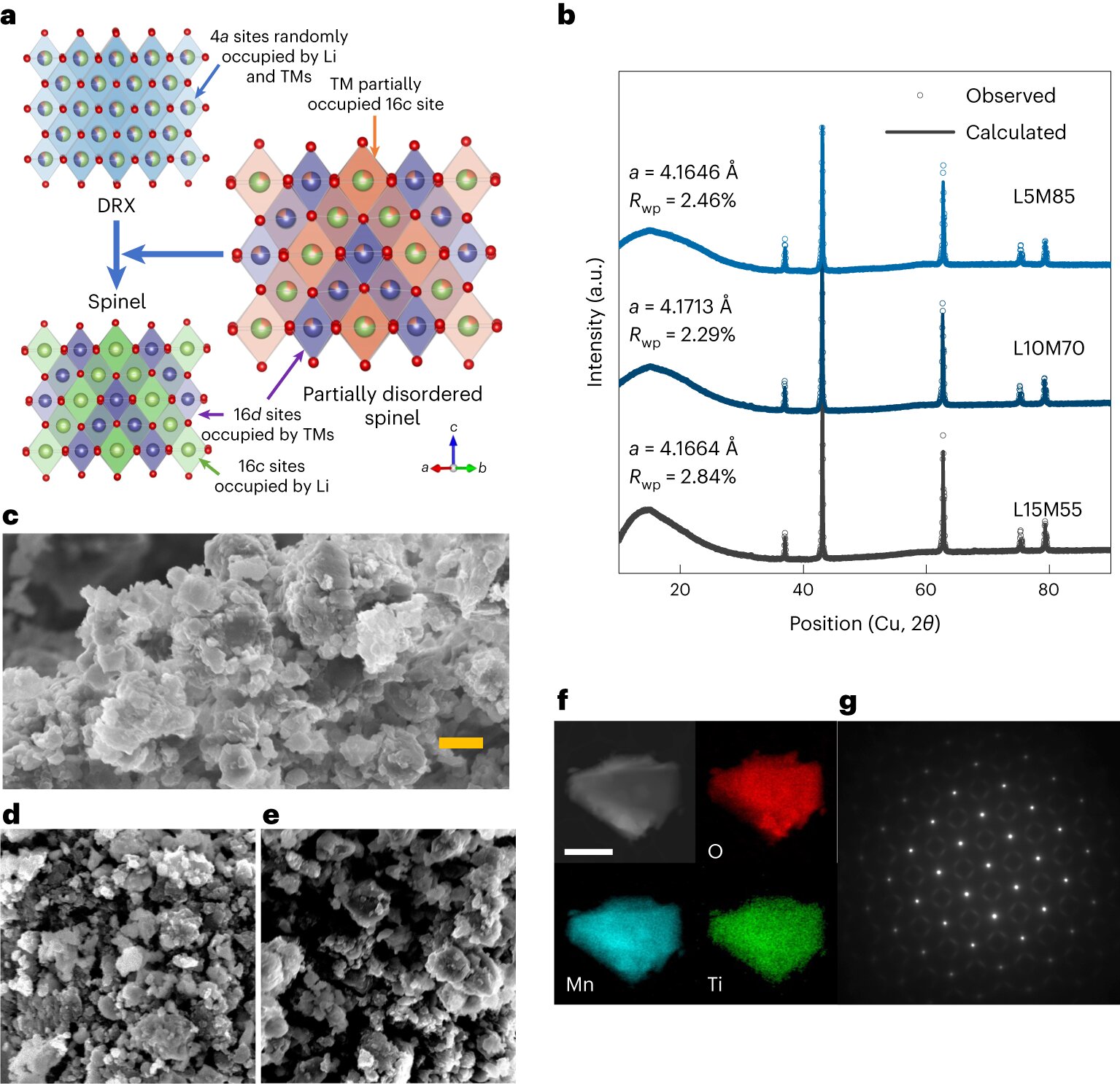
Researchers at University of California Berkeley and other institutes across the United States have recently unveiled an unconventional phase transformation in cathode materials that are rich in Li and manganese (Mn). The new phase they uncovered, outlined in a paper in Nature Energy, could enable the creation of highly performing batteries with Mn-based cathodes.
“We want to create high energy density cathode materials for Li-ion that can be made from earth-abundant metals, unlike current cathode materials which contain both Co and Ni,” Gerbrand Ceder, co-author of the paper, told Tech Xplore. “This would mean Li-ion batteries that are less expensive, thereby helping their market penetration in EVs, grid, etc.”
Mn is an Earth abundant metal, as it is already widely produced in large quantities for various real-world applications. This metal has a good redox voltage and could thus work well in Li-ion batteries with high energy densities.
These advantageous properties are what ultimately inspired Ceder and his colleagues to try to create cathodes containing a high amount of Mn. Some studies have already explored the potential of Mn-rich cathodes, yet most results gathered so far have been unsatisfactory.
“Previous efforts to use Mn-based cathodes have suffered from the fact that Mn has a tendency to move around and rearrange the crystal structure that you start from,” Ceder said. “We decided to turn that into an advantage and start from a material (DRX) that when cycled would turn into a structure that is very good for storing lithium. So, it was a form on inverse design: We knew the material would transform, so we just made sure it transformed to something very good for storing lithium.”
The new phase that Ceder and his colleagues unveiled in their study, dubbed the delta (δ) phase, has a unique, unconventional structure. This structure resembles that of spinels, a class of ceramics typically marked by an ordered internal organization.
“The phase we uncovered is related to the known spinel structure, but only forms that structure in very small domains, which are anti-phased with each other,” Ceder explained. “Spinel is a structure that is known to store lithium ions, but its commercialization has been problematic, as it undergoes a destructive phase transformation when cycled in a battery. ”
In the phase observed by the researchers, small domains of spinel act independently. This prevents the destructive transition previously observed in spinel-based cathodes during a battery’s operation, instead allowing batteries to retain a good capacity for several battery cycles.
“We can make ‘complex’ structures in-situ while we charge and discharge a battery and these complex structures can have excellent performance,” Ceder said. “A cathode material based on only Mn- and Ti-oxide precursors can potentially be very inexpensive and could reduce the cost of Li-ion batteries by 40–50%. This would make batteries for EV and grid much cheaper.”
In their experiments, the researchers were able to identify the kinetic mechanisms underpinning their Li- and Mn-rich cathodes’ transition to the so-called delta phase. This could pave the way for the development of more promising cathode materials with similar characteristics.
Initial tests performed by Ceder and his colleagues yielded very promising results, as the phase they unveiled was found to enable both a high energy density and good battery cyclability. In the future, their work could thus also encourage other teams to explore the potential of cathodes rich in Mn using similar experimental strategies.
“We believe that we can make even higher energy density materials,” Ceder added. “Also, we are working on accelerating this transformation to delta so one doesn’t have to wait for 10–20 cycles to get the best performance out of one’s battery.”
More information:
Zijian Cai et al, In situ formed partially disordered phases as earth-abundant Mn-rich cathode materials, Nature Energy (2023). DOI: 10.1038/s41560-023-01375-9
© 2023 Science X Network
Read the full article here


