


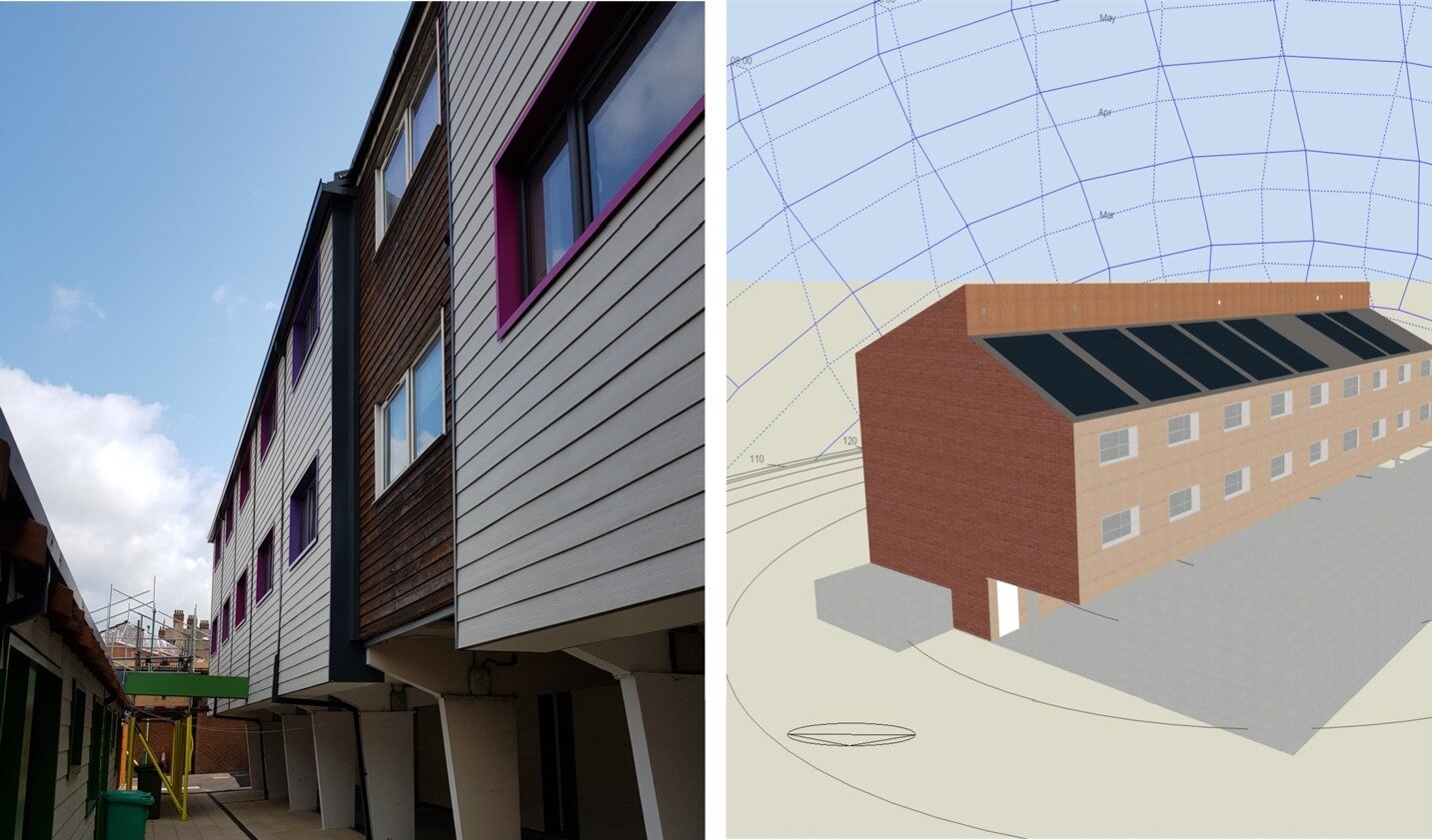
Inefficient UK homes, which were built decades ago, can now do away with their gas boilers and get all their energy needs off-grid by retrofitting a combination of existing renewable energy technologies, new research shows.
A study led by Professor Anton Ianakiev, an expert in civil engineering and carbon solutions at Nottingham Trent University (NTU), proves how millions of existing UK properties—which produce thousands of tons of CO2 per year—can become completely carbon-free.
The study centers on combining existing insulation technology with photovoltaic solar panels, air or ground-source heat pumps, shared small-scale wind turbines, and shared large-scale batteries and heat storage facilities.
The renewable energy technology is also located closely to the properties, rather than hundreds of miles away at a power station, doing away with the need to upgrade the grid.
The study—published in Smart Energy—is based on research into 27 homes in Nottingham which were insulated with external wall insulation, with a 200mm core of glass wool.
To reach zero-carbon, existing homes require:
- Two small-scale vertical axis wind turbines (VAWT)—that spin vertically as similar to a helicopter blade—which is shared between the 27 properties
- Three 41.4kW ground-source heat pumps between 27 homes
- A 40kW battery to store excess electricity which can be used during peak periods of demand, shared between 27 homes
- A 12 cubic meters water-based thermal energy store to save excess heat energy for peak periods, shared between 27 homes
- 21 photovoltaic solar panels per home to harness up to 2.7 kilowatt (kW) per home per day
Professor Ianakiev, of the School of Architecture, Design and the Built Environment, said, “In urban areas, vertical access wind turbines have low noise emissions and can harness wind energy from any direction, during low and high winds, 24 hours a day, making them particularly useful during the windy winter months.
“To complement these turbines, when the potential for wind energy is reduced during mild summer months, photovoltaic solar cells can harness the energy from the sun during the long daylight hours.
“All the excess electricity can be stored in a large, shared battery which can be drawn on during peak periods, such as during the winter evenings.
“In turn, just three ground-source heat pumps can provide heat energy all year round, with a shared heat store facility available to be drawn on during peak demand.”
The 27 homes in Nottingham, based in Sneinton, were fitted with sustainable energy technology—less the VAWTs—as part of the European-wide Remourban project. The VAWTs were applied to the study virtually.
Professor Ianakiev said, “This study shows what’s required to allow average UK homes to become completely carbon zero. It’s based on combining renewable energy technologies which are already available to buy on the open market today.
“What’s needed, now, is for the retrofitting of this technology to be scaled-up to a national, and for it to be made affordable for consumers, so that the move to net zero can take the necessary steps forward to 2050 when our all-important climate targets must be met.”
The research team included Dr. Kevin Naik from the sustainable tech company, Ecolibrium, Dr. Ahmad Galadanci of the University of Exeter, Dr. Giorgio Cucca (former NTU Ph.D. now with De Blasio Associati), NTU Ph.D. candidate Shubham Shubham and Professor Ming Sun, Associate Dean for Research at NTU’s School of Architecture Design and the Built Environment.
Dr. Naik, who worked on the study as part of his Ph.D. at Nottingham Trent University, said, “This research presents a pragmatic approach for achieving zero-energy homes by harnessing wind and solar power.
“It has proven that the technologies needed are already available, and when combined, create the critical mass which is required to power homes sustainably from renewable sources to help avert a looming climate catastrophe.”
More information:
Kevin Naik et al, Evaluating the potential of wind and solar energy in achieving zero energy ratings in residential homes: A Nottingham case study, Smart Energy (2023). DOI: 10.1016/j.segy.2023.100129
Nottingham Trent University
Read the full article here


