


Syngas, short for synthesis gas, holds immense potential for further synthesis of various fuels and chemicals, and is environmentally sustainable and economically viable. Currently, non-renewable fossil fuels like natural gas and coal are the main components for syngas production via steam methane reforming or coal gasification, respectively. However, both conversion technologies are energy-intensive and highly polluting. Thus, the complete or partial replacement of fossil fuels for syngas production is a necessity.
Biomass, ranging from agricultural and forestry waste to municipal solid waste and sewage sludge, stands as a renewable asset that represents an abundant alternative for the production of syngas. In Canada, potato cultivation ranks as the fifth largest agricultural activity, which significantly contributes to economic growth, particularly in Atlantic Canada. However, a unique challenge arises from the substantial volume of potato peel byproduct in the potato cultivation, storage, and processing. Appropriate waste management approaches must be established and implemented in order to meet the strict environmental regulations.
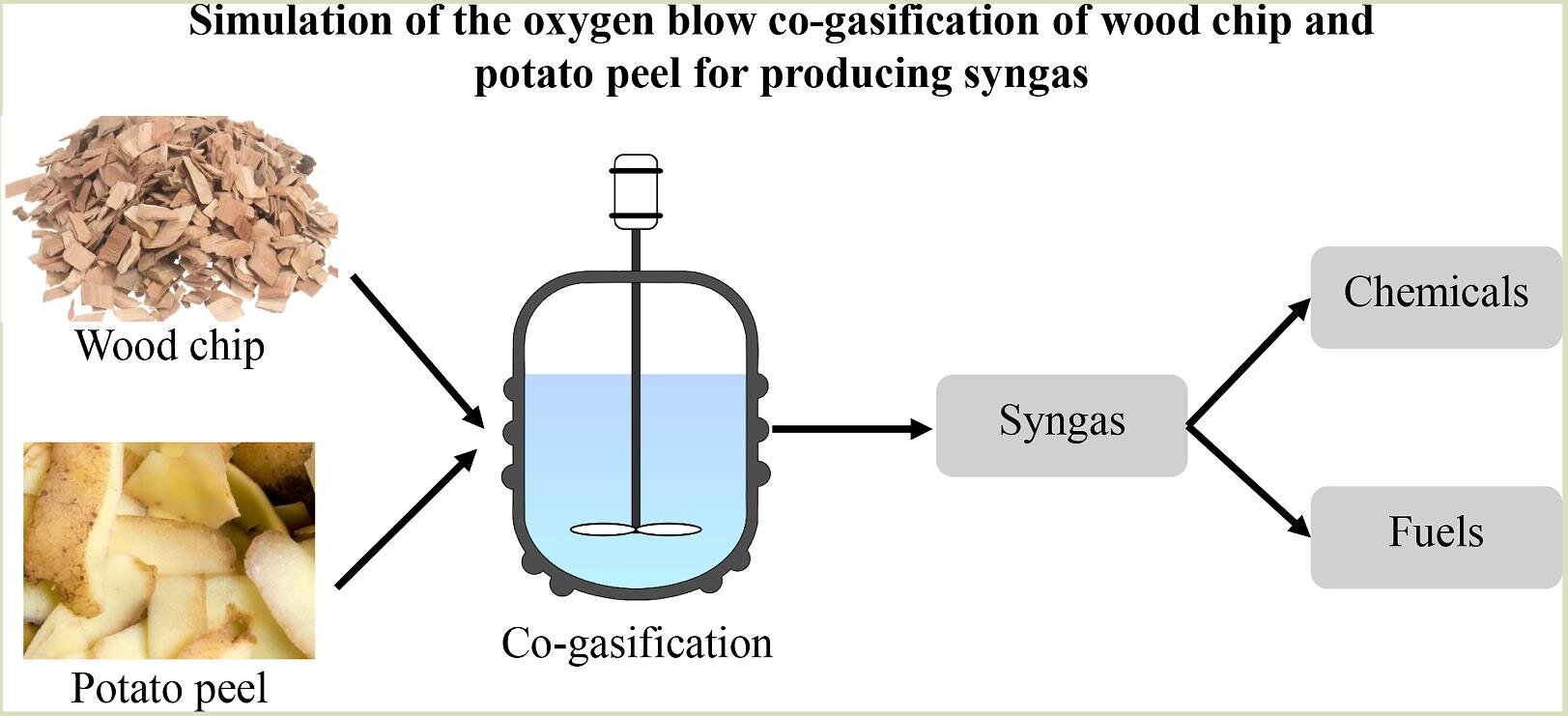
In order to address these challenges head-on, Assistant Professor Yulin Hu from the University of Prince Edward Island (UPEI) and Assistant Professor Kang Kang from the Lakehead University (LU), along with their dedicated research teams, simulated the co-gasification of potato peel and wood chips for producing syngas using Aspen Plus simulation software.
Their study, published in the Journal of Frontiers of Agricultural Science and Engineering, evaluated the co-gasification process, employing oxygen (O2) as the gasifying agent and keeping the equivalence ratio of 0.3 at a constant. The investigation was primarily focused on the elucidation of the influences of gasification temperature and the weight ratio of wood chips to potato peel on critical parameters such as carbon conversion efficiency (CCE), product gas composition, and lower heating value (LHV) of the product gas.
Simulation results clearly indicated a positive synergistic interaction between wood chips and potato peels during co-gasification treatment. This synergy promoted CCE, surpassing the arithmetic sum of individual values across all the investigated weight ratios of potato peel to wood chip. However, more studies are needed to optimize the wood chip-to-potato peel ratio to strike a balance between efficiency and syngas composition.
In summary, this study provides evidence of the feasibility and environmental soundness of co-gasification as an effective approach for valorizing potato peel and potentially other organic waste into value-added bioproducts like syngas. By harnessing the positive synergies between potato peel and woody biomass, this method not only addresses the disposal challenges of organic waste but also offers an environmentally friendly method to produce syngas. This research significantly contributes to the development of sustainable agriculture in Canada.
More information:
Yulin Hu et al, Simulation of O2-blown co-gasification of wood chip and-potato peel for producing syngas, Frontiers of Agricultural Science and Engineering (2023). DOI: 10.15302/J-FASE-2023490
Read the full article here


