


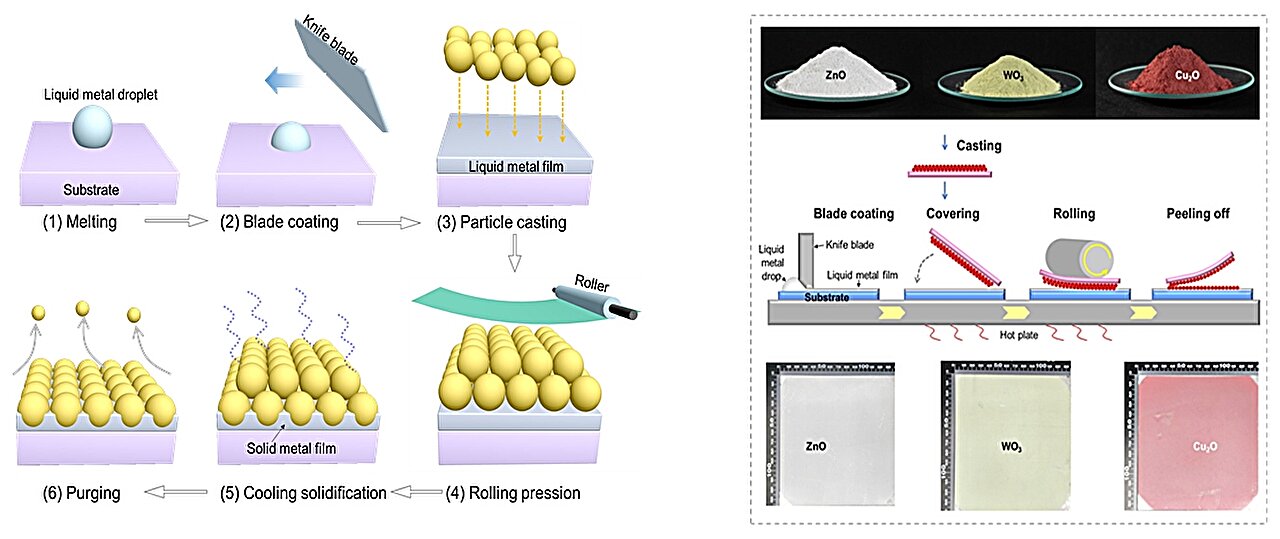
Solar-driven photocatalytic or photoelectrochemical water splitting holds great promise for direct solar-to-hydrogen energy conversion, especially in the context of the carbon-neutral initiative, while its practical applications hinge on significant advances in the scalable production of robust and efficient photoactive films.
A research team led by Prof. Liu Gang from the Institute of Metal Research (IMR) of the Chinese Academy of Sciences has developed a brand-new particle-implanting (PiP) technique to embed photoactive semiconductors in liquid metal films for the scalable fabrication of robust and efficient photoactive films, inspired by the fact that photosystems I and II are embedded in the thylakoid membranes of chloroplasts in plant leaves to efficiently drive photosynthesis in nature.
This work is published in Nature Communications.
Like the living leaf, the film converts solar energy directly into a chemical fuel. Under simulated sunlight irradiation, its photocatalytic activity for water splitting to produce hydrogen is 2.9 times that of traditional films. Moreover, the liquid metal-embraced photoactive semiconductor films have good stability and scalability. The activity remains constant during long-term (>100 hours) continuous operation, more than 95% even after experiencing 105 bending cycles, and about 70% when scaled up to 64 cm2.
The excellent performance can be attributed to the three-dimensional semiconductor/metal strong interaction, which enables efficient collection of photogenerated charges, strong architectural stability and superior photoactivity.
In addition, the film has the advantages of universality and recyclability, a wide range of low-melting-point metals (LMP) and semiconductors can be used and easily recycled via ultra-sonication in hot water. Overall, the LMP metal-based PiP technique offers a new opportunity for solar energy conversion devices and applications.
More information:
Chao Zhen et al, Liquid metal-embraced photoactive films for artificial photosynthesis, Nature Communications (2024). DOI: 10.1038/s41467-024-46073-6
Chinese Academy of Sciences
Read the full article here


