


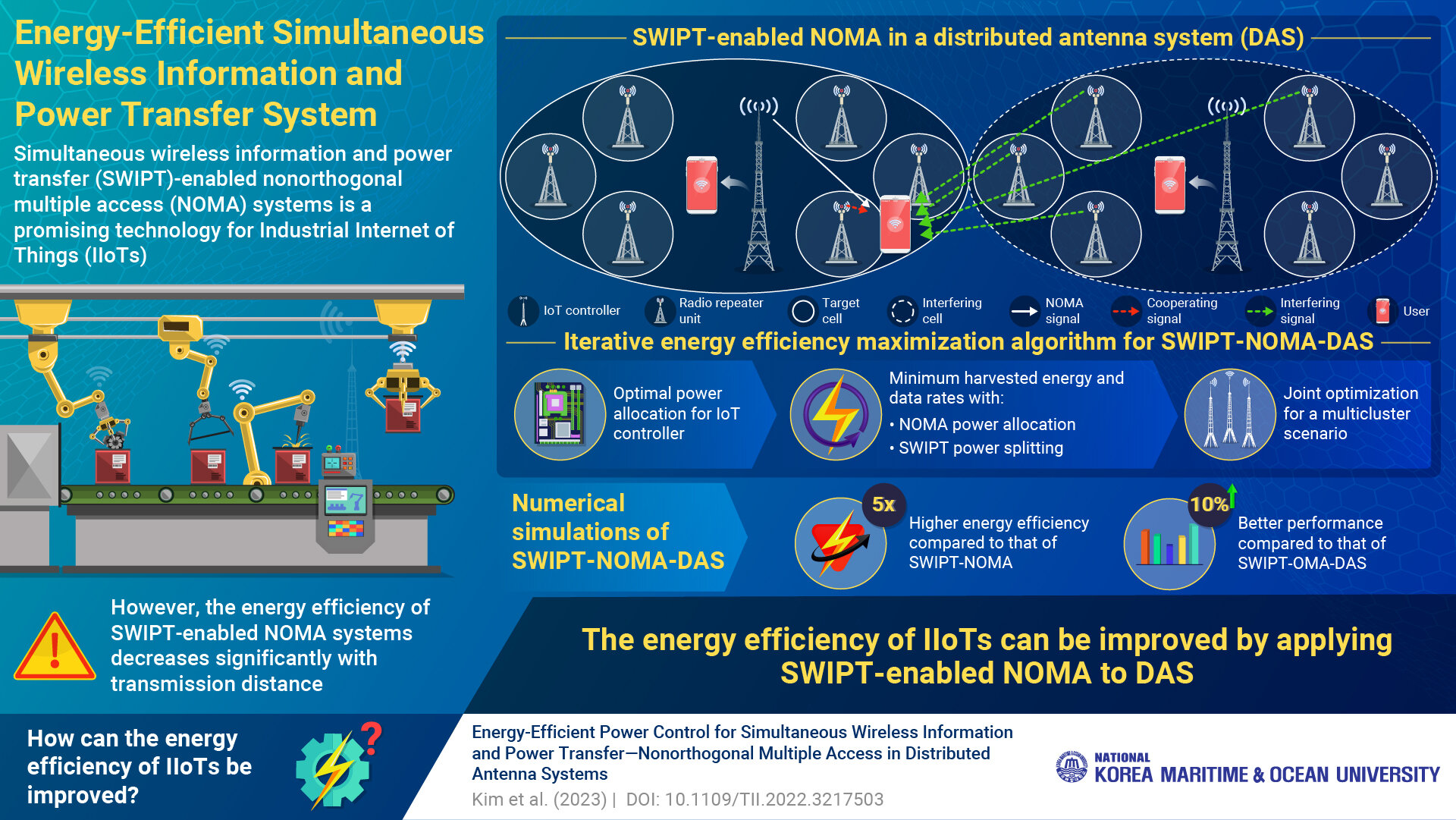
Industrial Internet of Things (IIoTs) refers to a technology that combines wireless sensors, controllers, and mobile communication technologies to make every aspect of industrial production processes intelligent and efficient. Since IIoTs can involve several small battery-driven devices and sensors, there is a growing need to develop a robust network for data transmission and power transfer to monitor the IIoT environment.
In this regard, wireless power transfer is a promising technology. It utilizes radio frequency signals to power small devices that consume minimal power. Recently, simultaneous wireless information and power transfer (SWIPT), which utilizes a single radio frequency signal to simultaneously perform energy harvesting and information decoding, has attracted significant interest for IIoTs.
Additionally, with smart devices rapidly growing in number, SWIPT has been combined with nonorthogonal multiple access (NOMA) system, which is a promising candidate for IIoTs due to their ability to extend the battery life of sensors and other devices. However, the energy efficiency of this system falls significantly with transmission distance from the central controller.
To overcome this limitation, a team of researchers from South Korea, led by Associate Professor Dong-Wook Seo from the Division of Electronics and Electrical Information Engineering at Korea Maritime and Ocean University, has developed a new framework by applying SWIPT-aided NOMA to a distributed antenna system (DAS), significantly improving the energy and spectral efficiencies of IIoTs.
“By applying a DAS with supporting antennas relatively close to edge users alongside a central base station, SWIPT-NOMA’s loss with growing distance can be reduced efficiently. This improves information decoding and energy harvesting performance,” explains Dr. Seo.
Their study was published in IEEE Transactions on Industrial Informatics.
The researchers formulated a three-step iterative algorithm to maximize the energy efficiency of the SWIPT-NOMA-DAS system. They first optimized the power allocation for the central IoT controller. After that, the power allocation for NOMA signaling and power splitting (PS) assignment for SWIPT were optimized jointly, while minimizing the data rates and harvested energy requirements.
Finally, the team analyzed an outage event in which the system cannot provide sufficient energy and data rates, thereby extending the joint power allocation and PS assignment optimization method to the multi-cluster scenario.
They validated their algorithm through extensive numerical simulations, finding that the proposed SWIPT-NOMA-DAS system is five times more energy efficient than SWIPT-NOMA without DAS. Also, it shows a more than 10% improvement in performance over SWIPT-OMA-DAS.
Highlighting the significance of their study, Dr. Seo says, “This technology ensures very efficient energy consumption and offers various advantages such as convenience, low power, and battery life extension. Thus, it can be applied to smartphones, laptops, wearable devices, and electric vehicles. Most importantly, the SWIPT-NOMA-DAS system can optimize resource allocation and efficiently perform wireless charging and information transmission for users in an IoT environment.”
More information:
Dongjae Kim et al, Energy-Efficient Power Control for Simultaneous Wireless Information and Power Transfer—Nonorthogonal Multiple Access in Distributed Antenna Systems, IEEE Transactions on Industrial Informatics (2022). DOI: 10.1109/TII.2022.3217503
Provided by
National Korea Maritime and Ocean University
Read the full article here


