


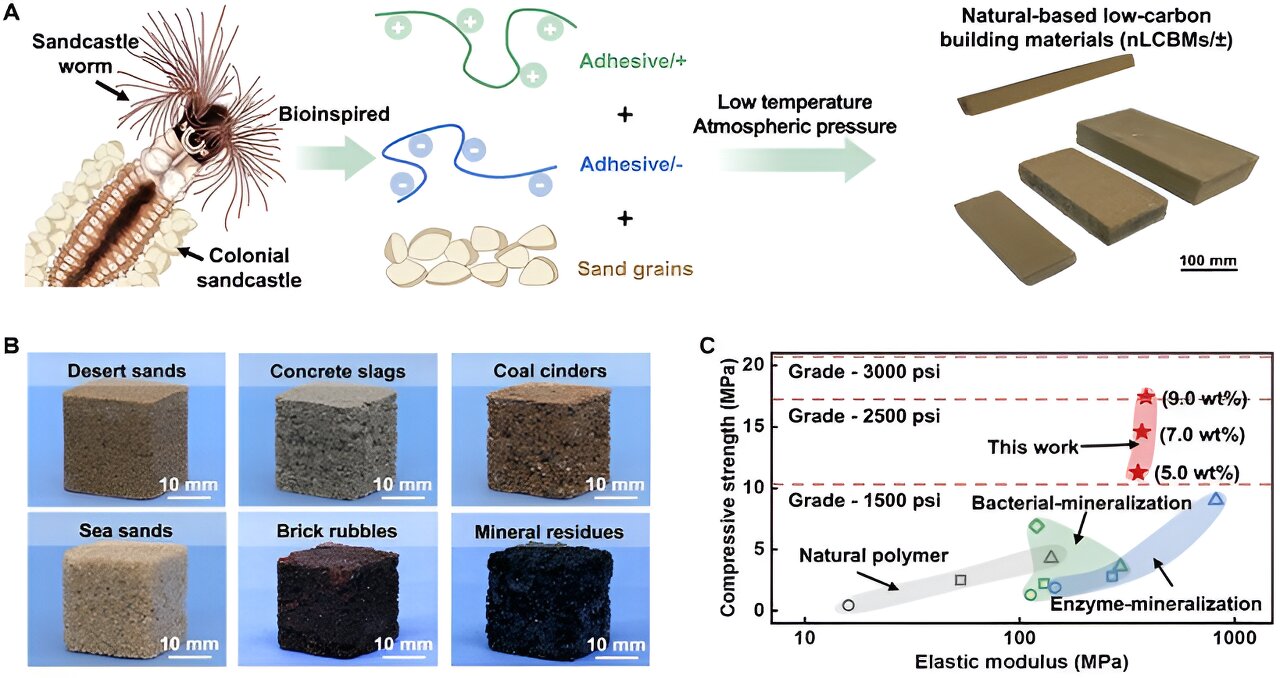
Sandcastle worms are marine creatures about two inches long that build huge colonies of honeycombed, reef-like structures by cementing sand grains together.
Inspired by these structures, a research team led by Prof. Wang Shutao from the Technical Institute of Physics and Chemistry (TIPC) of the Chinese Academy of Sciences (CAS) has developed natural-based, low-carbon building materials for use in the next generation of low-carbon construction. The study was published in Matter on Sept. 20.
Low-carbon building materials are urgently needed due to the massive energy consumption and carbon emissions associated with traditional cement-based building materials.
Typically, various adhesives such as geopolymers, resins, and high-pressure-induced adhesives are used as cement substitutes to produce low-carbon building materials. Compared with these binders, natural-based adhesives are promising due to the renewability and eco-friendliness of bioresources.
Considerable research efforts have been made to bind grains using bio-polymers as adhesives or bio-mineralization approaches. Due to the weak mechanical properties of these grain aggregates, however, practical construction limitations still exist.
Looking at nature, the researchers found that sandcastle worms build strong colonial sandcastles as their nests along the coastlines by binding various grains such as sand and shell pieces.
The researchers realized that the composite adhesive secreted by the sandcastle worms was key to this structure. The adhesive contains both cationic proteins and anionic proteins, thus allowing it to firmly bind grains together.
By mimicking this process, the researchers fabricated colonial sandcastle-inspired, low-carbon building materials with good mechanical performance. Using oppositely charged biopolymer adhesives, these natural-based low-carbon building materials can be constructed from various grains (e.g., desert sand, sea sand, concrete slag, etc.) under low temperature and atmospheric pressure.
This study offers a promising way to accelerate the transformation of the construction industry by decreasing energy consumption and carbon emissions.
More information:
Xuetao Xu et al, Colonial sandcastle-inspired low-carbon building materials, Matter (2023). DOI: 10.1016/j.matt.2023.08.023
Chinese Academy of Sciences
Read the full article here


