


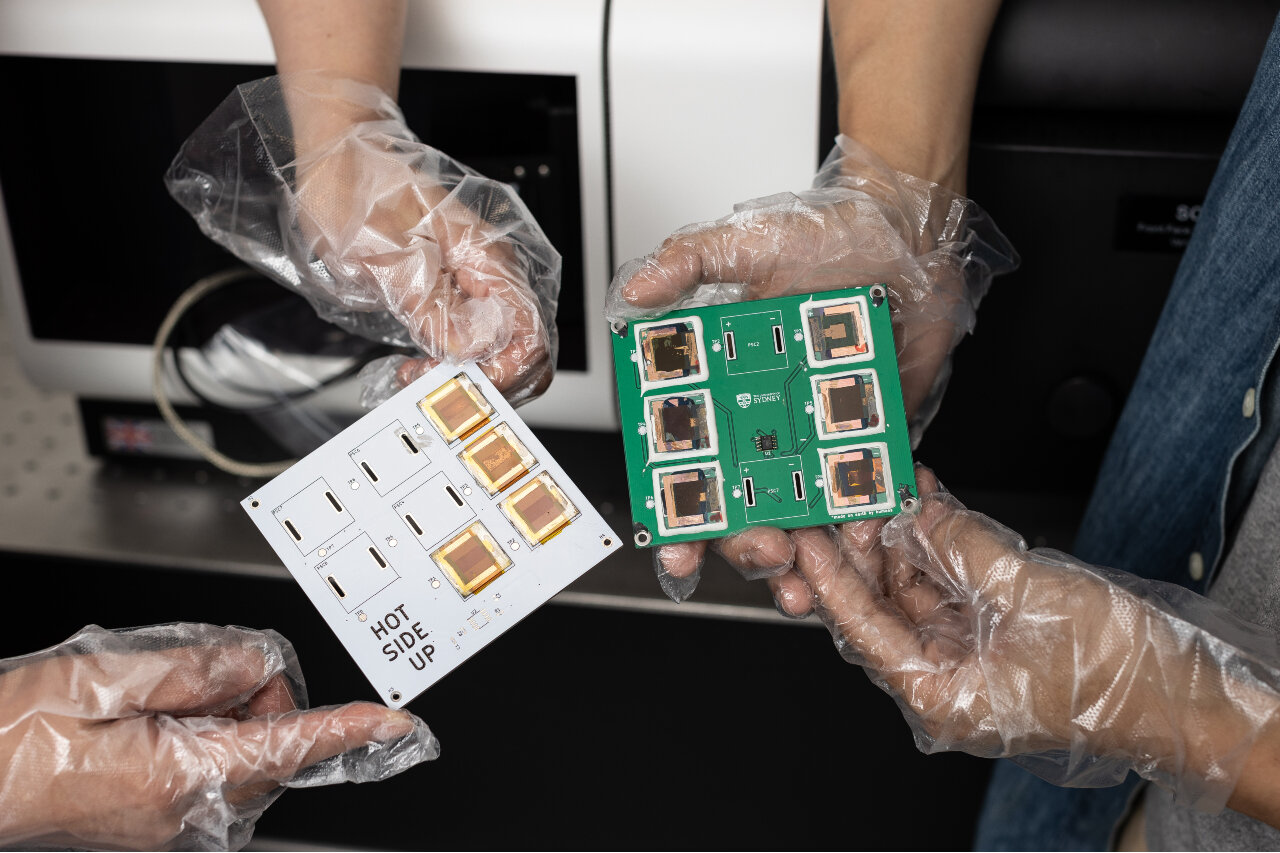
Australian researchers have demonstrated that perovskite solar cells damaged by proton radiation in low-Earth orbit can recover up to 100% of their original efficiency via annealing in thermal vacuum.
This is achieved through careful design of the hole transport material (HTM), which is used to transport photo-generated positive charges to the electrode in the cell.
The multidisciplinary project is the first to use thermal admittance spectroscopy (TAS) and deep-level transient spectroscopy (DLTS) to study the defects in proton-irradiated and thermal-vacuum recovered perovskite solar cells (PSCs). It is also the first study to use ultrathin sapphire substrates with the high power-to-weight ratios suitable for commercial applications.
The results have been published in the journal Advanced Energy Materials.
Light-weight PSCs are a strong candidate for powering low-cost space hardware thanks to their low manufacturing cost, high efficiency and radiation hardness.
All previous proton irradiation studies of PSCs took place on heavier substrates thicker than 1mm. Here, to take advantage of high power-to-weight ratios, ultrathin radiation resistant and optically transparent sapphire substrates of 0.175mm were used by a team based at the University of Sydney. The project was led by Professor Anita Ho-Baillie, who is also an Associate Investigator with the ARC Center of Excellence in Exciton Science.
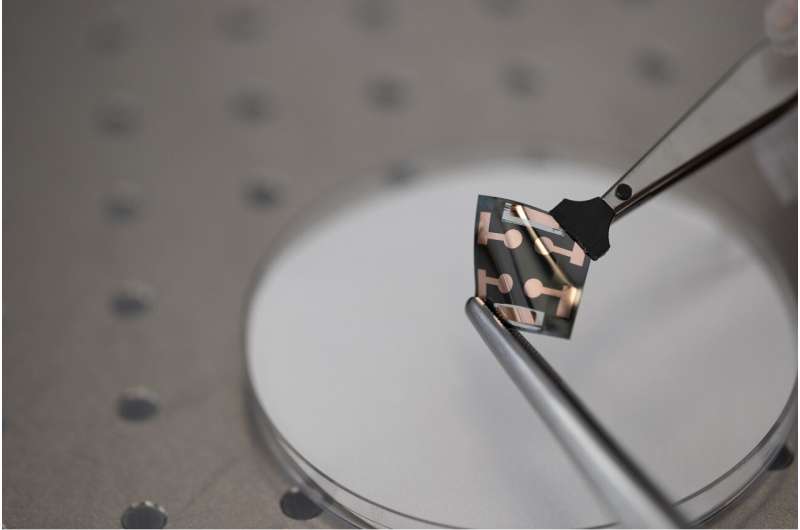
The cells were exposed to rapid scanning pencil beam of seven mega-electron-volts (MeV) protons using the high energy heavy ion microprobe at the Center for Accelerator Science (CAS) at ANSTO, mimicking the proton radiation exposure that the solar cell panels would undergo while orbiting the Earth on a satellite in low-Earth orbit (LEO) for tens to hundreds of years.
It was found that the type of cells featuring a popular HTM and a popular dopant within its HTM are less radiation tolerant than their rivals. The HTM in question is the compound 2,2,’7,7′-Tetrakis[N,N-di(4-methoxyphenyl)amino]-9,9′-spirobifluorene (Spiro-OMeTAD), while the dopant is lithium bis(trifluoromethanesulfonyl)imide (LiTFSI).
Through chemical analysis, the team found that fluorine diffusion from the LiTFSI induced by proton radiation introduces defects to the surface of the perovskite photo-absorber, which could lead to cell degradation and efficiency losses over time.
“Thanks to the support provided by Exciton Science, we were able to acquire the deep-level transient spectroscopy capability to study the defect behavior in the cells,” lead author Dr. Shi Tang said.
The team was able to ascertain that cells free of Spiro-OMeTAD and free of LiTFSI did not experience fluorine diffusion related damage, and degradation caused by proton-radiation could be reversed by heat treatment in vacuum. These radiation-resistant cells had either Poly[bis(4-phenyl) (2,5,6-trimethylphenyl) (PTAA) or a combination of PTAA and 2,7-Dioctyl[1]benzothieno[3,2-b][1]benzothiophene (C8BTBT) as the hole transport material, with tris(pentafluorophenyl)borane (TPFB) as the dopant.
“We hope that the insights generated by this work will help future efforts in developing low-cost light-weight solar cells for future space applications,” Professor Ho-Baillie said.
More information:
Shi Tang et al, Effect of Hole Transport Materials and Their Dopants on the Stability and Recoverability of Perovskite Solar Cells on Very Thin Substrates after 7 MeV Proton Irradiation, Advanced Energy Materials (2023). DOI: 10.1002/aenm.202300506
Provided by
ARC Centre of Excellence in Exciton Science
Read the full article here


