


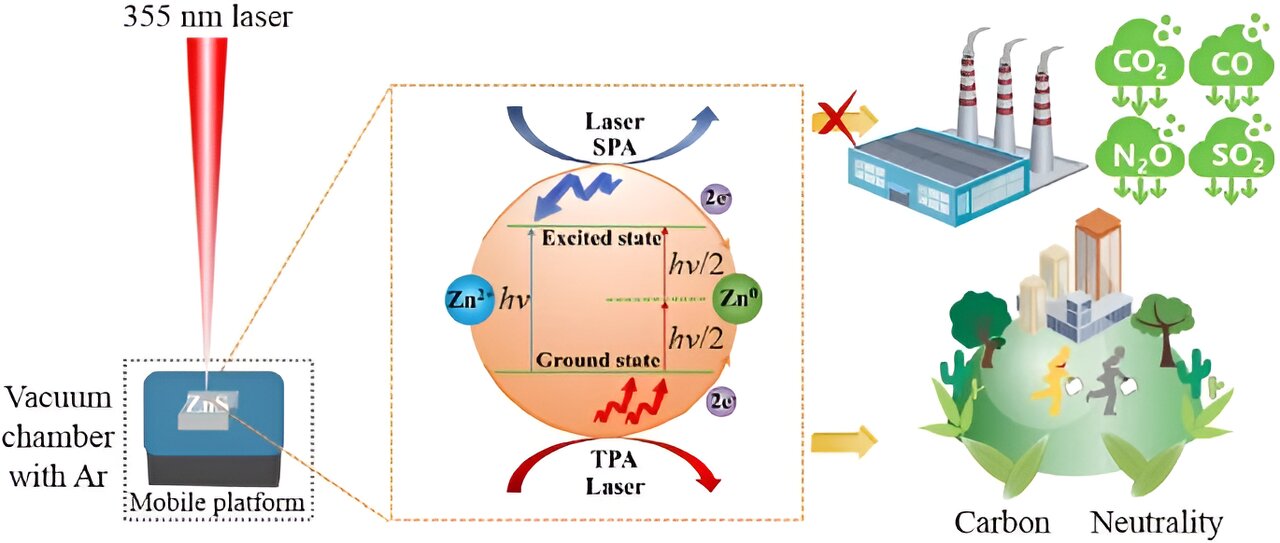
One of the leading causes of pollution in China is the non-ferrous metallurgical industry, which processes heavy metals for use in a variety of industries. In an effort to meet China’s goals of carbon neutrality before 2060, researchers are studying how to reduce carbon emissions in this vital industry. In a recently published paper, researchers propose smelting zinc with lasers instead of traditional high-temperature roasting and electrolysis.
The paper was published in Frontiers of Environmental Science & Engineering.
“The zinc industry, with a total carbon dioxide emission of 33 million tons, is a major driver of greenhouse gas emissions. It is estimated that the electrolytic zinc industry in China produces around 6 million tons of solid hazardous waste each year, which causes environmental pollution and significant health risks,” said Ning Duan, a researcher at the State Key Laboratory of Pollution Control and Resources Reuse at the College of Environmental Science and Engineering at Tongji University in Shanghai, China.
“We propose a new optical metallurgy method, which uses laser-induced photoreduction to decompose sphalerite and reduce metal ions to metal. Since it does not use high-temperature roasting, this method provides a new way to produce high-purity metal without the greenhouse gas emissions and heavy metal pollution caused by traditional zinc electrolysis.”
A material called sphalerite (ZnS) is the main source material for the electrolytic zinc industry. It is an ideal candidate for the proposed laser treatment because it responds well to light. Researchers then constructed an experimental apparatus to test the reaction of sphalerite to laser-induced decomposition. It included a laser, lens, vacuum chamber, and camera. The vacuum chamber prevented the interference of oxygen in the experiment.
Researchers completed Raman spectroscopy, XPS analysis, and EXAFS spectra analysis to determine how well the sphalerite responded to the laser. They also looked at the micromorphology of the damage caused by the laser using electron microscopy. When the laser interacts with the surface of the sphalerite, it produces a photochemical reduction and a photothermal reduction.
The photothermal effect that occurs when the ultraviolet laser irradiates the sphalerite is strong, creating molecular vibration energy that converts into heat energy. This makes the surface temperature of the sphalerite rise, cracking ionic bonds, melting and vaporizing materials on the surface of the sphalerite, and producing zinc.
“This study demonstrated that zinc can be produced by decomposing sphalerite using laser irradiation under an inert argon gas atmosphere. This process does not require high temperatures and produces no greenhouse gases or pollutants. Our results are encouraging for the prospect of optical metallurgy,” said Duan.
Researchers also did an economic comparison between optical metallurgy and traditional metallurgy for zinc production to confirm that the proposed laser irradiation method is not cost prohibitive. They estimated that the annual operational costs are estimated to be at 1.9 billion RMB (261 million USD) for a traditional zinc metallurgy plant and 1.67 billion RMB (219 million USD) for optical zinc metallurgy. This economic analysis showed the feasibility of optical metallurgy as an alternative to traditional, high-temperature roasting techniques.
Looking ahead, researchers are hoping to find ways to bring optical metallurgy to scale.
More information:
Ying Chen et al, Direct generation of Zn metal using laser-induced ZnS to eradicate carbon emissions from electrolysis Zn production, Frontiers of Environmental Science & Engineering (2023). DOI: 10.1007/s11783-024-1767-8
Provided by
Higher Education Press
Read the full article here


