


Photovoltaic (PV) modules are devices that convert sunlight into electrical energy. However, they suffer from a low conversion efficiency of around 20% because they can only convert near-infrared wavelengths into electricity, while other wavelengths simply heat up the PV module, reducing its efficiency.
To counter this, scientists have developed photovoltaic-thermal (PVT) systems, in which the generated heat is carried away by a heat exchanger containing a coolant fluid (air or liquid). This, in turn, cools down the PV module, increasing its efficiency. Moreover, the captured heat can be utilized in the form of thermal energy.
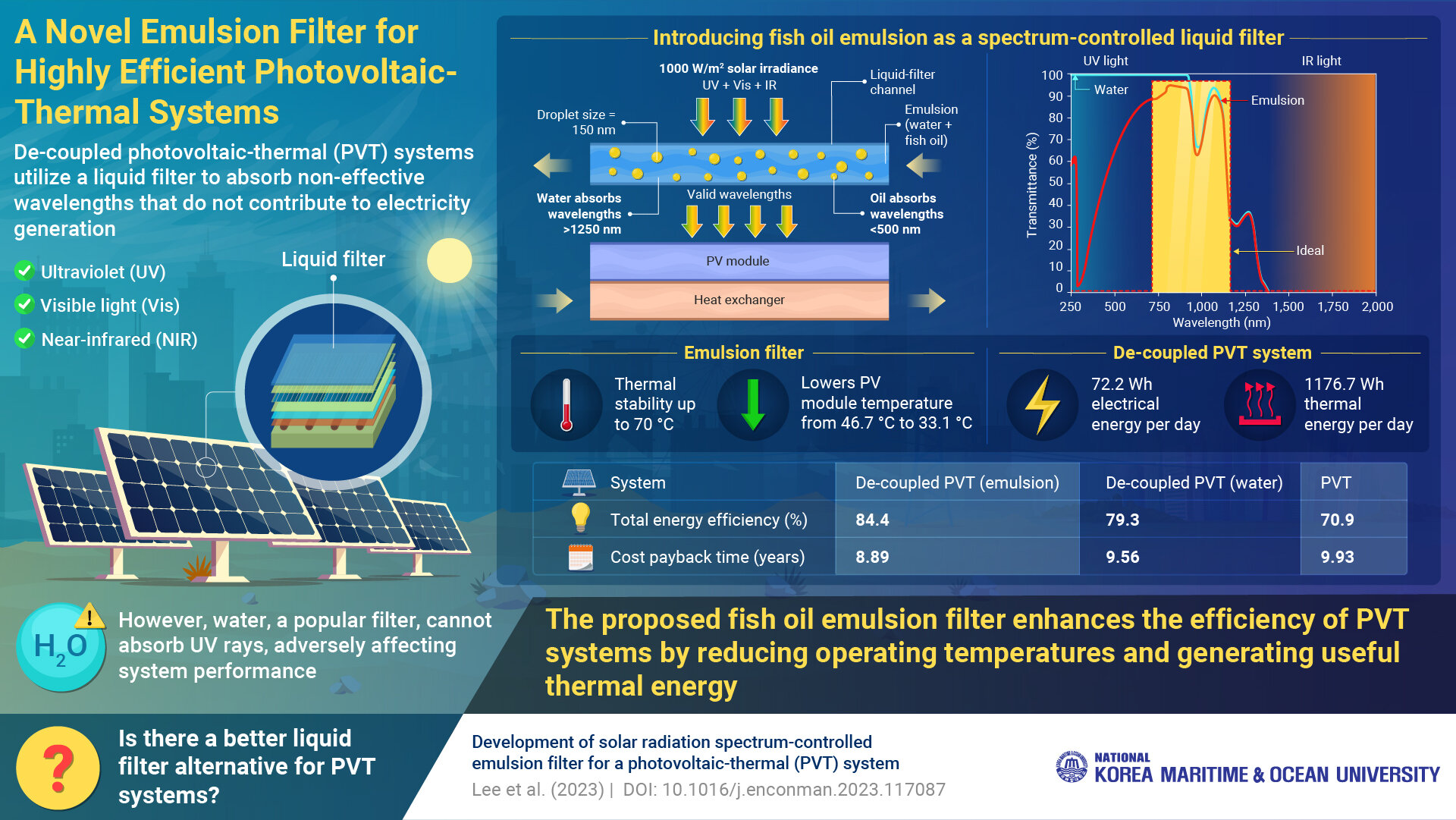
To further enhance the cooling effect of PV modules and harvest thermal energy, de-coupled PVT systems equipped with liquid filters have been devised. These filters, placed over PV modules, capture specific wavelengths of sunlight that contribute minimally to electricity generation, including ultraviolet (UV), visible light, and near-infrared, facilitating their conversion into thermal energy for various applications. However, water, a popular liquid filter, cannot absorb UV rays.
Now, a team of researchers, led by Assistant Professor Jae Won Lee from Korea Maritime & Ocean University, has introduced an innovative emulsion (mixture) of fish oil and water as a liquid filter. It efficiently absorbs both infrared and UV light, increasing the energy harvesting potential of de-coupled PVT systems. Their work was published in Energy Conversion and Management.
“Most liquid filters use either water or a mixture of water and solid nanoparticles to absorb the unused wavelengths of solar irradiance. However, water only absorbs the infrared portion of sunlight with wavelengths exceeding 1250 nm. Solid nanoparticles, on the other hand, tend to settle over time, which diminishes their efficiency,” points out Dr. Lee. In contrast, the proposed emulsion remains stable at high temperatures of up to 70 °C.
Furthermore, the oil droplets within the emulsion are effective at absorbing UV light with wavelengths below 500 nm.
The presence of the emulsion filter significantly improved the conversion efficiency and lowered the operating temperature compared to systems with heat exchangers alone. The efficiency increased from 70.9% to 84.4%, while the temperature decreased from 46.7 °C to 33.1 °C.
The researchers found that, under a standard solar irradiance of 1000 W/m2, the de-coupled PVT system with emulsion filter produced electrical and thermal energies amounting to 72.2 Wh and 1176.7 Wh per day, respectively. This proved to be economically beneficial, with a lower cost payback time than both PVT systems and de-coupled PVT systems with water filter.
The proposed system can even be operated under specific requirements and environmental conditions. For example, during summer, the fluid in the liquid filter could be bypassed to maximize electricity production, while in winter, the liquid filter could capture thermal energy for heating applications. Its implementation is also expected to be straightforward.
“Emulsion technology is already well established and finds applications in various industries, such as cosmetics and food,” explains Dr. Lee. “Therefore, emulsion filters can be easily applied to existing systems. Additionally, they hold immense potential for new applications, including selective separation of the solar wavelength spectrum.”
More information:
Jae Won Lee et al, Development of solar radiation spectrum-controlled emulsion filter for a photovoltaic-thermal (PVT) system, Energy Conversion and Management (2023). DOI: 10.1016/j.enconman.2023.117087
Provided by
National Korea Maritime and Ocean University
Read the full article here


