


Solar technologies have become increasingly advanced over the years, with the discovery of new photovoltaic materials and designs. While solar cells based on a mixture of organic and inorganic halide perovskite materials have been the topic of numerous research studies and achieved promising performances, these cells are often difficult to fabricate on a large-scale.
Researchers at Chonnam University in South Korea recently introduced an alternative solar cell design fully based on inorganic perovskites. Their solar cells, introduced in Nature Energy, could be easier to fabricate on a large-scale, while nonetheless achieving promising power conversion efficiencies (PCEs).
“Previous efforts in the perovskite community mostly used single junction and single phase for the fabrication of perovskite solar cells using hazardous antisolvents,” Dr. Sawanta S. Mali, lead author of the paper, told Tech Xplore.
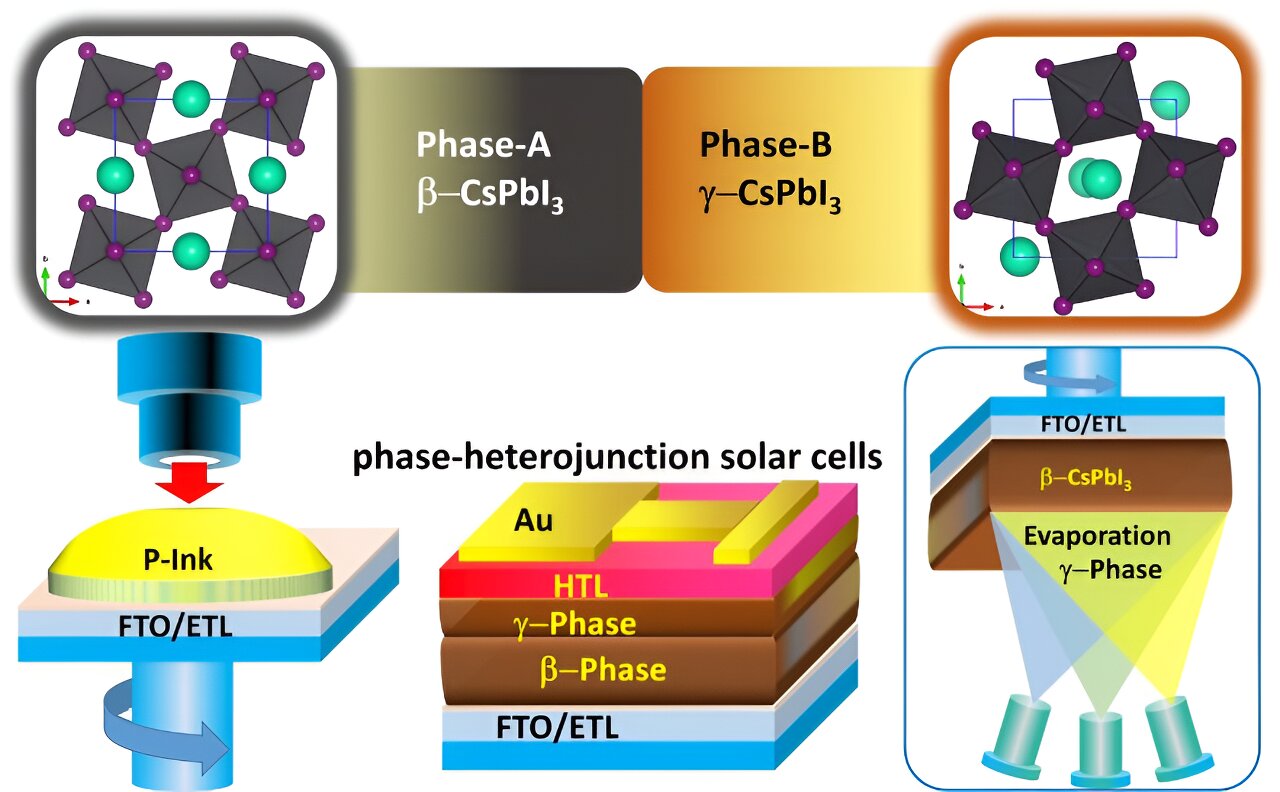
“Instead, we introduced an anti-solvent free hot-air method for fabrication of beta (β)-CsPbI3 phase in ambient condition and gamma (γ)-CsPbI3 phase has been deposited on to β-CsPbI3 bottom layer using simple thermal evaporation method. Both these two phases playing key role in charge extraction process which results in >21.5 % power conversion efficiency.”
The key objective of the recent work by Dr. Sawanta and his colleagues was to create new solar cells fully based on inorganic perovskites using a developed method that could be easy to up-scale. Ultimately, they fabricated their solar cells using hot-air and thermal evaporation deposition techniques that work at ambient conditions without requiring polar solvents (i.e., liquids containing both positive and negative charges).
“We introduced an anti-solvent free hot-air method for fabrication of bottom β-CsPbI3 phase in ambient condition and then γ-CsPbI3 phase has been deposited on to β-CsPbI3 bottom layer using simple thermal evaporation method,” Dr. Sawanta explained. “Both these two phases playing key role in charge extraction process. The unique advantage of our approach is that both layers are deposited via an anti-solvent free deposition technique.”

As part of their recent study, Dr. Sawanta and his colleagues used their proposed method to fabricate prototype solar cells with a promising PCE of 21.59%. Remarkably, they also added fewer additives for stabilizing the photoactive phase of the absorber layer, such as DMAI and PEAI, to the CsPbI3 layer in the cell.
“We are processing an all-inorganic perovskite composition, which is more thermally stable than conventional organic-inorganic hybrid perovskite compositions,” Dr. Sawanta said. “Therefore, this approach will be suitable for making highly stable long-life perovskite modules.”
When scaled from a laboratory to a real-world solar module, the team’s design exhibited a PCE of 18.43% with an active area of 18.08 cm2. These initial results highlight the potential of the team’s approach for developing ultra-large perovskite solar cell modules (PSMs) and reliably assessing their stability.
The recent work by Dr. Sawanta and his colleagues could pave the way for the development of additional solar cells based on all inorganic perovskites or other halide perovskite compositions. Collectively, these efforts could lead to the widespread adoption of these solar cells in the future.
“In my next studies, I wanted to implement this phase-heterojunction approach for making tandem, triple or multijunction all-inorganic perovskite solar cells and currently this is our prime task,” Dr. Sawanta added.
More information:
Sawanta S. Mali et al, Phase-heterojunction all-inorganic perovskite solar cells surpassing 21.5% efficiency, Nature Energy (2023). DOI: 10.1038/s41560-023-01310-y.
© 2023 Science X Network
Read the full article here


