


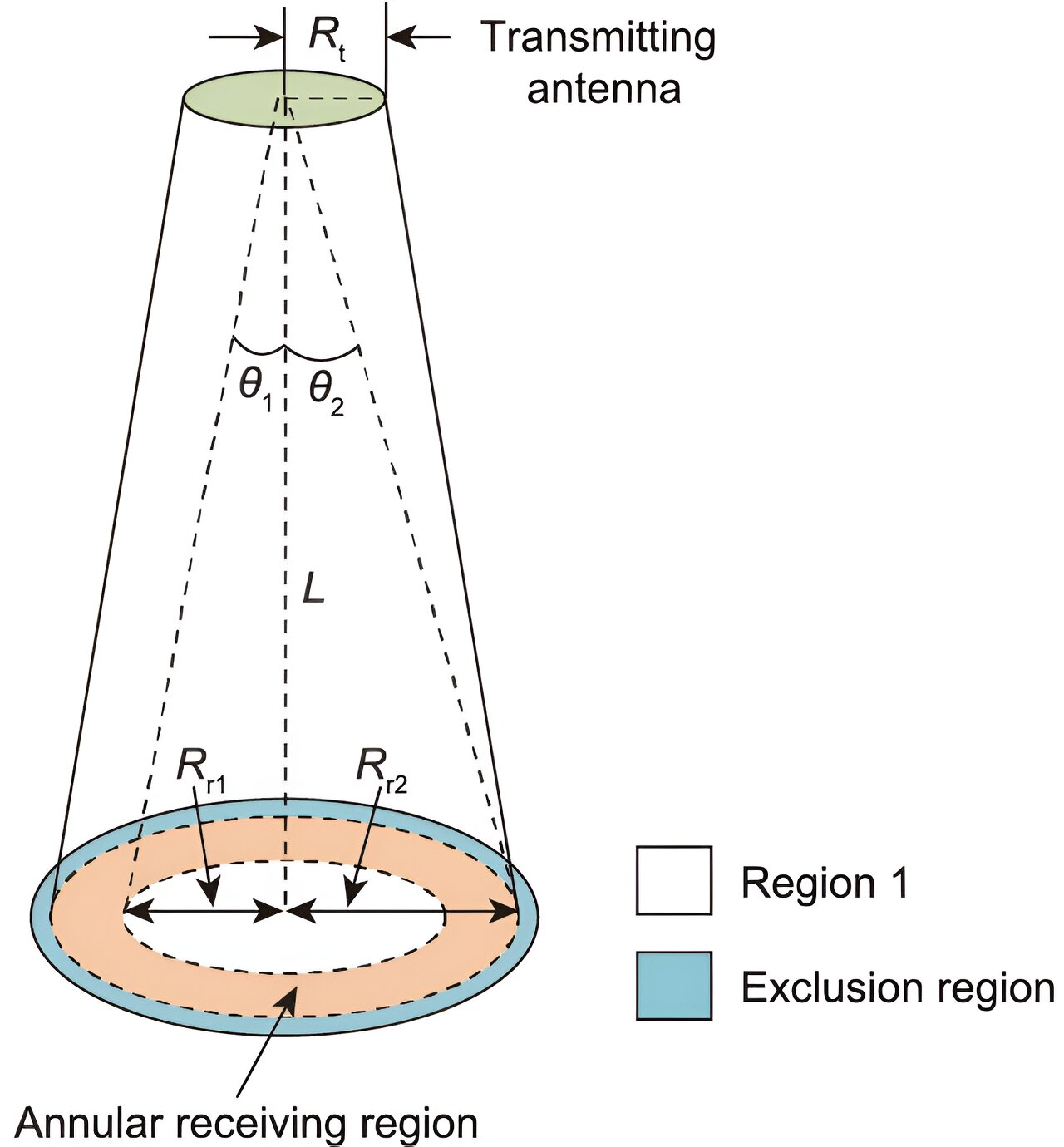
A team of researchers from Xidian University in China has achieved a new result in the field of microwave power transmission. Their study, published in Engineering, introduces an optimal design method for antenna aperture illumination with an annular collection area, with the goal of maximizing the power radiated on the collection area.
The research, led by Professor Baoyan Duan from Shaanxi Key Laboratory of Space Solar Power Station System, Xidian University, focused on formulating the aperture amplitude distribution using a unique series set.
As a result, they were able to simplify the optimal design problem to maximize the ratio of two real quadratic forms. Leveraging matrix theory, the team identified the solution to the optimization problem as determining the largest characteristic value and its associated characteristic vector.
In addressing security concerns, the researchers also integrated additional constraints to account for peak radiation levels outside the receiving area. To address this constrained optimization problem, they developed a hybrid gray wolf optimizer and Nelder–Mead simplex method.
The effectiveness of this novel approach was confirmed through numerical experiments using continuous apertures. Furthermore, the optimized results were validated using discrete arrays of isotropic elements and patch arrays.
The newly proposed method offers several advantages in the field of microwave power transmission. “Our optimal design method enables the achievement of maximum beam collection efficiency (BCE) while satisfying security requirements,” explained the team. “This method allows for the design of continuous aperture distributions to maximize BCE, with or without extra constraints, and facilitates the easy design of array antennas of various sizes.”
The impact of this research extends beyond annular collection areas. The team emphasized, “Our method is not only applicable to annular collection areas but also extends to microwave power transmission applications with circular collection areas, as the circular collection area is a special case of an annular collection area.”
This breakthrough in optimal design methods for antenna aperture illumination holds significant potential for advancing microwave power transmission technologies. It has the capacity to optimize power radiated in collection areas, leading to more efficient and effective transmission of microwave power.
The research conducted by the team at Xidian University represents a promising development in the field. Their approach introduces new possibilities for enhancing the design and performance of microwave power transmission systems. As the demand for wireless power transfer continues to grow, advancements like these are crucial.
The paper is published in the journal Engineering.
More information:
Xun Li et al, Optimal Design of Aperture Illuminations for Microwave Power Transmission with Annular Collection Areas, Engineering (2023). DOI: 10.1016/j.eng.2023.07.016
Provided by
Engineering
Read the full article here


