


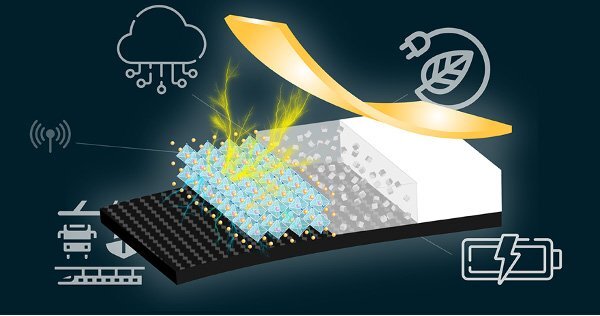
An international research group has engineered a new energy-generating device by combining piezoelectric composites with carbon fiber-reinforced polymer (CFRP), a commonly used material that is both light and strong. The new device transforms vibrations from the surrounding environment into electricity, providing an efficient and reliable means for self-powered sensors.
Details of the group’s research were published in the journal Nano Energy on June 13, 2023.
Energy harvesting involves converting energy from the environment into usable electrical energy and is something crucial for ensuring a sustainable future.
“Everyday items, from fridges to street lamps, are connected to the internet as part of the Internet of Things (IoT), and many of them are equipped with sensors that collect data,” says Fumio Narita, co-author of the study and professor at Tohoku University’s Graduate School of Environmental Studies. “But these IoT devices need power to function, which is challenging if they are in remote places, or if there are lots of them.”
The sun’s rays, heat, and vibration all can generate electrical power. Vibrational energy can be utilized thanks to piezoelectric materials’ ability to generate electricity when physically stressed. Meanwhile, CFRP lends itself to applications in the aerospace and automotive industries, sports equipment, and medical equipment because of its durability and lightness.
“We pondered whether a piezoelectric vibration energy harvester (PVEH), harnessing the robustness of CFRP together with a piezoelectric composite, could be a more efficient and durable means of harvesting energy,” says Narita.
The group fabricated the device using a combination of CFRP and potassium sodium niobate (KNN) nanoparticles mixed with epoxy resin. The CFRP served as both an electrode and a reinforcement substrate.
The so-called C-PVEH device lived up to its expectations. Tests and simulations revealed that it could maintain high performance even after being bent more than 100,000 times. It proved capable of storing the generated electricity and powering LED lights. Additionally, it outperformed other KNN-based polymer composites in terms of energy output density.
The C-PVEH will help propel the development of self-powered IoT sensors, leading to more energy-efficient IoT devices.
Narita and his colleagues are also excited about the technological advancements of their breakthrough. “As well as the societal benefits of our C-PVEH device, we are thrilled with the contributions we have made to the field of energy harvesting and sensor technology. The blend of excellent energy output density and high resilience can guide future research into other composite materials for diverse applications.”
More information:
Yaonan Yu et al, Energy harvesting and wireless communication by carbon fiber-reinforced polymer-enhanced piezoelectric nanocomposites, Nano Energy (2023). DOI: 10.1016/j.nanoen.2023.108588
Tohoku University
Read the full article here


