


In order to prevent power grid failure in a society where electrification is supplied increasingly by variable sources like solar and wind, researchers in Sweden report the development of artificial intelligence algorithms intended to react swiftly when the network’s voltage balance is threatened.
They may be better for the planet but when combined, renewable energy and electric vehicles may also destabilize power grids, setting in motion a range of problems from malfunctioning laptops to regional blackouts. That’s because random variations in supply and demand place pressure on the network’s capacity to maintain a steady voltage level.
It’s this pressure that an open-source AI solution was developed to address, says Qianwen Xu, a researcher at KTH Royal Institute of Technology in Stockholm.
“Wind power and solar radiation are not consistent from hour to hour,” Xu says. “And demand for charging EVs is based on people’s personal needs and habits. So, you have a high level of stochastics and uncertainties. Their integration will lead to voltage fluctuations, deviations and even voltage security violation challenges.”
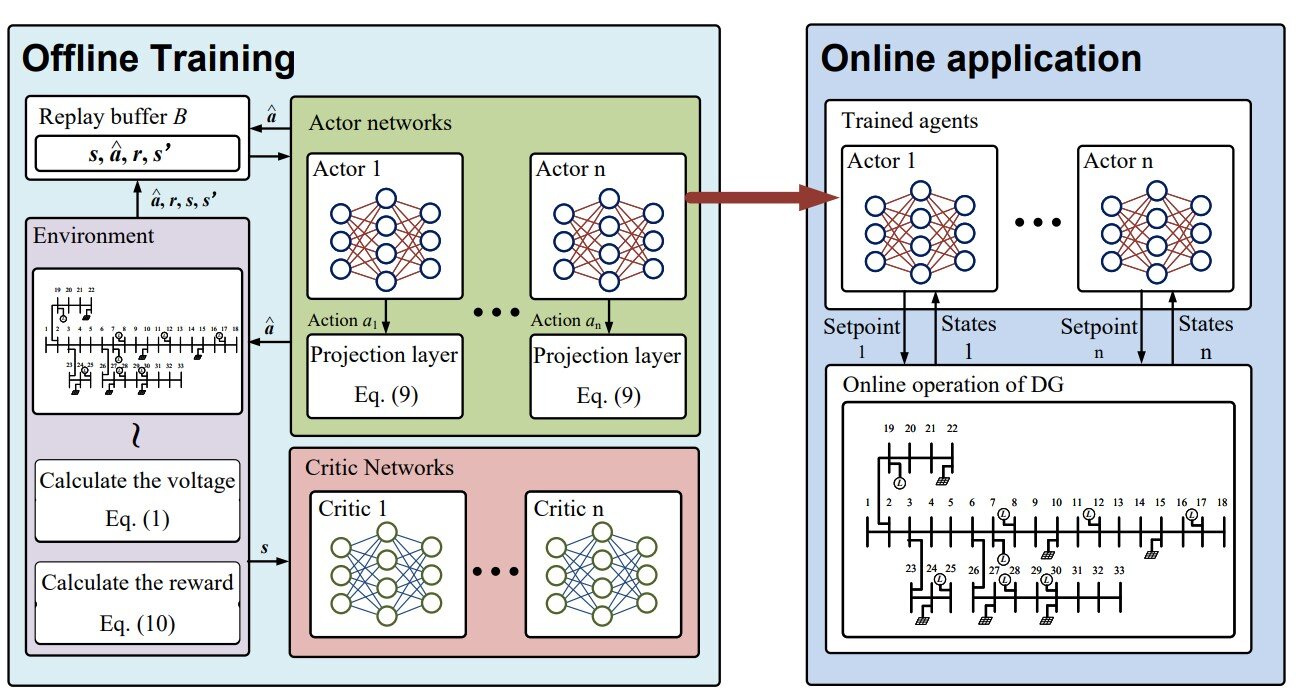
The new open-source deep reinforced learning (DRL) algorithms are designed to solve this challenge by delivering intelligence for power converters deep in the grid, where they optimize large-scale coordination of energy sources safely under fast fluctuations without real-time communication, she says. The DRL provides a novel data synchronization strategy to deal with communication delay for data-driven algorithms.
“Centralized control is not cost-efficient or fast under continuous fluctuations of renewable energy and electric vehicles,” she says. “Our aim is an AI-based self control for each distributed energy source, which are interfaced by power converters.”
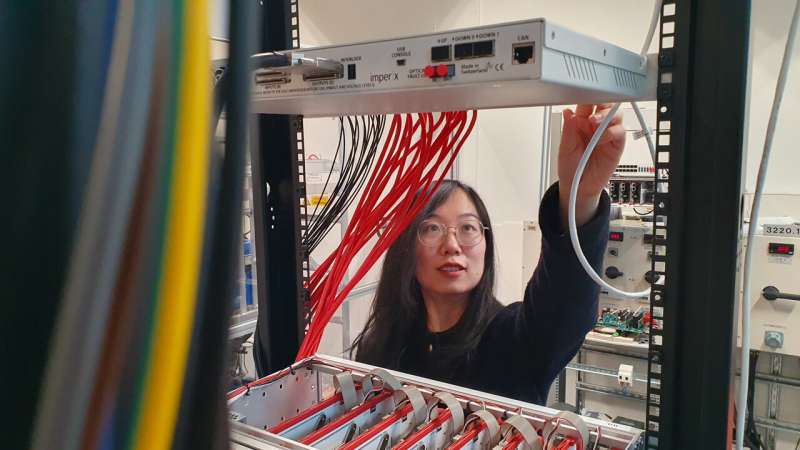
The researchers demonstrated it in a real-world smart microgrid hardware platform at KTH. The open-source software package is published in GitHub, and the research paper is reported in the journal IEEE Transactions on Sustainable Energy.
The solution’s decentralized management approach would maintain voltage levels within certain required limits. Beyond that margin voltage fluctuations would risk a detrimental effect on the performance of electrical equipment as well as on the overall stability of the grid, Xu says.
Voltage deviations can lead to the inefficient operation of electrical devices, reduce their lifespan, and in extreme cases, cause damage to the grid infrastructure. More alarmingly, voltage security violations can lead to blackouts or the need for emergency interventions, such as load shedding or the use of reserve generators, to maintain grid stability, she says.
“Our purpose is to improve control strategies for power converters, by making them more adaptive and intelligent in order to stabilize complex and changing power grids,” Xu says.
This work is part of Digital Futures, a KTH-based research center that explores and develops digital technologies, along with researchers from University of California, Berkeley and Stockholm University.
More information:
Mengfan Zhang et al, Data Driven Decentralized Control of Inverter based Renewable Energy Sources using Safe Guaranteed Multi-Agent Deep Reinforcement Learning, IEEE Transactions on Sustainable Energy (2023). DOI: 10.1109/TSTE.2023.3341632
KTH Royal Institute of Technology
Read the full article here


