


In a new landmark chemistry study, researchers describe how they have achieved the highest level of energy storage—also known as capacitance—in a supercapacitor ever recorded.
The study, led by Luis Echegoyen, Ph.D., professor emeritus at The University of Texas at El Paso, and Marta Plonska-Brzezinska, Ph.D., of the Medical University of Bialystok, Poland, was recently featured in the journal Scientific Reports.
Supercapacitors are devices that store electrical energy between two metal plates that are close together but separated by a surface that cannot conduct electricity. Supercapacitors are similar to batteries, except that batteries store and retrieve energy using chemical transformations, while capacitors store energy by using oppositely charged surfaces. They are frequently used in machines that require rapid discharge of energy, like electric cars, buses, trains and cranes.
“This is a big step forward and gets us closer to achieving supercapacitors with high energy density, which would radically change how we store and manage energy,” said Echegoyen, a longtime faculty member within UTEP’s Department of Chemistry and Biochemistry.
“I’m very proud to be part of the team that reached this milestone.”
Supercapacitors have high potential because they can charge much faster than batteries —within seconds to fractions of a second, according to Echegoyen. However, current supercapacitors can only store a low amount of energy, which limits their range of potential applications. If supercapacitors could be designed to store more energy, they would be physically lighter and charge much faster than batteries, which would have a significant commercial impact, according to scientists.
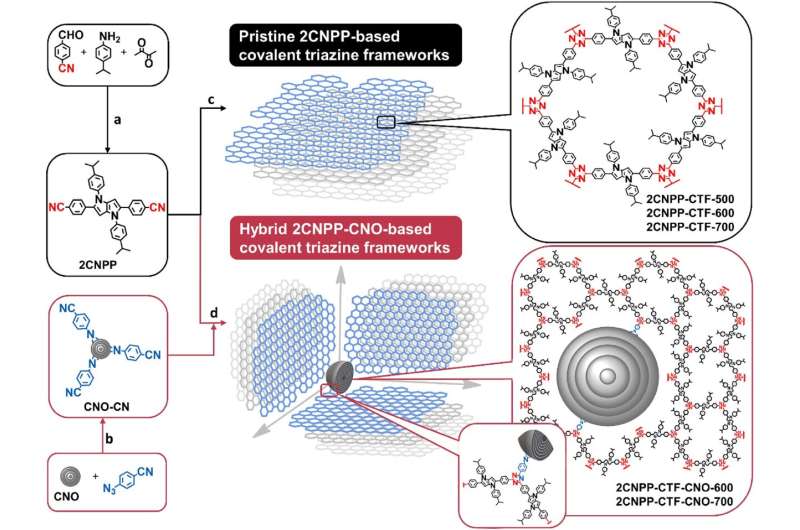
The new supercapacitor designed by Echegoyen and Plonska-Brzezinska achieved a record level of storage, or capacitance, using a material with a carbon “nano-onion” core structure, which creates multiple pores that allow storage of a greater volume of energy.
“I’m very happy to see this innovative research get the attention it deserves,” said Robert Kirken, Ph.D., dean of the UTEP College of Science. “This is further proof of the academic and research excellence by faculty here at UTEP.”
More information:
Agnieszka Hryniewicka et al, Three-dimensional organization of pyrrolo[3,2-b]pyrrole-based triazine framework using nanostructural spherical carbon: enhancing electrochemical performance of materials for supercapacitors, Scientific Reports (2023). DOI: 10.1038/s41598-023-37708-7
University of Texas at El Paso
Read the full article here


