


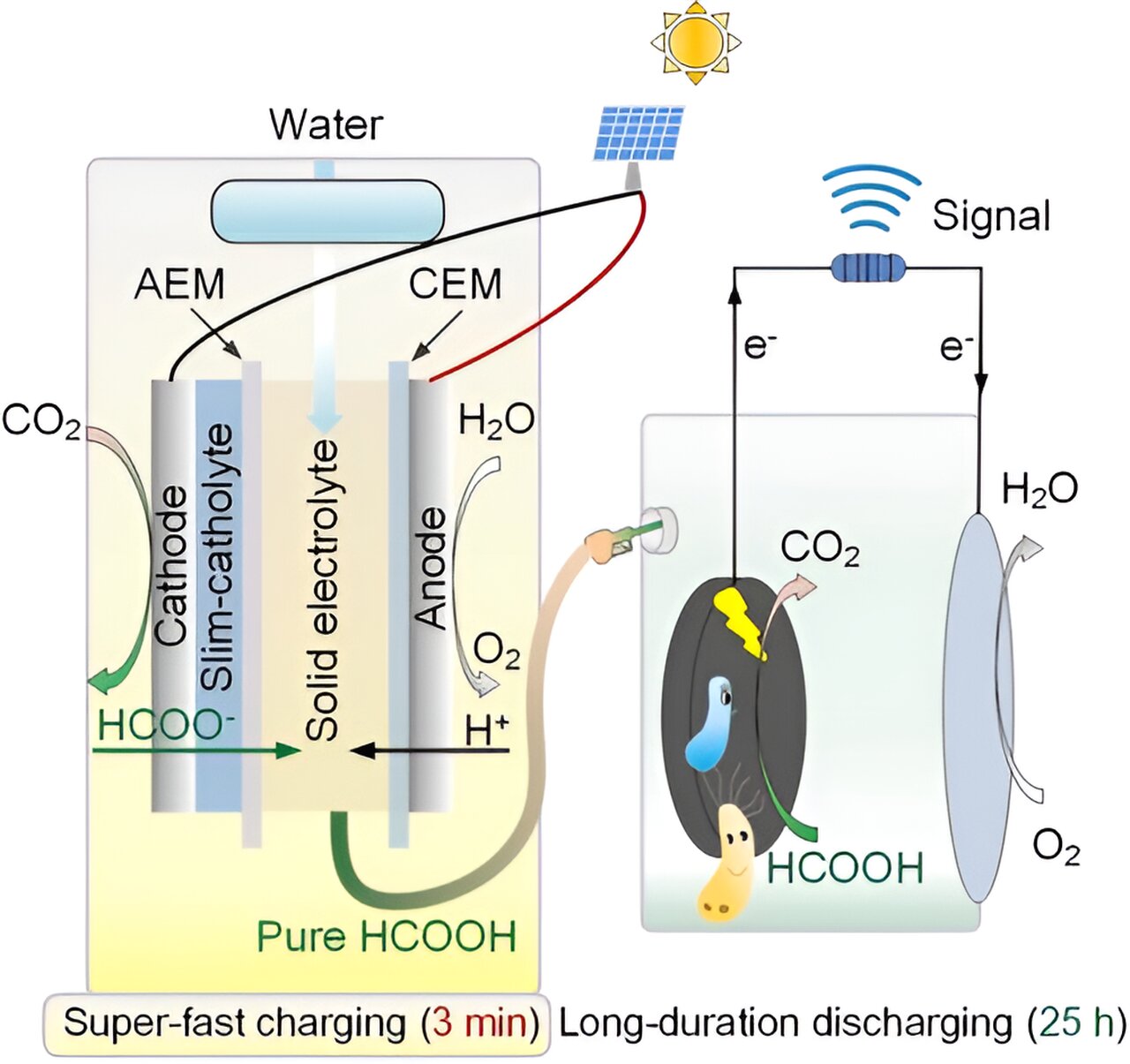
Formic acid, which can be produced electrochemically from carbon dioxide, is a promising energy carrier. A Chinese research team has now developed a fast-charging hybrid battery system that combines the electrochemical generation of formic acid as an energy carrier with a microbial fuel cell.
As the team demonstrate in an article published in the journal Angewandte Chemie International Edition, this novel, fast-charging biohybrid battery system can be used to monitor the toxicity of drinking water, just one of many potential future applications.
Microbial fuel cells harness bacteria to generate electricity, exploiting the ability of some bacterial species to convert energy-rich molecules into electrical energy. In fully microbial batteries, bacteria also produce the energy carrier molecules during the charging process, which are then used to generate electricity during the discharging process. However, one of the disadvantages of fully microbial batteries is that charging is still rather inefficient and slow.
By coupling the purely inorganic electrochemical generation of a biological active molecule with a microbial fuel cell, Yong Jiang’s research team at the Agriculture and Forestry University in Fuzhou, China, and colleagues, have for the first time developed a two-stage hybrid microbial battery system that overcomes many of the challenges faced by fully microbial batteries.
The team also aimed to produce a biohybrid battery using simple and inexpensive components to provide sustainable energy. They found that formic acid is a sustainable biological energy carrier, because it can be produced either biologically or electrocatalytically from carbon dioxide and is then available for consumption by the bacteria in the microbial fuel cell.
Using commercially available components, they designed an electrolysis cell in which inorganic catalysts convert carbon dioxide gas into formic acid. Using this design, the team found that the charging process takes place within a few minutes. Once formic acid has been produced and extracted from the electrolyte, it is fed into a second device—the microbial fuel cell—where bacteria slowly convert it into carbon dioxide and electricity at the bioanode.
This two-stage system produced enough current for 25 hours of discharge, a value that is very useful in many applications. As a proof of concept, the team used the discharge current produced to monitor water for toxins and found that the current signal changed when environmental toxins such as formaldehyde and copper were added to the water. The team suggest further applications in sustainable wastewater treatment or desalination.
More information:
Na Chu et al, Super‐fast Charging Biohybrid Batteries through a Power‐to‐formate‐to‐bioelectricity Process by Combining Microbial Electrochemistry and CO2 Electrolysis, Angewandte Chemie International Edition (2023). DOI: 10.1002/anie.202312147
Read the full article here


