


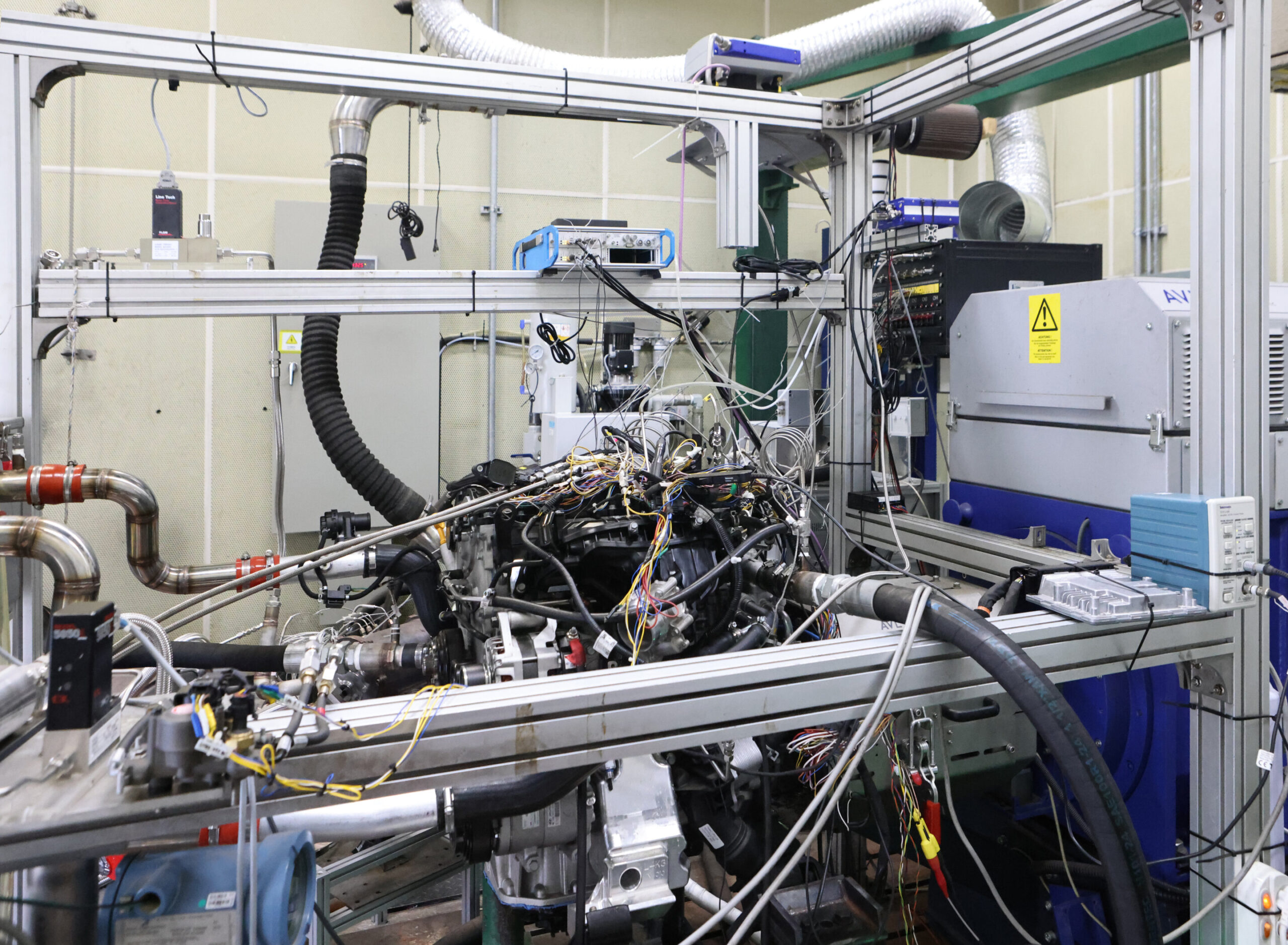
Amid the fierce competition throughout the globe to develop hydrogen mobility technologies to achieve carbon neutrality, a new technology for a 2-liter class hydrogen-fueled engine (a passenger car hydrogen engine) capable of running entirely on hydrogen has been developed for the first time in Korea.
The joint research team led by Principal Researcher Young Choi of the Department of Mobility Power Research of the Korea Institute of Machinery and Materials (KIMM), and Researcher Hong-gil Baek of the Zero-Carbon Engine Research Lab of Hyundai-Kia Motor Company (HMC) developed the “direct injection hydrogen engine” that runs entirely on hydrogen fuels, and demonstrated its world-class excellence through performance evaluation.
The joint research team of KIMM and HMC injected hydrogen directly into the combustion chamber of the engine of HMC’s existing hybrid vehicle, with a pressure of more than 30 bar. By using a turbo charger that improves the performance of the engine, the research team was able to maintain high thermal efficiency in all domains from the ignition of the engine to the upper limit of the engine load, allowing the engine to be stably operated throughout the entire engine operating conditions.
In the case of conventional “port injection engines,” the amount of air that flows into the combustion chamber declines because of the space taken up by the hydrogen fuel that exists in a gaseous state, which leads to lower fuel efficiency and poorer engine performance due to the backfire of the hydrogen fuel and air.
On the other hand, the “direct injection hydrogen engine” newly developed by the joint research team has fundamentally resolved the issue of backfire by injecting high-pressure hydrogen fuel directly into the combustion chamber. At the same time, the high compression ratio, fuel stratification, and ultra-lean combustion help to maximize thermal efficiency and improve power performance, while at the same time reducing the amount of harmful emissions.
Compared with gasoline engines, the newly developed hydrogen engine helps to reduce the emissions of carbon dioxide and fine dust by 99 percent and 90 percent, respectively, which meets the European Union’s requirements for zero-emission vehicles. Additionally, the hydrogen engine emits nitrogen oxides of less than 15 ppm even without an aftertreatment system that purifies exhaust gases, achieving a high thermal efficiency of up to 40 percent.
Principal Researcher Young Choi of the Department of Mobility Power Research of KIMM said, “The newly developed hydrogen engine technology is an instantaneous and economical technology that can help to replace fossil fuels, which are currently being used as the main power source for vehicles, with carbon-free hydrogen fuels.”
He added, “Through collaboration with HMC, we will verify the durability of the engine and also expand the application of this technology to not only passenger vehicles but also commercial vehicles and electricity generation power units. Through continuous research and development of technologies for generating power using carbon-free fuels, we will take the lead in the realization of carbon neutrality.”
Related research has been published in the International Journal of Hydrogen Energy.
More information:
Cheolwoong Park et al, Effect of fuel injection timing and injection pressure on performance in a hydrogen direct injection engine, International Journal of Hydrogen Energy (2022). DOI: 10.1016/j.ijhydene.2022.04.274
Provided by
National Research Council of Science & Technology
Read the full article here


