


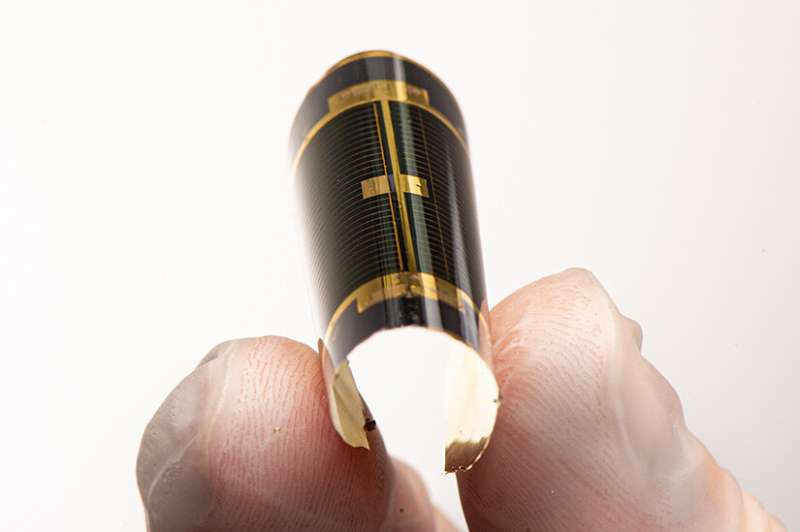
Sound waves could play a part in making III-V solar cells more affordable for Earth-bound applications, according research led by scientists at the U.S. Department of Energy’s National Renewable Energy Laboratory (NREL). The article, “GaAs solar cells grown on acoustically spalled substrates with 27% efficiency,” appears in the journal Joule.
Researchers say the application of sound waves, used in a new process called acoustic spalling, holds the potential for significantly reduced cost in manufacturing these types of highly efficient solar cells.
The III-V solar cells are called that because they are grown using elements from the III and V groups of the periodic table. While III-V solar cells are highly efficient, their cost has limited their use to space applications such as powering satellites. Reducing manufacturing costs is considered key to terrestrial applications, and one way to accomplish this is by having the ability to repeatedly reuse the substrate upon which the cells are grown.
“This is super promising for the substrate reuse,” said Kevin Schulte, a scientist in NREL’s High-Efficiency Crystalline PV group and the lead author of the journal article detailing the success of acoustic spalling. “This alone will not make III-V solar cells cost-effective, but as part of this portfolio of research, we’re trying address cost from multiple different angles.”
Existing technology uses a sacrificial etch layer, which allows a cell to be lifted off a gallium arsenide (GaAs) substrate so that the substrate can be used again, but the process takes hours and leaves behind a residue that requires a polishing step. Polishing is relatively expensive and limits the potential cost savings of this substrate reuse method.
In contrast, spalling takes seconds, creating a controlled fracture within the substrate nearly parallel to its surface. This fracture allows the cell to be easily removed, revealing a new, contaminant-free surface from within the substrate that does not require polishing.
Spalling of standard GaAs layers creates relatively large facets on the substrate that consume extra material and may require planarization (via polishing or other methods) before the substrate can be reused. This latest advancement uses acoustic spalling, or sound waves, to control the fracture, suppress the formation of facets, and improve the flatness of the substrate.
“The surface is less corrugated,” Schulte said, “so when you grow a new device on it, it’s possible to achieve a high efficiency with relatively minimal, or potentially no, surface repreparation.”
Acoustic spalling was developed at Arizona State University; the technology is being commercialized by a company in Phoenix called Crystal Sonic Inc. Two of the company’s researchers are co-authors on the Joule article. Other co-authors are Steve Johnston, Jacob Boyer, Anica Neumann, William McMahon, Michelle Young, Emily Warren, and Myles Steiner, all from NREL; and Anna Braun of Colorado School of Mines.
Additional research is needed to determine how many times the substrate can be reused after being subjected to acoustic spalling, which Crystal Sonic calls Sonic Lift-Off. The researchers were able to make a cell on a previously spalled substrate with an NREL-certified efficiency of 26.9%.
“I don’t think there’s any difference in that performance compared to what efficiency we could get on a brand-new substrate,” Schulte said.
More information:
Kevin L. Schulte et al, GaAs solar cells grown on acoustically spalled GaAs substrates with 27% efficiency, Joule (2023). DOI: 10.1016/j.joule.2023.05.019
Joule
National Renewable Energy Laboratory
Read the full article here


