

Close Menu
  • Home
  • News
  • Startups
  • Innovation
  • Industry
  • Business
  • Green Innovations
  • Venture Capital
  • Market Data
    • Economic Calendar
    • Stocks
    • Commodities
    • Crypto
    • Forex
Facebook X (Twitter) Instagram
[gtranslate]
Facebook X (Twitter) Instagram YouTube
Innovation & Industry
Banner
  • Home
  • News
  • Startups
  • Innovation
  • Industry
  • Business
  • Green Innovations
  • Venture Capital
  • Market Data
    • Economic Calendar
    • Stocks
    • Commodities
    • Crypto
    • Forex
Login
Innovation & Industry
Green Innovations

Replacing tape used to make lithium-ion batteries could slow battery degradation and reduce self-discharge

News RoomNews RoomSeptember 29, 2023No Comments3 Mins Read
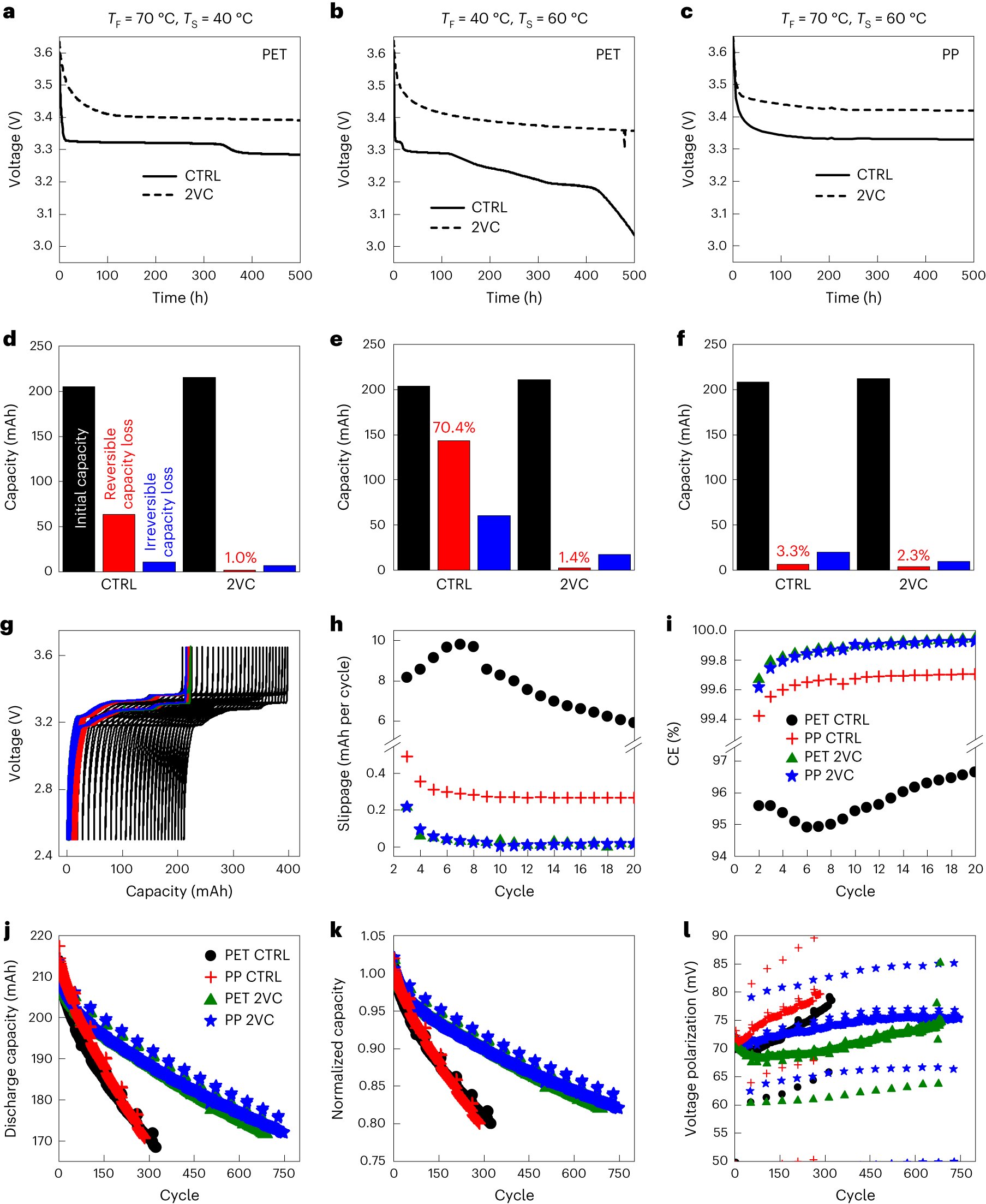
Demonstration of improvements in self-discharge and cycling performance when PP tape is used instead of PET tape. a–c, Voltage versus time profiles of LFP–graphite pouch cells with PET tape formed at TF = 70°C and stored at TS = 40°C (a), with PET tape formed at 40°C and stored at 60°C (b) and with PP tape formed at 70°C and stored at 60°C (c). d–f, The corresponding bar graphs (d–f) show initial capacity, reversible capacity loss and irreversible capacity loss. g–i, UHPC cycling profiles (g), charge endpoint capacity slippage (h) and Coulombic efficiency (CE) (i) for LFP–graphite cells with either PET or PP tape. Cells were formed at 70°C and transferred to the UHPC system at 50% SOC. All UHPC data were recorded at C/20 and 40°C from 2.5 to 3.65 V. The CTRL electrolyte was 1.5 M LiPF6 in EC:DMC (3:7). CTRL electrolyte with 2% VC is marked as 2VC. j–l, Discharge capacity (j), normalized capacity (k) and the voltage polarization (l) of LFP–graphite pouch cells with either PP or PET tape, formed at 40°C and cycled at 70°C with a current of C/3. The CTRL electrolyte was 1.5 M LiFSI in EC:DMC (15:85). CTRL electrolyte with 2% VC is abbreviated to 2VC. Credit: Nature Materials (2023). DOI: 10.1038/s41563-023-01673-3

A team of chemists and physicists at Dalhousie University in Canada has found that replacing the type of tape used to make lithium-ion batteries could slow battery degradation and reduce the amount of self-discharge in smartphones and other personal devices. In their project, reported in the journal Nature Materials, the group studied the behavior over time of polyethylene terephthalate (PET) tape used to make lithium-ion batteries in smartphones.

Personal device makers and owners alike know that there is one feature of such devices both would like to improve—battery performance and lifespan. Lithium-ion batteries in devices such as smartphones only last a few years. They also self-discharge, losing charge even when they are not being used. In this new effort, the research team wondered about the impact of using PET tape in batteries.

To find out, they studied characteristics of the tape over long periods of time in smartphones. They found that the tape was not chemically stable—it tended to depolymerize, which led to reductions in performance. This had a negative impact on both battery longevity and self-discharge. The team then looked for a suitable replacement and found that polypropylene (PP) tape worked just as well as PET tape in lithium-ion batteries and does not depolymerize.

The researchers found that using PP tape instead of PET tape made lithium-ion batteries last approximately 10% longer. They also found that using PP tape reduced self-discharge by approximately 70%. In the real world, that would mean phones would lose little of their charge when inactive for long periods of time.

The research team also noted that switching from PET to PP tape likely would not change the cost of devices using lithium-ion batteries. They acknowledge, however, that further testing is required to make sure PP tape works as well at PET tape and that it holds up to use in other ways before it could be used in new devices.

More information:
Anu Adamson et al, Improving lithium-ion cells by replacing polyethylene terephthalate jellyroll tape, Nature Materials (2023). DOI: 10.1038/s41563-023-01673-3

© 2023 Science X Network


Read the full article here

Related Articles

Neutron scattering study points the way to more powerful lithium batteries

Green Innovations April 16, 2024

Researchers can help shipowners achieve ambitious climate targets

Green Innovations April 16, 2024

Solar energy can uplift rural Ethiopians, but is hard to come by

Green Innovations April 16, 2024

A timer can shorten your shower even when you have no incentive to save water

Green Innovations April 16, 2024

High electric bills threaten California’s clean future: This plan could help

Green Innovations April 16, 2024

New insight about the working principles of bipolar membranes could guide future fuel cell design

Green Innovations April 16, 2024
Add A Comment
Leave A Reply Cancel Reply

Copyright © 2026. Innovation & Industry. All Rights Reserved.
  • Privacy Policy
  • Terms of use
  • Press Release
  • Advertise
  • Contact

Type above and press Enter to search. Press Esc to cancel.

Sign In or Register

Welcome Back!

Login to your account below.

Lost password?