

Close Menu
  • Home
  • News
  • Startups
  • Innovation
  • Industry
  • Business
  • Green Innovations
  • Venture Capital
  • Market Data
    • Economic Calendar
    • Stocks
    • Commodities
    • Crypto
    • Forex
Facebook X (Twitter) Instagram
[gtranslate]
Facebook X (Twitter) Instagram YouTube
Innovation & Industry
Banner
  • Home
  • News
  • Startups
  • Innovation
  • Industry
  • Business
  • Green Innovations
  • Venture Capital
  • Market Data
    • Economic Calendar
    • Stocks
    • Commodities
    • Crypto
    • Forex
Login
Innovation & Industry
Green Innovations

Renewable solar energy can help purify water, research shows

News RoomNews RoomJuly 24, 2023No Comments2 Mins Read
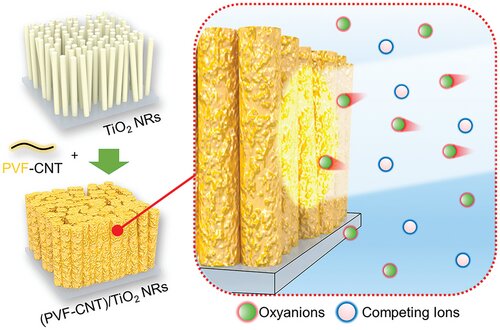
Schematic diagram of (left) the formation of (PVF-CNT)/TiO2 NR electrodes. PVF-functionalized CNT was deposited on the NR arrays by electrodeposition. (Right) The proposed solar-driven PEC separation of heavy metal oxyanions is displayed. Credit: Small (2023). DOI: 10.1002/smll.202305275

Using electrochemistry to separate different particles within a solution (also known as electrochemical separation) is an energy-efficient strategy for environmental and water remediation: the process of purifying contaminated water. But while electrochemistry uses less energy than other, similar methods, the electric energy is largely derived from nonrenewable sources like fossil fuels.

Chemists at the University of Illinois Urbana-Champaign have demonstrated that water remediation can be powered in part—and perhaps even exclusively—by renewable energy sources. Through a semiconductor, their method integrates solar energy into an electrochemical separation process powered by a redox reaction, which manipulates ions’ electric charge to separate them from a solution like water. This work appears in the journal Small.

Using this system, the researchers successfully separated and removed dilute arsenate—a derivative of arsenic, which is a major waste component from steel and mining industries—from wastewater.

This work represents proof-of-concept for the applicability of such systems for wastewater treatment and environmental protection.

“Global electrical energy is still predominantly derived from nonrenewable, fossil-fuel-based sources, which raises questions about the long-term sustainability of electrochemical processes, including separations. Integrating solar power advances the sustainability of electrochemical separations in general, and its applications to water purification benefit the water sector as well,” said lead investigator Xiao Su, a researcher at the Beckman Institute for Advanced Science and Technology and an assistant professor of chemical and biomolecular engineering.

More information:
Ki‐Hyun Cho et al, Redox‐Functionalized Semiconductor Interfaces for Photoelectrochemical Separations, Small (2023). DOI: 10.1002/smll.202305275

Journal information:
Small

Provided by
Beckman Institute for Advanced Science and Technology


Read the full article here

Related Articles

Neutron scattering study points the way to more powerful lithium batteries

Green Innovations April 16, 2024

Researchers can help shipowners achieve ambitious climate targets

Green Innovations April 16, 2024

Solar energy can uplift rural Ethiopians, but is hard to come by

Green Innovations April 16, 2024

A timer can shorten your shower even when you have no incentive to save water

Green Innovations April 16, 2024

High electric bills threaten California’s clean future: This plan could help

Green Innovations April 16, 2024

New insight about the working principles of bipolar membranes could guide future fuel cell design

Green Innovations April 16, 2024
Add A Comment
Leave A Reply Cancel Reply

Copyright © 2026. Innovation & Industry. All Rights Reserved.
  • Privacy Policy
  • Terms of use
  • Press Release
  • Advertise
  • Contact

Type above and press Enter to search. Press Esc to cancel.

Sign In or Register

Welcome Back!

Login to your account below.

Lost password?