


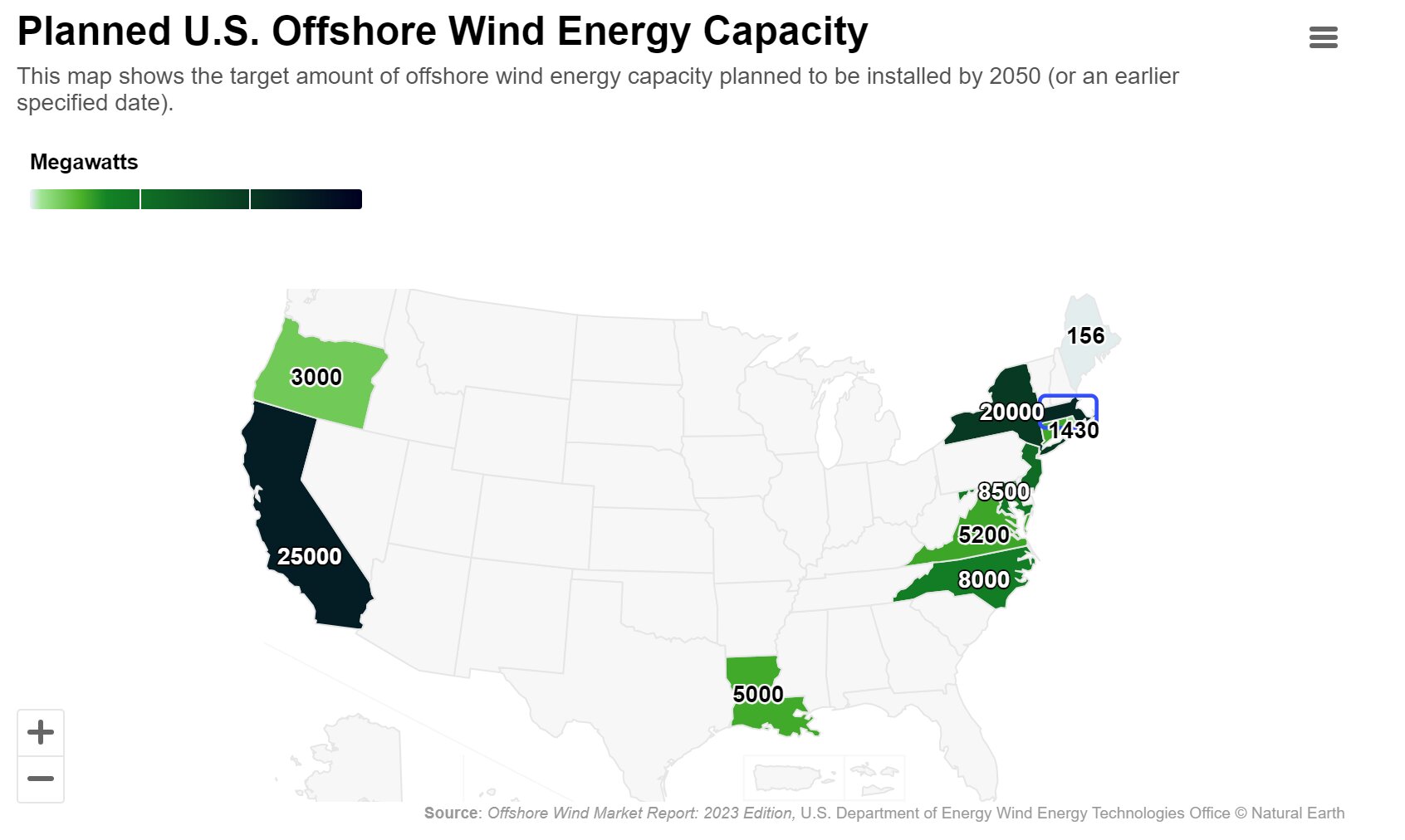
The U.S. offshore wind energy project development and operational pipeline reached a potential generating capacity of 52,687 megawatts (MW) at the end of May 2023, according to a National Renewable Energy Laboratory (NREL) analysis recently released in the Offshore Wind Market Report: 2023 Edition. If fully developed, these projects would be enough to power more than 18 million American homes.
Representing a 15% increase from May 31, 2022, this potential generating capacity includes:
- Two operating projects totaling 42 MW
- Over 40 projects under development totaling 47,606 MW
- An additional 5,039 MW of potential capacity in the planning stage.
The report also found that the market has become more volatile in the past year, with project costs increasing due to inflation, interest rates, and supply chain uncertainty. The Inflation Reduction Act may provide some relief to keep projects profitable.
The NREL analysis, which wind energy researchers conduct annually on behalf of the U.S. Department of Energy (DOE) Wind Energy Technologies Office, also includes worldwide wind energy industry data spanning Jan. 1, 2022–Dec. 31, 2022 and U.S. data spanning Jan. 1, 2022–May 31, 2023.
Globally, the researchers reported, total offshore wind energy capacity reached 59,009 MW from 292 operating projects and more than 11,900 operating wind turbines. Nearly 22,000 MW of offshore wind capacity were under construction worldwide at the end of December 2022.
“Our analysis confirms that the offshore wind energy market is powering up despite some significant economic headwinds,” said Walt Musial, NREL offshore wind energy expert and the lead author on the report. “Fueled by industry investments, state policies, new offshore lease areas, government incentives, and growing momentum, offshore wind energy is poised to become a major source of electricity for U.S. homes and businesses in the long term, assuming near-term economic challenges can be mitigated.”
The Offshore Wind Market Report: 2023 Edition provides detailed information about offshore wind energy development to inform policymakers, researchers, and analysts about technology and market trends. Released by DOE on Aug. 24, 2023, the report also highlights findings in the following areas:
Markets driven locally
From January 2022 to May 2023, key developments in the U.S. offshore wind energy industry market included:
- The Bureau of Ocean Energy Management’s (BOEM’s) announcement of three new domestic lease areas in the Gulf of Mexico with an estimated capacity of 4,885 MW
- Announced investments of $2.7 billion in the United States in ports, vessels, supply chain, and transmission
- Continued momentum driven by state-level procurement activities and policies that aim to install 42,730 MW of offshore wind energy capacity by 2040.
Floating gains traction
Floating offshore wind energy—a type of technology in which wind turbines are mounted on buoyant structures that are anchored to the seabed rather than fixed to the ocean floor—is the newest form of offshore wind energy. This allows wind farms to be deployed in deeper waters where traditional fixed-bottom offshore wind turbines are not feasible.
According to the market report, key floating offshore wind market developments included:
- Global installed capacity remained at 123.4 MW, with no new projects coming online January 2022–May 2023.
- In December 2022, BOEM sold the first-ever commercial floating offshore wind energy lease areas off the coast of California for more than $750 million.
- The U.S. Departments of Energy, the Interior, Commerce, and Transportation announced the Floating Offshore Wind Shot, which established ambitious goals to reduce the cost of floating offshore wind energy by 70% and deploy 15 gigawatts (GW) of floating offshore wind in the U.S. by 2035.
Policies support growth
The Inflation Reduction Act of August 2022 provides tax credit incentives for investing in offshore wind energy and the domestic supply chain while also potentially softening adverse impacts of rising costs due to inflation, supply chain constraints, and interest rates.
Commercialization begins at utility scale
Trends in offshore wind energy projects show growth in project size and turbine size. At both a national and global level, developers have increased project size as well as water depth and distance to shore. In addition, offshore wind energy project developers are advancing 15-MW wind turbine prototypes toward commercial production.
Costs increase
Project costs globally:
- Increased by 11%–30% because of supply chain constraints, high inflation, and rising interest rates
- Could have the most significant impacts on projects planned for commercial operations between 2025 and 2028, with offtake agreements (long-term contracts between energy sellers and buyers) already in place.
Future looks bright
Offshore wind energy continues to expand, with forecasts showing that:
- Global capacity could reach 380–394 GW by 2032, which would represent a sixfold increase over the next decade.
- U.S. market growth could parallel anticipated global market growth, despite current large-scale economic challenges.
- Broad federal and state support for commercial leasing, energy planning targets, procurement policies, offtake agreements, and U.S. jobs and domestic supply chain development point toward sustained market growth.
- The large-scale economic hurdles facing the first generation of commercial projects could significantly hinder workforce and manufacturing growth.
“Despite recent market uncertainty, the project pipelines continue to grow in both fixed and floating offshore wind project developments,” Musial said. “As the first major projects move toward commercial operation in the next year, we are likely to see offshore wind begin to make a significant contribution toward reducing the carbon emissions of our electric supply.”
More information:
Report: www.energy.gov/sites/default/f … ort-2023-edition.pdf
National Renewable Energy Laboratory
Read the full article here


