


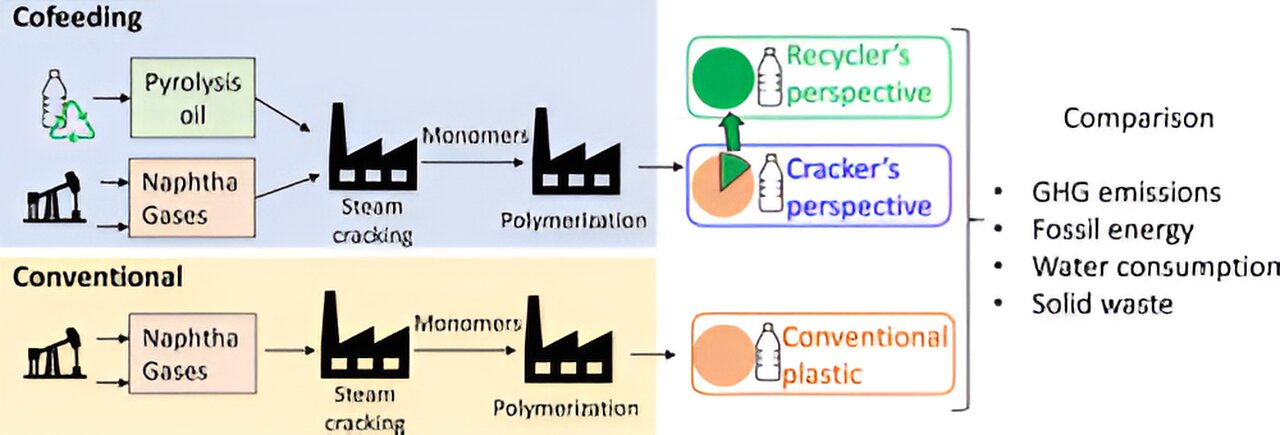
Producing new plastic by advanced recycling of post-use plastic (PUP), instead of fossil-based production, can reduce greenhouse gas emissions (GHG) and increase the U.S. recycling rate, according to research by the U.S. Department of Energy’s (DOE) Argonne National Laboratory. The life cycle analysis study appears in the November 2023 issue of Journal of Cleaner Production.
This is the first analysis of multiple U.S. facilities taking PUP all the way to new plastics again. Specifically, the new plastics are low-density and high-density polyethylene (LDPE and HDPE, respectively). The recycling process used is pyrolysis, whereby plastics are heated to high temperatures in an oxygen-free environment.
The main product is pyrolysis oil, a liquid mix of various compounds that can be an ingredient in new plastic. The oil can replace fossil ingredients like naphtha and gases to manufacture ethylene and propylene. They are two important monomers, or building blocks, for plastic production.
The study collected 2017-2021 operating data from eight companies with varying pyrolysis oil production processes. The analysis shows an 18% to 23% decrease in GHG emissions when making plastic with just 5% pyrolysis oil from PUP compared to crude oil-derived LDPE and HDPE, respectively.
When factoring in current end-of-life practices for many plastics in the U.S., such as incineration, there is a further 40% to 50% reduction in GHG emissions when manufacturing pyrolysis-based LDPE and HDPE, respectively, according to the analysis. Reductions are much higher (up to 131%) in the European Union as more PUP is currently incinerated.
“As advanced recycling becomes increasingly efficient, it is poised to play a major role in achieving global sustainability goals by reducing waste and GHG emissions,” said Benavides. “It can transform hard-to-recycle plastics into a multitude of high-value raw materials, reducing the need for fossil resources and potentially minimizing the environmental impact of waste management.”
Advanced recycling enables reliance on PUP to produce valuable industrial chemicals and develop markets for recycled plastic materials. Pyrolysis is one of the most common advanced technologies being implemented at industrial scale to convert PUP that cannot typically be turned into new products using other means.
In addition to GHG emissions, the Argonne team assessed the fossil energy, water consumption and solid waste impacts of converting PUP into new plastics. The most-likely scenario of 5% recycled materials when compared to virgin production shows a reduction of 65% to 70% in fossil energy use, a 48% to 55% reduction in water use and a 116% to 118% reduction in solid waste.
The study utilized Argonne’s Greenhouse Gases Regulated Emissions and Energy use in Technologies (GREET) model, which has more than 55,000 users worldwide. GREET is widely used by the DOE as well as multiple agencies including U.S. Environmental Protection Agency.
In addition to Benavides, Argonne Principal Energy Systems Analyst Uisung Lee, Energy Systems Analyst Ulises R. Gracida-Alvarez, and Interim Energy Systems and Infrastructure Analysis Division Director Michael Wang are additional researchers on the project.
More information:
Ulises R. Gracida-Alvarez et al, Life-cycle analysis of recycling of post-use plastic to plastic via pyrolysis, Journal of Cleaner Production (2023). DOI: 10.1016/j.jclepro.2023.138867
Argonne National Laboratory
Read the full article here


