


by Li Zhaoqian and Zhao Weiwei, Hefei Institutes of Physical Science, Chinese Academy of Sciences
According to research published in Small, a team led by Prof. Hu Linhua from Hefei Institutes of Physical Science (HFIPS), Chinese Academy of Science (CAS) found that the electrochemical properties of NH4V4O10 can be successfully enhanced by introducing oxygen vacancies.
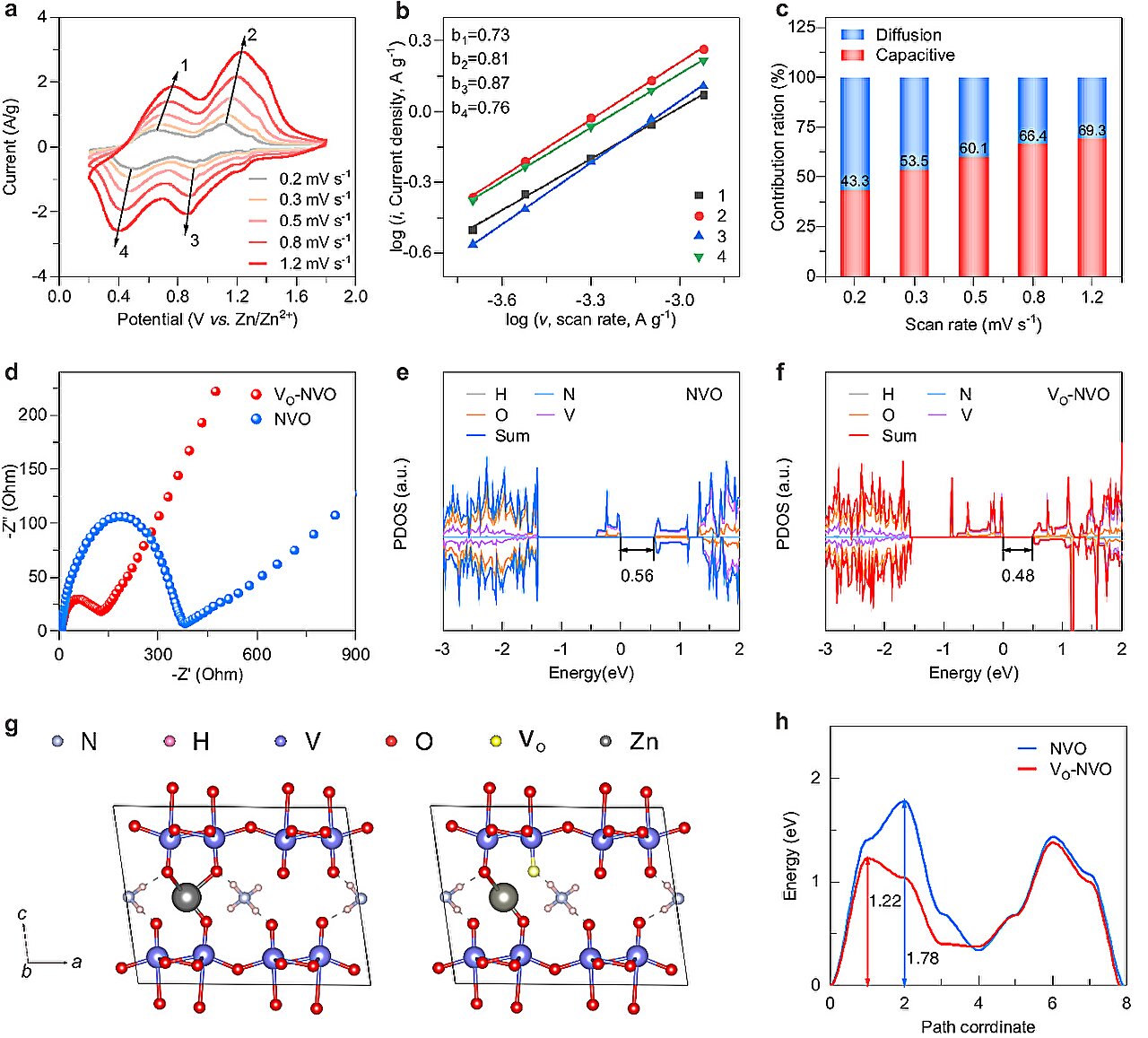
“The introduction of oxygen vacancy accelerates the ion and charge transfer kinetics, reduces the diffusion barrier of zinc ions, and establishes a stable crystal structure during zinc ion (de-intercalation),” said Li Zhaoqian, a member of the team.
Aqueous zinc ion batteries (AZIBs) have attracted significant attention among energy storage devices. Vanadium-based compounds have been identified as promising cathode materials for aqueous zinc ion batteries due to their high specific capacity. However, the low intrinsic conductivity and sluggish Zn2+ diffusion kinetics seriously impede their further practical application.
In this study, researchers develop a facile hydrothermal approach to introduce oxygen vacancies into NH4V4O10 nanobelts (denoted as VO-NVO) as a cathode material for high-performance AZIBs.
Generating oxygen vacancies into the NVO lattice can accelerate the ion and charge transfer kinetics, reduce the diffusion barrier of zinc ions, and establish a stable crystal structure during zinc ion (de-intercalation). This defect engineering also facilitates the enhancement of the surface capacitive contribution of NVO due to the higher electrochemical surface reactivity and lower required number of formation electrons.
As a result, the obtained VO-NVO cathode delivers a remarkable capacity of 498.6 mAh g-1 at 200 mA g-1, exceptional rate capability of 295.6 mAh g-1 at 10 A g-1 and ultra-long cycling stability with a capacity retention of 95.1% after 4000 cycles at 5 A g-1.
This method of introducing oxygen vacancies provides an idea for solving the problem of AZIB high-performance cathodes, according to the team.
More information:
Yuqi Peng et al, Oxygen Vacancies on NH4V4O10 Accelerate Ion and Charge Transfer in Aqueous Zinc–Ion Batteries, Small (2023). DOI: 10.1002/smll.202306972
Small
Provided by
Hefei Institutes of Physical Science, Chinese Academy of Sciences
Read the full article here


