


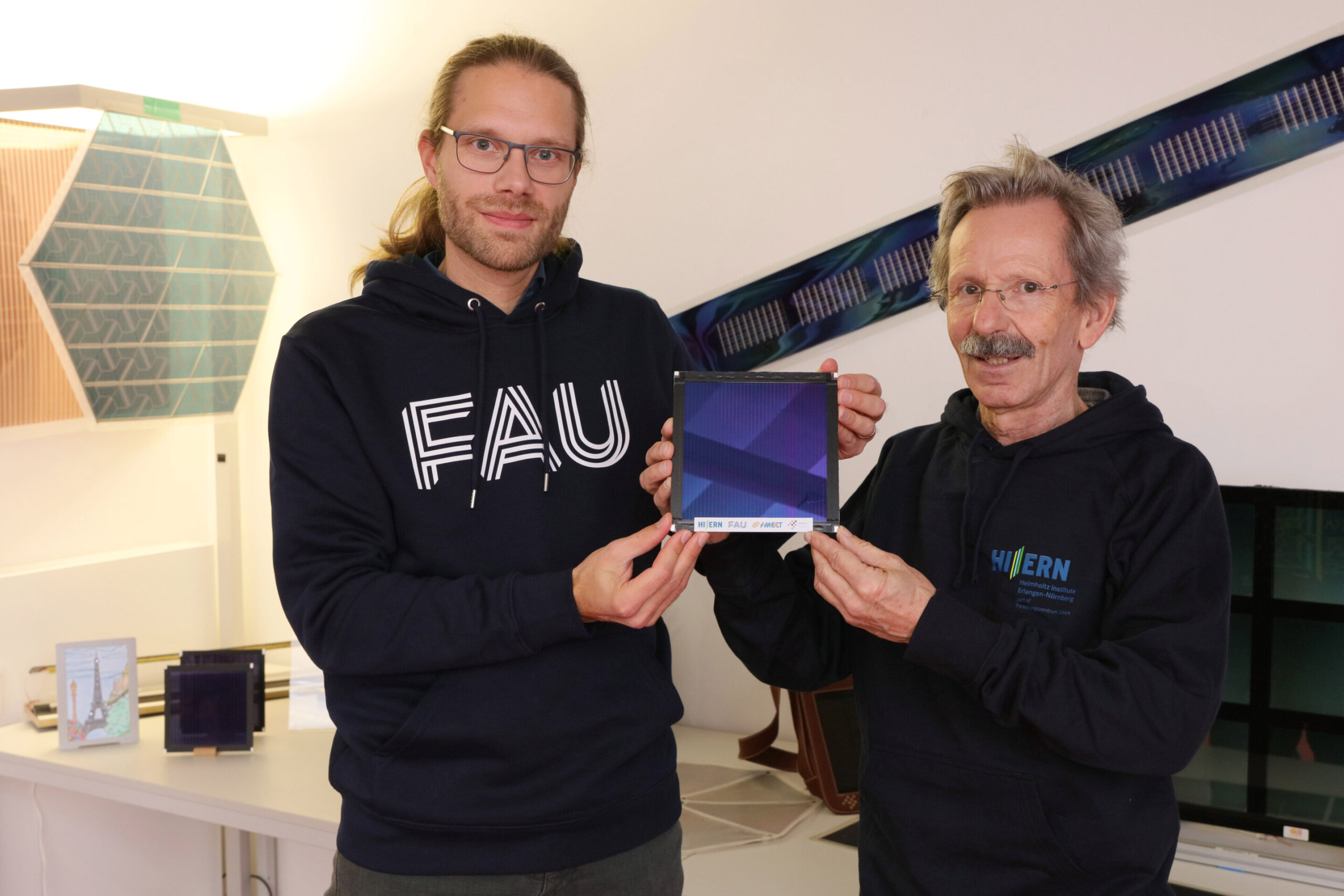
Solar energy is one of the great hopes when it comes to the energy transition. Research in this future-oriented field is accordingly extensive. One of the biggest challenges is finding the perfect material. In terms of efficiency, silicon is currently hard to beat. However, it has serious disadvantages: it is too rigid and heavy and difficult to recycle.
A research group headed by Dr. Christoph Brabec, Chair of Materials for Electronics and Energy Technology at FAU and director at the Helmholtz Institute Erlangen-Nürnberg (HI ERN), is therefore pursuing a different approach: they want to conquer the market with organic photovoltaics (OPV).
The advantage of OPV is that the modules can be flexible and transparent; they can be integrated into windows and façades, used indoors or as roofing in fields, for example, in greenhouse tunnels. They also have a much more favorable ecological footprint—the manufacturing processes are more environmentally friendly, and the material is easier to recycle.
“Solution-processed organic photovoltaics is becoming an important component of a photovoltaic strategy that focuses on the speed of capacity expansion and integration capability. Like perovskites, it enables photovoltaic applications beyond the gigawatt fields in desert regions. Organic photovoltaics can thus make a sustainable contribution to bringing the production of photovoltaics back to Europe,” explains materials scientist Christoph Brabec.
The weakness of the technology to date lies in its efficiency: While silicon modules already achieve efficiencies of over 20%, OPV researchers were still struggling to achieve double-digit results just a few years ago. It is, therefore, all the more pleasing to see that new records are gradually being set in this area: Christoph Brabec’s team has managed to increase efficiency to 14.46%.
Dr. Andreas Distler, who achieved the coup, worked on three parameters. “Firstly, we used improved active materials. But it was just as important for us to reduce the inactive areas on such a module—to do this, we further optimized the laser structuring process, which divides the module surface into individual solar cells and interconnects them electrically. The trick here is to keep the laser lines as thin as possible because this area on the module cannot generate electricity later,” explains the FAU researcher.
“Finally, together with our colleagues from the Georg Simon Ohm TH Nürnberg, we developed a more homogeneous coating. These are small efficiency boosters that increase efficiency by one percentage point.”
“For the successful cooperation between FAU and HI ERN, as part of Forschungszentrum Jülich, this current world record is a particularly visible milestone: It once again underlines the importance and success of the Solar Factory of the Future operated jointly by both institutions at Energie Campus Nürnberg,” adds Brabec.
Forschungszentrum Juelich
Read the full article here


