


A newly published doctoral thesis at Karlstad University shows that organic solar cells are a promising technology, due to its flexibility and vast potential applications.
“Research and development in this field has resulted in impressive power conversion of almost 20%, which is very good,” says Ishita Jalan, who recently received her Ph.D. in Physical Chemistry.
In order to increase efficiency even more, it is vital to understand the connection between the active layer and the solar cell performance, as well as how to control the molecular structure of the active layer.
Cheap and efficient solar cells
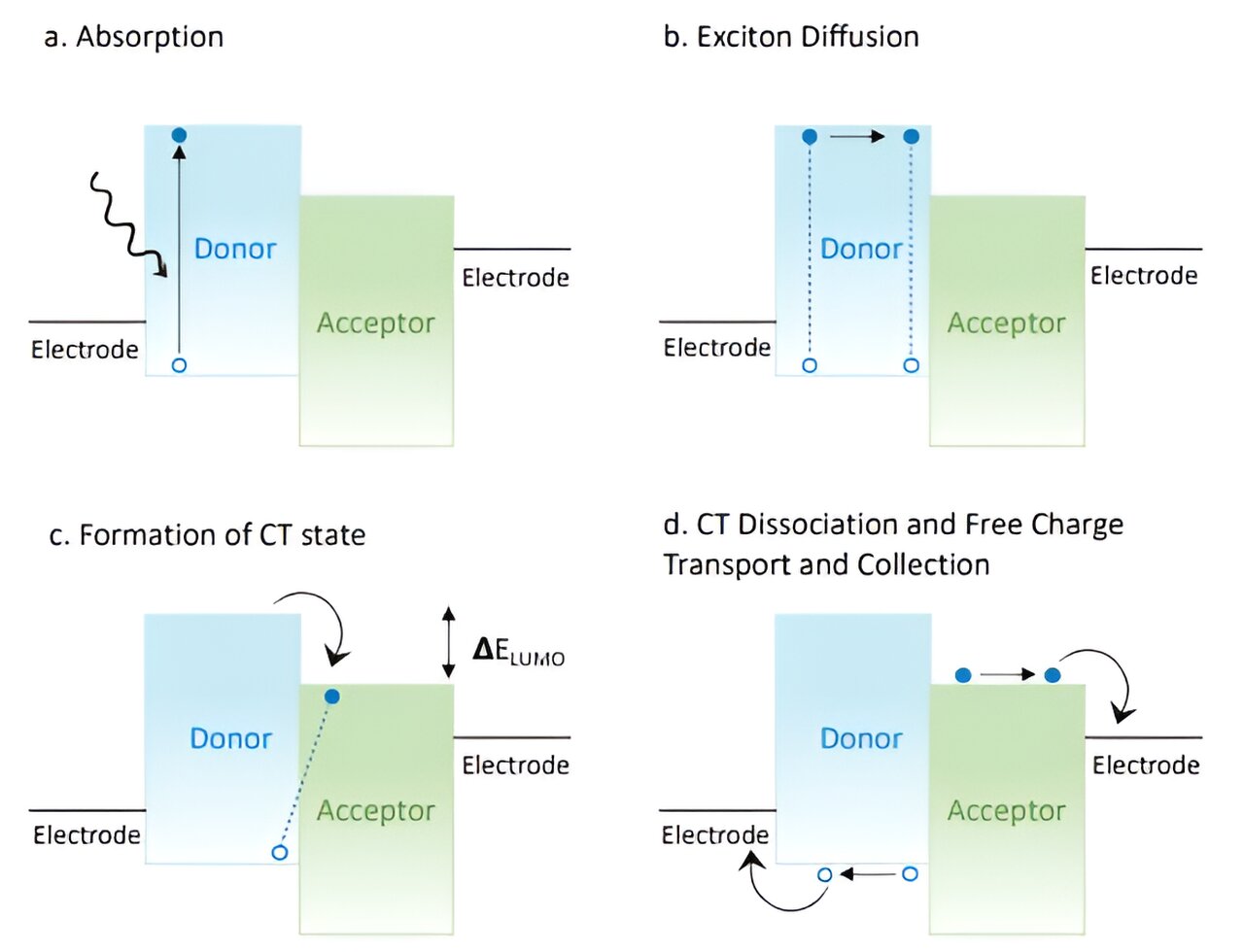
The idea is to create materials that can conduct electrical current by mixing the right molecules in a solvent that you spread out in a thin layer, which then is left to dry. This is how organic solar cells are created. Two different kinds of molecules are needed—those that donate electrons and those that accept them.
The doctoral thesis focuses on a molecular understanding of the thin polymer blend film that constitutes the active surface of the organic solar cell. In order to gain a deeper understanding of the phase separation of the polymers in the active layer, the processes were filmed in microgravity conditions, when the phase separation is slower.
Steep climbs and free falls
Solar cell researchers from Karlstad University conducted these experiments in zero gravity during parabolic flights in Bordeaux, France. When you remove gravity, structure formation slows down. This makes it possible to more closely study how the structure of the material changes. The flight begins with a steep climb, followed by a free fall where gravity is close to zero for a brief moment. During this time, the experiment can be completed without being affected by gravity.
“We have examined how the active layer is formed in microgravity conditions, says Ishita Jalan. Understanding and controlling that process, we can find an easier and more controlled way of manufacturing efficient polymer solar cells. Further research is needed in order to understand the complex effects of gravitational variations, as well as to eliminate any doubts regarding the process of drying the wet film during the microgravity phase.”
Huge solar energy potential
Effective and environmentally friendly solar cells are part of the solution for eliminating fossil fuel dependency. Currently, solar energy accounts for just a small percentage of energy consumption worldwide. However, if we could transform all solar energy that reaches our sun during just one hour into electricity, it would cover the entire planet’s energy consumption for approximately a year. In order to replace other energy sources, we need efficient, environmentally friendly solar cells that are cheap to manufacture.
“I’m from Kolkata in India, but moved to Great Britain where I received my Bachelor’s Degree in Chemistry at University of Manchester,” says Ishita Jalan. “I continued with my master’s studies at University of Rochester in the US. I met Professor Jan van Stam at a conference and decided to apply for a doctoral appointment at Karlstad University, since the research conducted here is very relevant and something I want to be a part of.”
More information:
Solution Chemistry and Morphological Properties for Organic Solar Cells. kau.diva-portal.org/smash/get/ … 49633/FULLTEXT02.pdf
Swedish Research Council
Read the full article here


