


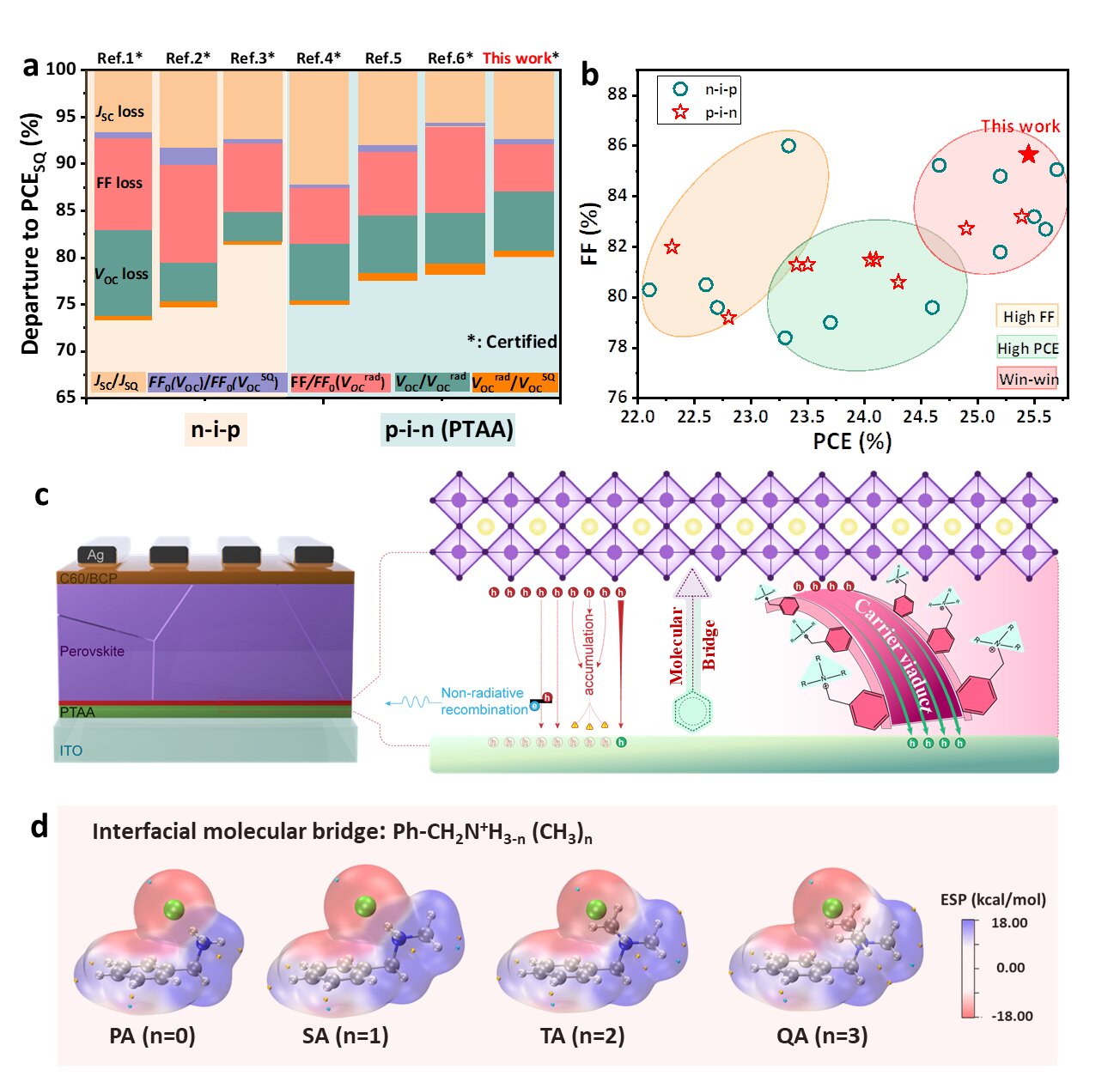
Recently, a research team by Professor Pan Xu from Institute of Solid-State Physics, Hefei Institutes of Physical Science (HIPS) of Chinese Academy of Sciences (CAS) proposed a novel strategy to enhance the performance of perovskite solar cells. Their strategy involves the creation of a robust connection between different layers of the solar cell using a molecular bridge made of ammonium cations.
The results were published in Energy & Environmental Science.
Perovskite solar cells have garnered considerable attention due to their remarkable power conversion efficiencies, which have surpassed 25%. Nevertheless, there remains ample room for improvement, particularly in terms of enhancing the fill factor (FF) of these devices. The FF represents the capacity of a solar cell to deliver maximum current under optimal conditions, and any advancements in this area are highly sought after.
To overcome the limitations associated with FF, the team focused on optimizing the bottom interface of the solar cell. They ingeniously developed a strategy to redistribute localized electrostatic potential by employing ammonium cations as a molecular bridge with various degrees of substitution.
The key to this strategy lies in creating a strong connection between different layers of the solar cell using a molecular bridge made of ammonium cations. The researchers used ammonium cations with different degrees of substitution as the molecular bridge to create a robust connection between layers.
Theoretical analyses revealed that the molecular bridge molecules helped flatten the localized potential and establish efficient contacts between layers. Experimental results showed that the robust bottom interface improved the extraction and transport of photo-generated carriers, enhancing overall device performance.
The interfacial molecular bridge strategy presented in this work could potentially offer a fresh optimization direction for top-performing perovskite solar cells and propel them towards commercialization. By addressing the limitations associated with the FF, this research contributes to the ongoing development of high-performance perovskite solar cells and their potential widespread use in clean energy generation.
More information:
Huifen Xu et al, Constructing robust heterointerfaces for carrier viaduct via interfacial molecular bridges enables efficient and stable inverted perovskite solar cells, Energy & Environmental Science (2023). DOI: 10.1039/D3EE02591H
Chinese Academy of Sciences
Read the full article here


