


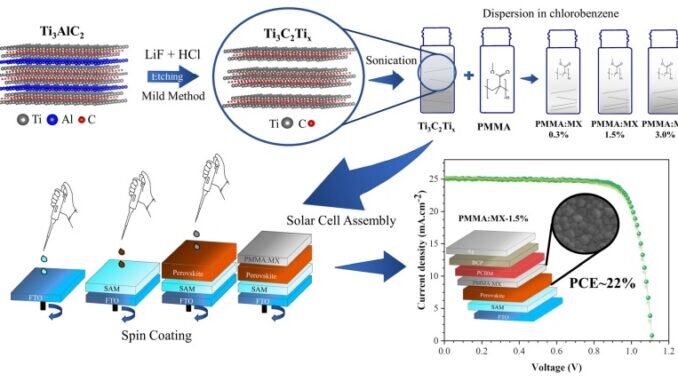
In an article published in the Journal of Materials Chemistry C, Brazilian researchers describe a strategy to enhance the efficiency and stability of solar cells made of perovskite, a semiconductor material produced in the laboratory. The results of the project could be highly positive for the future of the solar power sector.
Developed by researchers at São Paulo State University (UNESP) in Bauru, Brazil, the method involves the use of a class of materials known as MXenes, a family of two-dimensional materials with a graphene-like structure combining transition metals, carbon and/or nitrogen, and surface functional groups such as fluoride, oxygen or hydroxyl. Their properties include high electrical conductivity, good thermal stability, and high transmittance (relating to the amount of light that passes through a substance without being reflected or absorbed).
In the study, the MXene Ti3C2Tx was added to polymethyl methacrylate (PMMA) to form a passivation coating, which was spin-coated on top of the perovskite layer of inverted solar cells. Passivation coatings are designed to mitigate possible defects in polycrystalline solids (perovskite in this case) due to interaction with the environment or to their internal structure.
Perovskite solar cells have a layered structure, and the order of layers (architecture) is crucial to their performance. In an inverted solar cell, the architecture of the device is reversed to ensure high optical transparency as sunlight reaches the perovskite layer.
The use of Ti3C2Tx increased the cells’ power conversion efficiency from 19% to 22%. It also increased the stability of the cells, which lasted three times longer with no performance impairment compared to control cells (without the passivation layer).
For João Pedro Ferreira Assunção, first author of the article and a master’s candidate under UNESP’s program of graduate studies in materials science and technology, the results were surprising because the initial aim of the project was merely to remediate the drop in performance caused by addition of the insulating passivation layer.
Research on perovskite solar cells is currently focusing on how to devise large-scale industrial production systems to make stable high-performance cells.
“The article shows that addition of the MXene can be feasible under mass production conditions, and points to a way of achieving this. It also describes several electrical, morphological and structural characterization techniques that we explored to increase the scientific understanding of how this complex class of devices behaves and functions,” Assunção said.
The study is a promising step toward the sustainability goals of producing clean energy, mitigating environmental impact, and making Brazil a leading industrial producer of solar cells, he added.
More information:
João Pedro F. Assunção et al, Interface passivation with Ti3C2Tx-MXene doped PMMA film for highly efficient and stable inverted perovskite solar cells, Journal of Materials Chemistry C (2023). DOI: 10.1039/D3TC03810F
Read the full article here


