


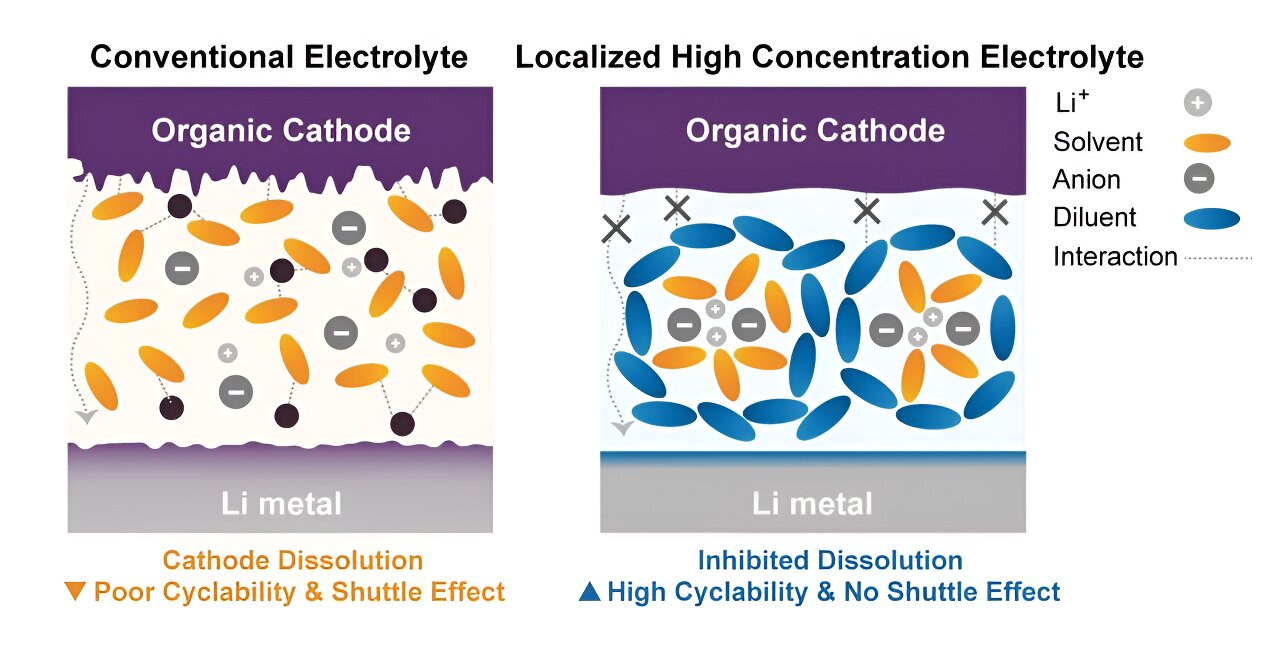
In a recent study, researchers have pioneered a method to significantly enhance the performance and lifespan of organic electrode-based batteries. The findings promise to accelerate the commercialization of eco-friendly batteries and pave the way for further advancements in the field.
Organic electrodes have long been recognized for their cost-effectiveness and natural abundance, making them a promising alternative to traditional lithium-ion battery materials. However, the dissolution of these active materials in the electrolyte has posed a significant challenge, limiting their practical application in batteries. To address this issue, the research team introduced diluted electrolytes as non-solvating electrolytes, effectively mitigating the physical limitations of high-concentration electrolytes (HCEs) and suppressing the dissolution of organic electrodes.
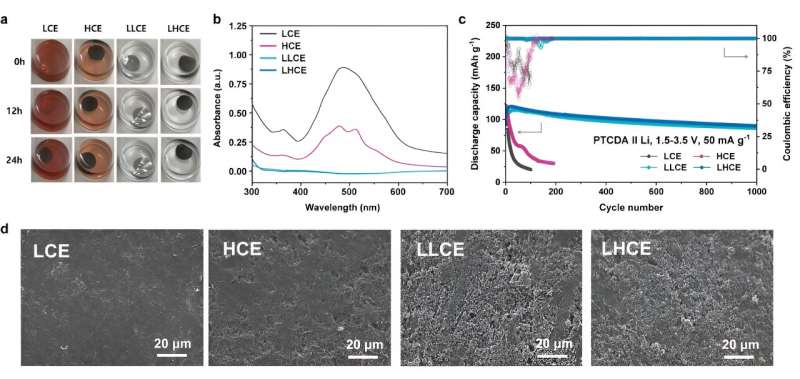
The study focused on perylene-3,4,9,10-tetracarboxylic dianhydride (PTCDA), a prominent organic electrode material, and demonstrated remarkable improvements in capacity retention and rate performance when using diluted electrolytes. Over 1,000 cycles, the PTCDA-based battery achieved an impressive 91% capacity retention at 1,000 mA g−1.
Through a combination of electrochemical and spectroscopic measurements, as well as molecular dynamics simulations, the team successfully inhibited the dissolution of the active material and mitigated the detrimental shuttle effect, thereby preventing capacity loss.
This research presents a promising strategy for achieving highly reversible organic electrode-based lithium-ion batteries, opening up new possibilities for the development of more efficient and sustainable energy storage solutions. By utilizing non-solvating electrolytes, the team has overcome the limitations associated with organic electrode materials and demonstrated a path toward extending the lifespan of these eco-friendly batteries.
The research involved professor Won-Jin Kwak in the School of Energy and Chemical Engineering at UNIST in collaboration with researchers from Hanyang University. Professor Kwak stated, “The development of non-solvating electrolytes provides an effective approach to suppress the elution of organic electrode materials, without compromising capacity or output. This study represents a major step towards practical applications of organic electrode-based batteries.”
The research team further validated their findings through computational methods and experimental verification, confirming that the use of the developed electrolyte led to the effective suppression of elution. In more than 1,000 charge/discharge experiments, more than 80% of the battery capacity was retained, in sharp contrast to conventional electrolytes, which exhibited less than 50% capacity after just 20 charge/discharge cycles.
More information:
Hyun‐Wook Lee et al, Diluents Effect on Inhibiting Dissolution of Organic Electrode for Highly Reversible Li‐Ion Batteries, Advanced Energy Materials (2023). DOI: 10.1002/aenm.202303033
Ulsan National Institute of Science and Technology
Read the full article here


