


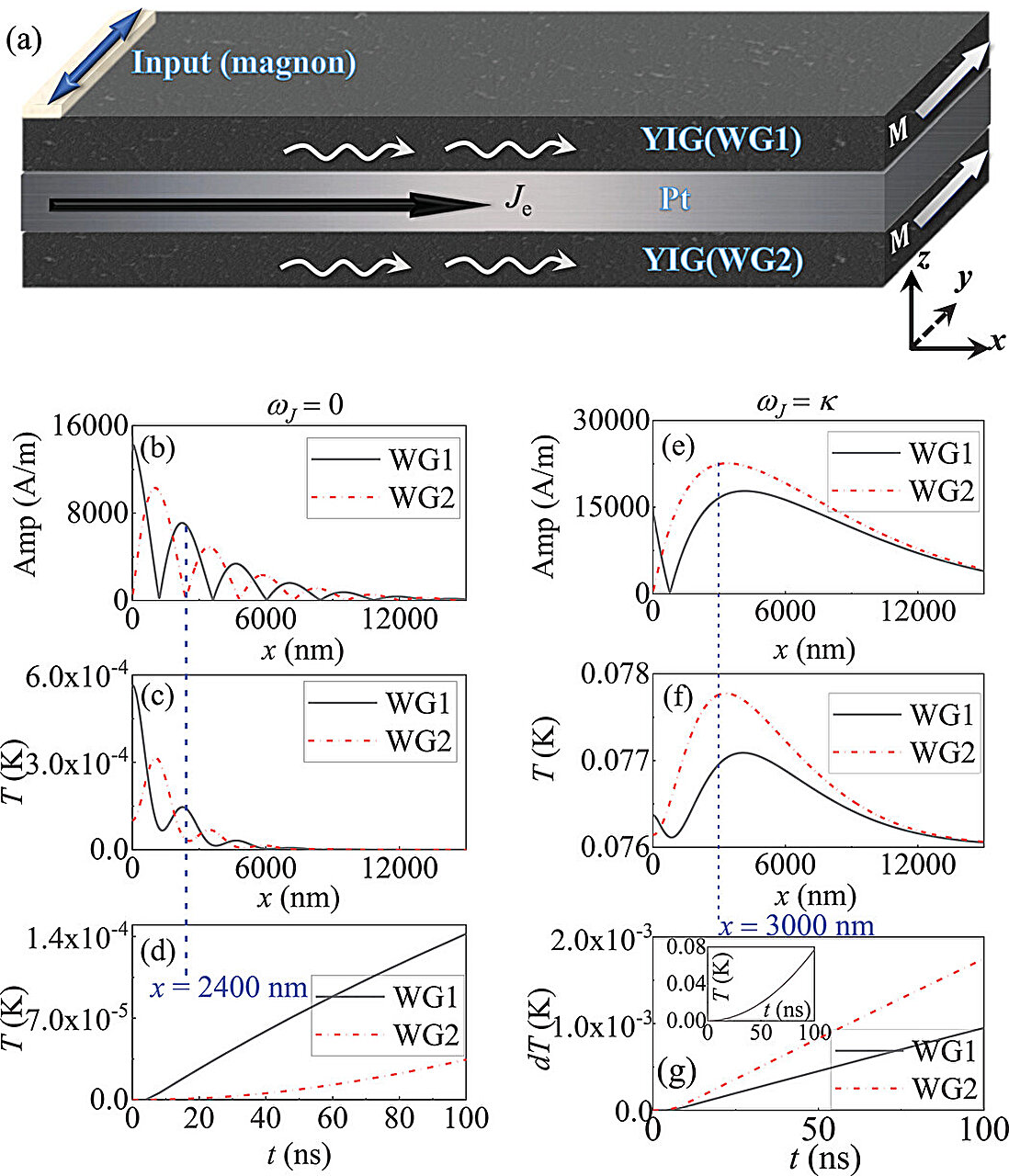
Physicists at Martin Luther University Halle-Wittenberg (MLU) and Central South University in China have demonstrated that, by combining specific materials, heat in technical devices can be used in computing. Their discovery is based on extensive calculations and simulations. The new approach demonstrates how heat signals can be steered and amplified for use in energy-efficient data processing. The team’s research findings have been published in the journal Advanced Electronic Materials.
Electric current flow heats up electronic devices. The generated heat is dissipated and energy is lost. “For decades, people have been looking for ways to re-use this lost energy in electronics,” explains Dr. Jamal Berakdar, a professor of physics at MLU. This is extremely challenging, he says, due to the difficulty in directing and controlling accurately heat signals. However, both are necessary if heat signals are to be used to reliably process data.
Berakdar carried out extensive calculations together with two colleagues from Central South University in China. The idea: instead of conventional electronic circuits, non-conductive magnetic strips are used in conjunction with normal metal spacers. “This unusual combination makes it possible to conduct and amplify heat signals in a controlled manner in order to power logical computing operations and heat diodes,” explains Berakdar.
One disadvantage of the new method, however, is its speed. “This method does not produce the kind of computing speeds we see in modern smartphones,” says Berakdar. That is why the new method is currently probably less relevant for use in everyday electronics and is better suited for next-generation computers which will be used to perform energy-saving calculations.
“Our technology can contribute to saving energy in information technology by making good use of surplus heat,” Berakdar concludes.
More information:
Xi‐guang Wang et al, PT‐Symmetry Enabled Spintronic Thermal Diodes and Logic Gates, Advanced Electronic Materials (2023). DOI: 10.1002/aelm.202300325
Martin Luther University Halle-Wittenberg
Read the full article here


