


Researchers of Karlsruhe Institute of Technology (KIT) and the SMS group have developed a new process to reduce CO2 emission of worldwide steel production by several hundred million tons per year. It is based on modernizing blast furnace technology with moderate investments and has already been demonstrated successfully in a pilot plant. The researchers report their results in Energy Advances.
About eight percent of worldwide CO2 emissions are produced by the steel industry. “This must be changed quickly,” says Professor Olaf Deutschmann from KIT’s Institute for Chemical Technology and Polymer Chemistry (ITCP). He admits that new hydrogen technologies may open up a climate-neutral perspective in the long term. But it will take several years until a sufficient amount of green hydrogen will be available worldwide and new plants will start operation.
“We are running out of time in this climate crisis, and we have to take countermeasures now.” A new process developed by Deutschmann’s research team in cooperation with the SMS group, Paul Wurth Entwicklungen, and KIT’s startup omegadot has now proved to be effective in conventional plants. “The potential is very high. We expect that backfitting existing blast furnaces with moderate investments will reduce worldwide direct CO2 emissions by two to four percent,” Deutschmann says.
New process reduces emissions and saves energy
The new process departs from iron. This raw material is contained in oxidized form in ores and extracted by means of reduction, i.e. the removal of oxygen, with coke in a blast furnace. Coke does not only produce the energy required for melting, but also serves as a reducing agent in the chemical reaction.
“For this special purpose, coke is produced from fossil coal in a highly energy-consuming process,” says Philipp Blanck from ITCP, who cooperated closely with the SMS group at the pilot plant that was part of the steelworks. “In our process, we recycle CO2 from the furnace gas using coke oven gas. This yields a synthesis gas with a large hydrogen fraction that can be used as a coke substitute in the blast furnace.
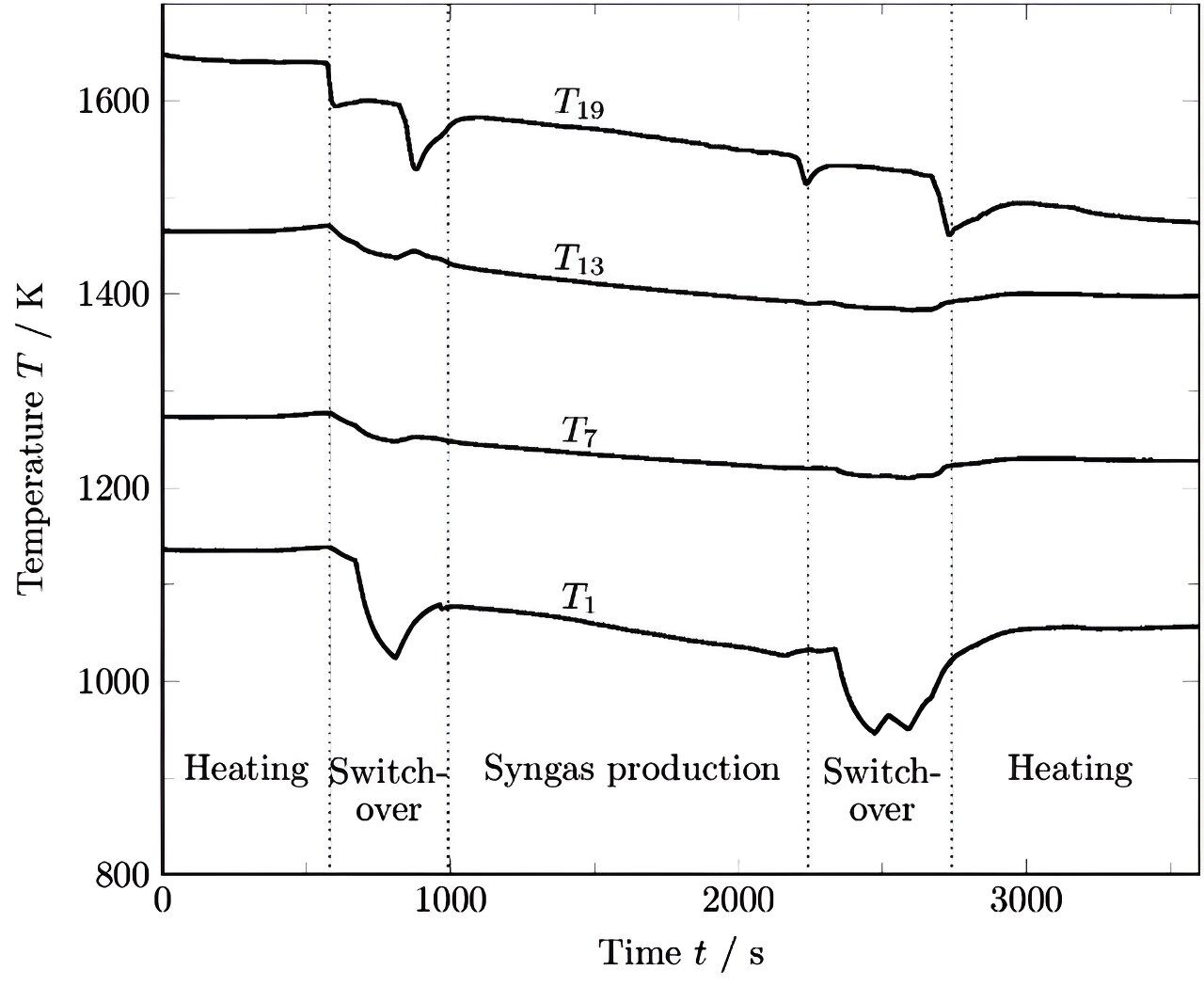
For backfitting an existing plant, the Cowper heaters must be modified. Then, methane and CO2 from the coke oven gas and CO2 from the blast furnace gas are converted into synthesis gas, a mix of hydrogen and carbon monoxide. This process, so-called dry reforming, requires a high temperature that is mainly taken from the process heat of the blast furnace.
The synthesis gas is then blown into the blast furnace to support iron oxide reduction there. “Per ton of steel produced, significant amounts of coke can be saved. Specific CO2 emissions are reduced by up to twelve percent,” Blanck says.
Successful demonstration in cooperation with industry partners
The process was demonstrated and validated at Dillinger Hüttenwerke, Saarland, in cooperation with omegadot software & consulting GmbH, a startup of KIT. omegadot has developed software for the precise simulation and visualization of the process and for supporting scale-up to an industrial plant.
The pilot plant in Dillingen is operated by the SMS group together with Dillinger Hüttenwerke and Saarstahl. Operation is aimed at producing steel with reduced CO2 emissions. “Integration of the new process in the steelworks is the first step in the transformation of the steel industry,” says Gilles Kass from the Research Section of SMS group, co-author of the publication.
More information:
Philipp Blanck et al, Dry reforming of steelworks off-gases in a pilot plant integrated into a steel mill: influence of operating parameters, Energy Advances (2023). DOI: 10.1039/D3YA00227F
Karlsruhe Institute of Technology
Read the full article here


