


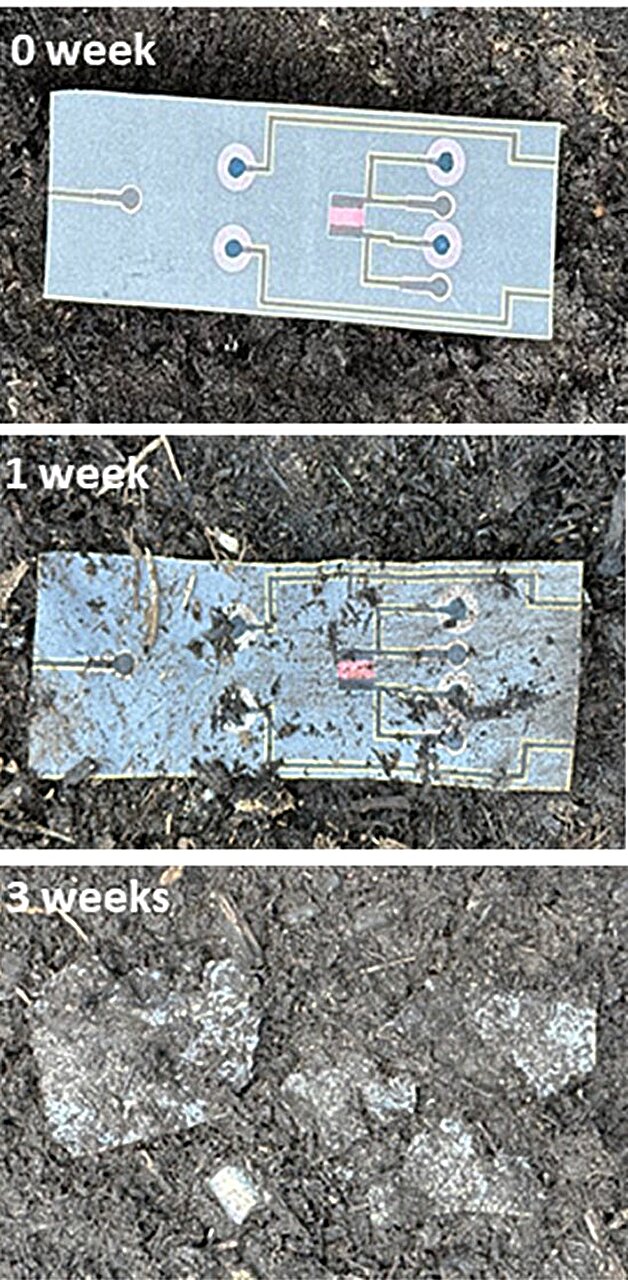
As the Internet of Things connects more devices into a collective network—even single-use sensors like food packaging, agriculture or “smart bandages”—the need for biodegradable electronics grows increasingly urgent.
Binghamton University Professor Seokheun “Sean” Choi sought to investigate his ideas about integrated papertronics. A new research paper published in Advanced Sustainable Systems reports his latest findings—and they could revolutionize how we monitor the world around us.
“The biggest problem with paper for electronics is that the paper is highly porous and rough,” said Choi, a faculty member in the Thomas J. Watson College of Engineering and Applied Science’s Department of Electrical and Computer Engineering. “These properties are very helpful for paperfluidics, because those devices require high surface area and roughness—but for electronics, they pose a critical challenge.”
To mitigate some of those issues, most previous papertronics have used laminated paper with electronic components affixed to them. That method maintains the flexibility that paper has but does not fully utilize what the material offers.
Choi worked with Ph.D. students Zahra Rafiee and Anwar Elhadad as part of the Bioelectronics and Microsystems Laboratory to develop a solution that takes advantage of paper’s attributes, combining functional inks, the capillary action that distributes the inks within the paper, and hydrophobic wax patterns that form the boundaries for the circuits.
The fully integrated tunable resistors, capacitors and transistors become part of the paper substrates, enabling the fabrication of complete paper circuits. The foldability and stackability allows for multilayered printed circuit boards, and all of it is biodegradable.
Choi said this new manufacturing method is a major improvement over the last iteration of printed paper circuit boards in 2022: “We integrated all these components into a single sheet of paper. It was flexible and disposable, but the problem is that all three components are not widely tunable. We couldn’t have specific resistance values or capacitor values. We also had to use some nonbiodegradable material.”
While Choi and his team have made a lot of progress, they already are thinking about the next steps for making their papertronics ready for wider use.
“We need to think of some packaging techniques to encapsulate our device for long-term operation,” he said. “We also are creating other types of electronic components like inductors, diodes or displays. We need to improve the density and performance, too.”
More information:
Zahra Rafiee et al, Revolutionizing Papertronics: Advanced Green, Tunable, and Flexible Components and Circuits, Advanced Sustainable Systems (2024). DOI: 10.1002/adsu.202400049
Binghamton University
Read the full article here


