


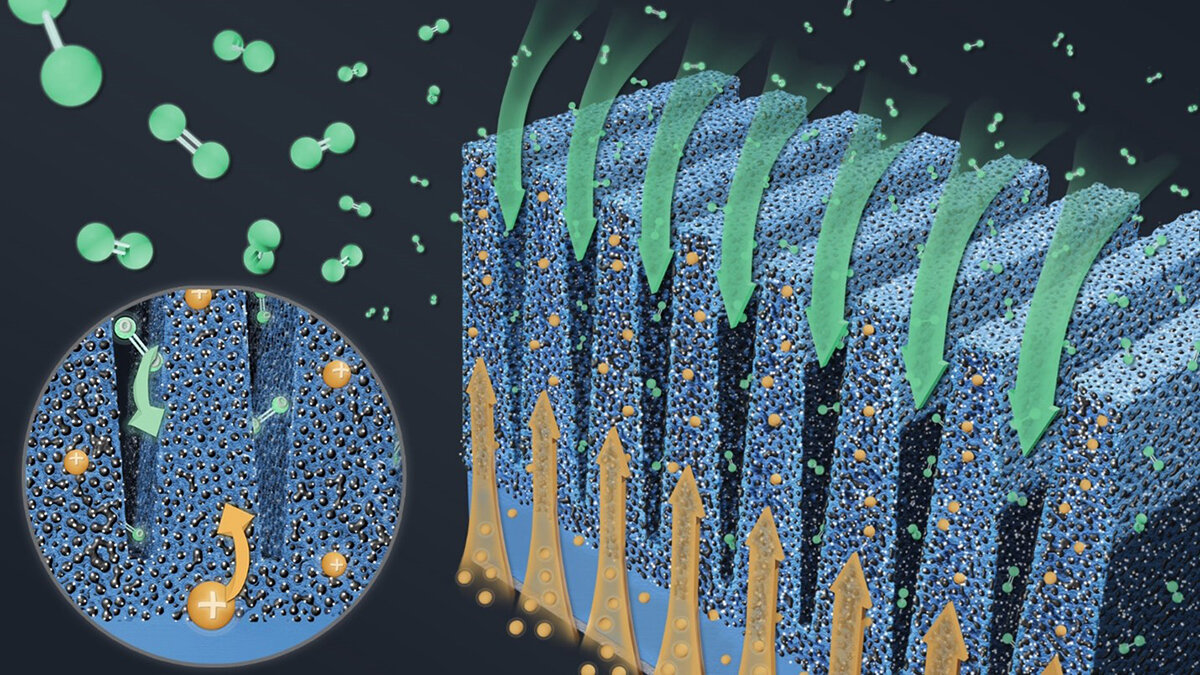
Promising new hydrogen fuel cell technology has up to 50% higher performance than current state-of-the-art technology, with improved durability. The grooved electrode design advance may help optimize next-generation fuel cell technology to power emission-free medium- and heavy-duty transportation.
“We had a theory that by reimagining the way electrodes are designed we could achieve improved performance,” said Jacob Spendelow, materials scientist with the Los Alamos National Laboratory team that described its results in the journal Nature Energy. “One of our biggest takeaways is that novel materials are not the only route to improve performance. The way the materials are put together can be equally important.
“All we did was take conventional commercially available materials and change the way we put them together to change the microscale architecture, and that resulted in substantially higher performance.”
Hydrogen fuel cells—and specifically a version of the technology called proton exchange membrane fuel cells—represent an emission-free engine design that uses hydrogen as a fuel. Fuel cells could transform the medium- and heavy-duty transportation sector, which has been difficult to decarbonize.
Design promotes efficiency and durability
In a fuel cell device, hydrogen and oxygen are reacted electrochemically to produce an electric current capable of powering an external device, such as an electric motor. The electrochemical reactions occur within the fuel cell electrodes, which include a platinum-based catalyst to enable the reaction and an ion-conducting polymer (ionomer) to transport the protons needed to complete the reaction.
Spendelow and colleagues developed a grooved electrode design that improves the efficiency with which oxygen and protons are transported through the device. The team fabricated the device at the Laboratory’s Center for Integrated Nanotechnologies, using photolithography and deep reactive ion etching at the micrometer scale (one-thousandth of one millimeter) to pattern silicon templates for electrode fabrication. The resulting electrode consists of catalyst ridges with high ionomer content separated by empty grooves, which protons and oxygen use as pathways to move through the system more efficiently.
The team’s diagnostics, combined with multiphysics modeling and simulations, demonstrated the improved oxygen transport. Machine learning also offered opportunities to guide the calculations of the multiphysics modeling, saving computing time. Notably, grooved electrodes also improved durability, even after carbon corrosion.
A history of innovation
The grooved electrode approach is one of several novel fuel cell designs on which the Los Alamos fuel cell program has embarked.
“The original fuel cell membrane electrode assembly was invented at Los Alamos more than 30 years ago, but the fuel cell design used today has barely changed,” said Spendelow. “This grooved electrode is one of the first alternative electrodes that can replace the historic Los Alamos electrode.”
The fuel cell team will continue to develop the grooved electrode design, especially looking to engage with manufacturing-specific research and development. Scaling up the fabrication to deploy it in a roll-to-roll manufacturing facility, with high-speed and low-cost manufacturing, is a long-term goal.
More information:
ChungHyuk Lee et al, Grooved electrodes for high-power-density fuel cells, Nature Energy (2023). DOI: 10.1038/s41560-023-01263-2
Los Alamos National Laboratory
Read the full article here


