


All-solid-state batteries (ASSBs)—battery technologies with solid electrodes and solid electrolytes—have become the focus in an increasing number of research studies. This is primarily because they could significantly outperform batteries with liquid or polymer-based electrolytes both in terms of safety and power density.
One of the most promising solid material combinations for ASSBs is sulfide solid electrolytes and lithium (Li) metal anodes. While operating, however, Li metal anodes can rapidly lose their capacity and stop functioning properly, due to the growth of dendrites and interfacial chemical reactions.
Researchers at the Tianmu Lake Institute of Advanced Energy Storage Technologies, the Chinese Academy of Sciences, and other institutes in China recently created new Li–Si anodes that could help to improve the performance of ASSBs, reducing their risk of failure. These anodes, introduced in a paper published in Nature Energy, can suppress the growth of lithium dendrites, stabilizing the battery cycling in the long-term.
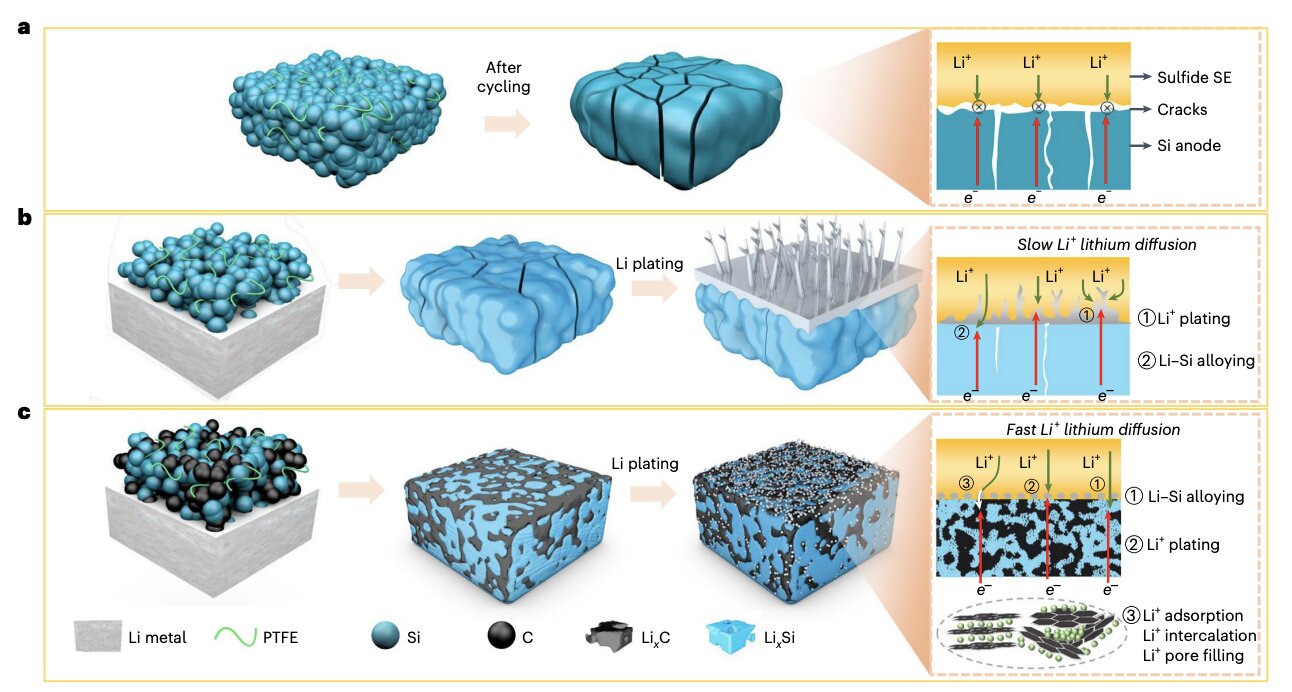
“ASSBs with Li metal anodes or Si anodes are promising candidates to achieve high energy density and improved safety, but they suffer from undesirable lithium dendrite growth or huge volume expansion, respectively,” Wenlin Yan, Zhenliang Mu, and their colleagues wrote in their paper.
“We synthesize a hard-carbon-stabilized Li–Si alloy anode in which sintering of Si leads to the transformation of micro-meter particles into dense continuum. A 3D ionic-electronic-conductive network composed of plastically deformable Li-rich phases (Li15Si4 and LiC6) that enlarges active area and relieves stress concentration is created in the anode, leading to improved electrode kinetics and mechanical stability.”
The researchers created their anode via a simple press-induced reaction between a Si-contained film and Li foil. They then tested its performance in a series of simulations and experiments, integrating them in cells with one of two different cathodes, as well as an electrolyte based on Li6PS5Cl.
“With the hard-carbon-stabilized Li–Si anode, full cells using LiCoO2 or LiNi0.8Co0.1Mn0.1O2 cathodes and Li6PS5Cl electrolyte achieve favorable rate capability and cycle stability,” Yan, Mu and their colleagues wrote.
“In particular, the ASSB with LiNi0.8Co0.1Mn0.1O2 at high loading of 5.86 mAh cm−2 delivers 5,000 cycles at 1 C (5.86 mA cm−2), demonstrating the potential of using hard-carbon-stabilized Li–Si alloy anodes for practical applications of ASSBs.”
In initial tests, the carbon-stabilized Li–Si anode created by this team of researchers appeared to perform very well, effectively suppressing the growth of dendrites and improving the current density of ASSBs. Compared to other solid material-based anodes introduced in the past, it could also be more stable and attain a better electrochemical performance.
In the future, this recent study and the new anode it has introduced could inspire the creation of other promising and highly performing components for ASSBs. Collectively, these research efforts could contribute to the commercialization of ASSBs, which could have important implications for the large-scale deployment of electric vehicles and other cutting-edge technologies.
More information:
Wenlin Yan et al, Hard-carbon-stabilized Li–Si anodes for high-performance all-solid-state Li-ion batteries, Nature Energy (2023). DOI: 10.1038/s41560-023-01279-8
© 2023 Science X Network
Read the full article here


