


Networked intelligent devices and sensors can improve the energy efficiency of consumer products and buildings by monitoring their consumption in real time. Miniature devices like these being developed under the concept of the Internet of Things require energy sources that are as compact as possible in order to function autonomously.
Monolithically integrated batteries that simultaneously generate, convert, and store energy in a single system could be used for this purpose.
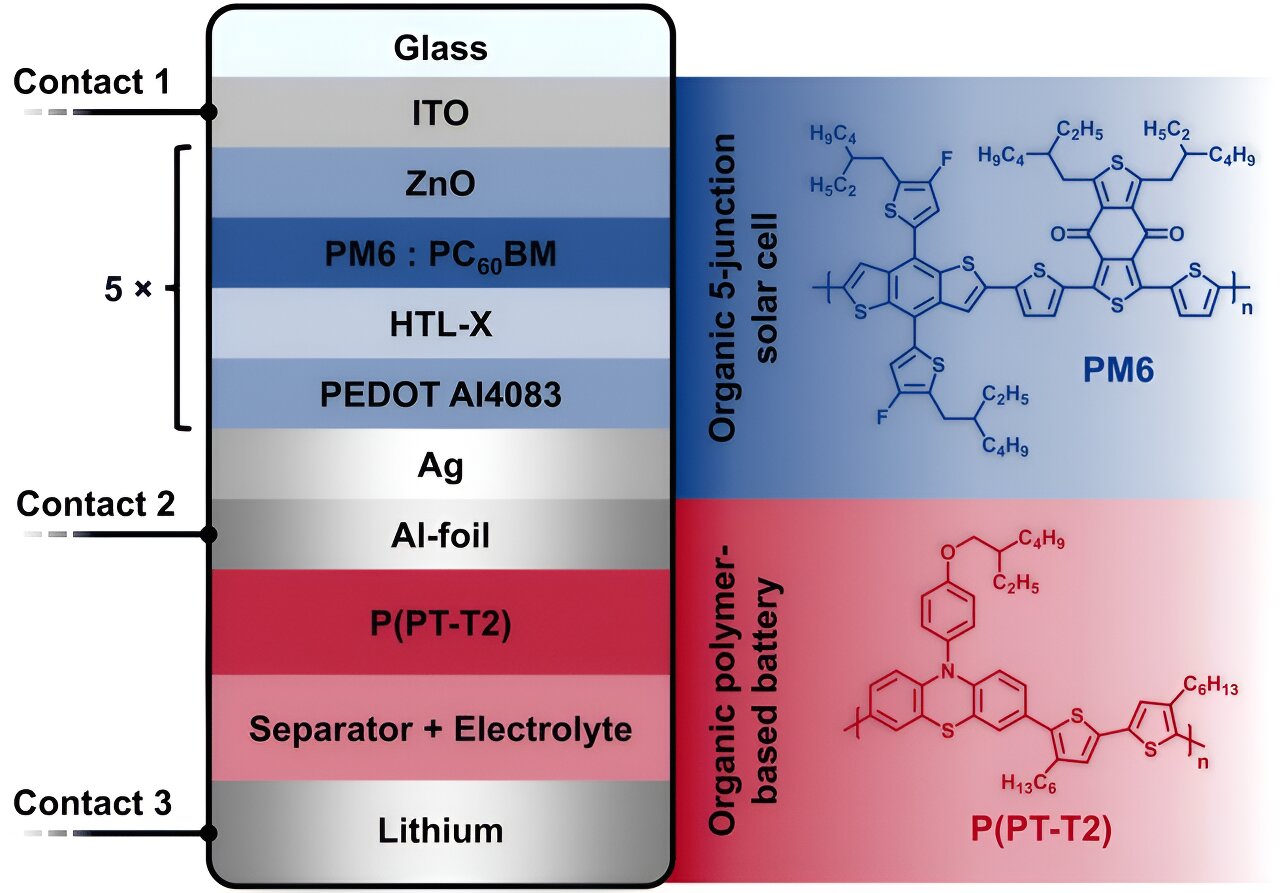
A team of scientists at the University of Freiburg’s Cluster of Excellence Living, Adaptive, and Energy-Autonomous Materials Systems (livMatS) has developed a monolithically integrated photo battery consisting of an organic polymer-based battery and a multi-junction organic solar cell.
The battery, presented by Rodrigo Delgado Andrés and Dr. Uli Würfel, University Freiburg, and Robin Wessling and Prof. Dr. Birgit Esser, University of Ulm, is the first monolithically integrated photo battery made of organic materials to achieve a discharge potential of 3.6 volts. It is thus among the first systems of this kind capable of powering miniature devices. The team published their results in the journal Energy & Environmental Science.
Combination of a multi-junction solar cell and a dual-ion battery
The researchers developed a scalable method for the photo battery which allows them to manufacture organic solar cells out of five active layers.
“The system achieves relatively high voltages of 4.2 volts with this solar cell,” explains Wessling. The team combined this multi-junction solar cell with a so-called dual-ion battery, which is capable of being charged at high currents, unlike the cathodes of conventional lithium batteries.
With careful control of illumination intensity and discharge rates, a photo battery constructed in this way is capable of rapid charging in less than 15 minutes at discharge capacities of up to 22 milliampere hours per gram (mAh g-1). In combination with the averaged discharge potential of 3.6 volts, the devices can provide an energy density of 69 milliwatt hours per gram (mWh g-1) and a power density of 95 milliwatts per gram (mW g-1).
“Our system thus lays the foundation for more in-depth research and further developments in the area of organic photo batteries,” says Wessling.
More information:
Rodrigo Delgado Andrés et al, Organic photo-battery with high operating voltage using a multi-junction organic solar cell and an organic redox-polymer-based battery, Energy & Environmental Science (2023). DOI: 10.1039/D3EE01822A
University of Freiburg
Read the full article here


