


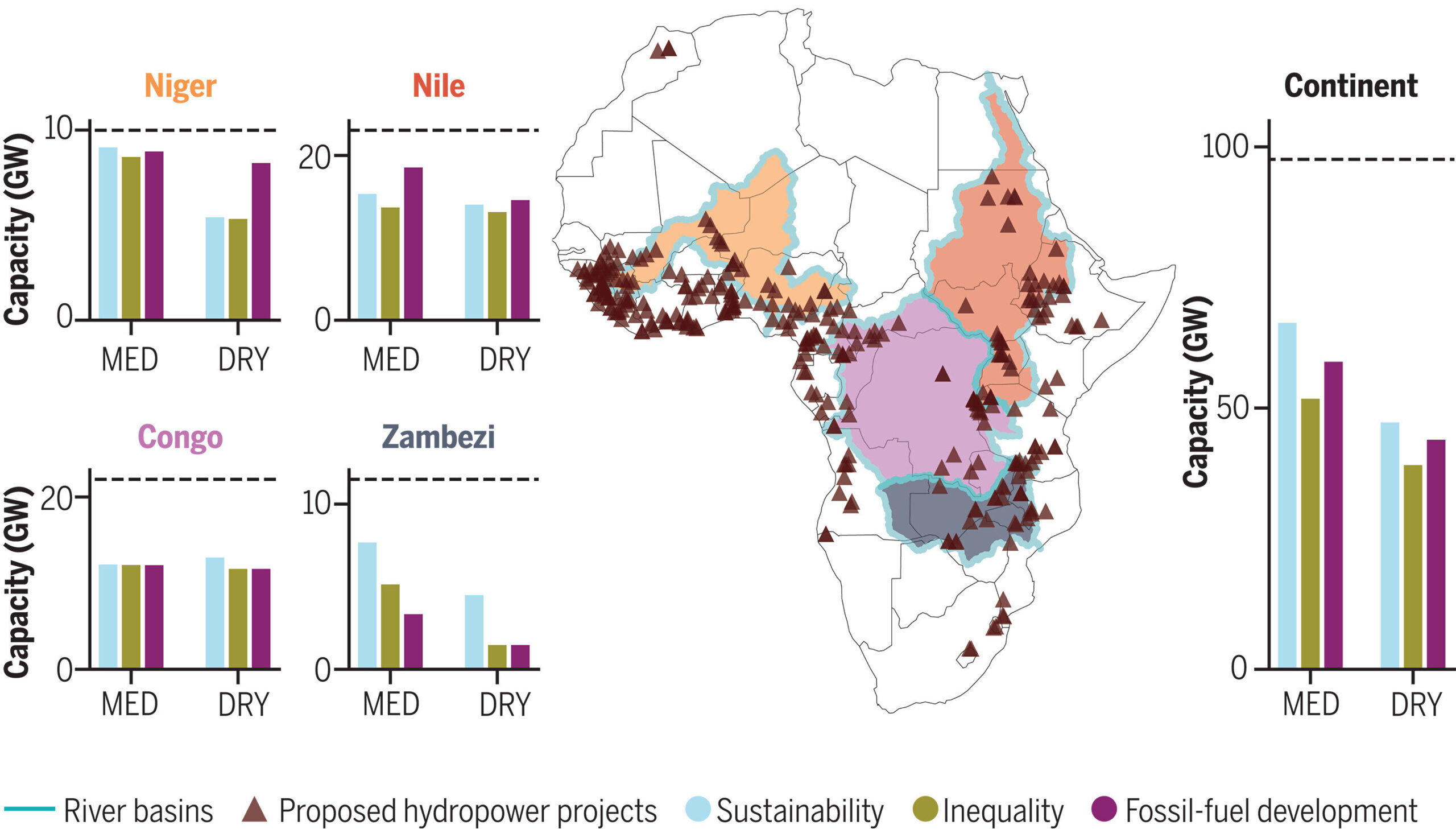
A team of hydrologists and bioengineers affiliated with several institutions across Europe has found, via modeling, that building dams to generate hydroelectricity in Africa may be not be a cost-effective approach in light of falling costs for solar and wind power. In their study, reported in the journal Science, the group developed models projecting energy needs up to the year 2050.
Currently, Africa’s energy needs are provided mostly by fossil fuels—up to 70% comes from burning coal, gas or diesel fuel. Africa is also in transition, as areas without electricity seek to join the grid. That, plus a growing population, suggest that Africa is going to require a lot more electricity in the coming years.
Fortunately for the planet, most countries in Africa have pledged to reduce carbon emissions. And most have suggested that the way to achieve that goal is to build more dams to produce more hydroelectricity. But that approach might not be the most sensible one, according to work by the team on this new effort.
Noting the falling costs for producing electricity using solar or wind, the team wondered if they might now be more cost-effective than building dams. To find out, the group collected data from a host of agencies regarding projected energy demands across the continent in the coming years. They also obtained data regarding the costs of building and maintaining hydro dams and solar- and wind-power-generating projects.
They then input the data into several models, adding other information such as population growth statistics and projected rainfall in the coming decades. They ran their models under several scenarios to provide comparisons of cost-effectiveness of building hydroelectric facilities versus solar and wind projects. The different scenarios involved such things as fluctuations in the cost of fossil fuels, changes in amount of rainfall, and increases in atmospheric temperatures.
The research team found that under most scenarios, building new hydroelectric facilities was not as cost-effective as building new wind and solar facilities. As an example, they found that under the most optimistic conditions, approximately a third of all the hydro-facilities currently planned will likely be uneconomical compared to renewables by the time construction starts.
More information:
Angelo Carlino et al, Declining cost of renewables and climate change curb the need for African hydropower expansion, Science (2023). DOI: 10.1126/science.adf5848
© 2023 Science X Network
Read the full article here


