


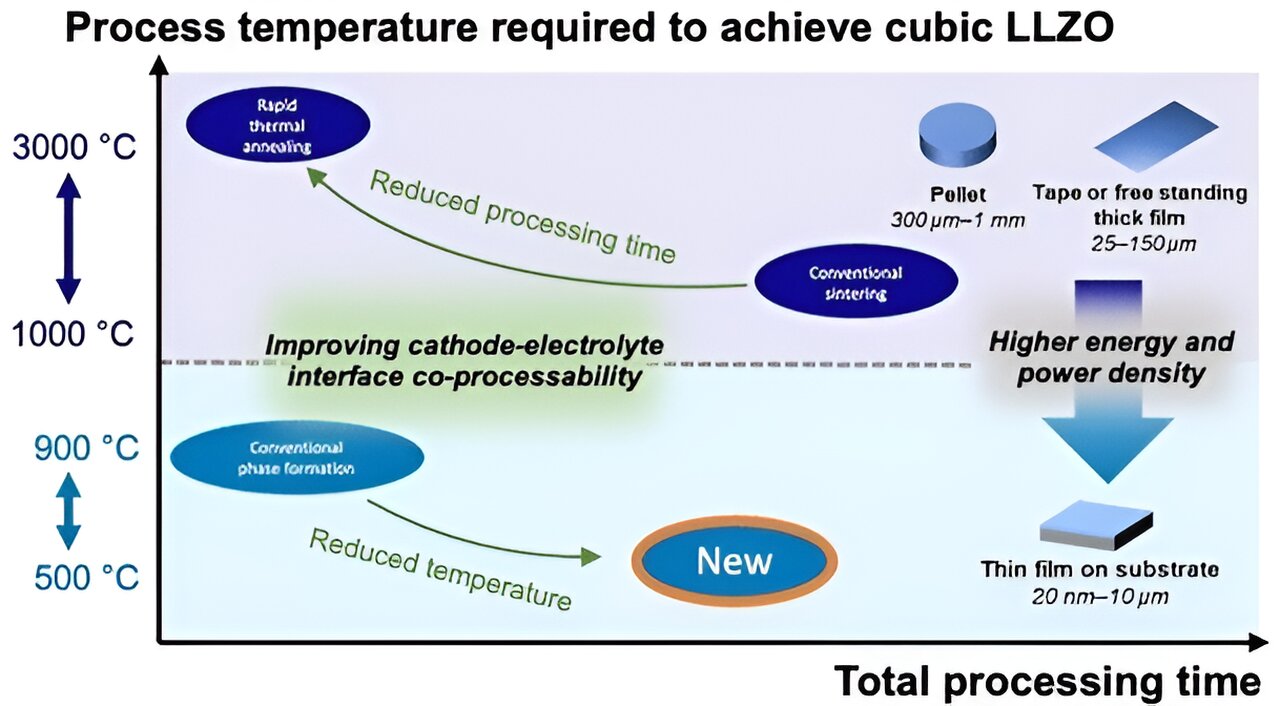
A lithium ceramic could act as a solid electrolyte in a more powerful and cost-efficient generation of rechargeable lithium-ion batteries. The challenge is to find a production method that works without sintering at high temperatures. In the journal Angewandte Chemie, a research team has now introduced a sinter-free method for the efficient, low-temperature synthesis of these ceramics in a conductive crystalline form.
Two factors dominate the development of batteries for electric vehicles: power, which determines the vehicle range; and cost, which is critical in the competition with internal combustion engines.
The US Department of Energy aims to accelerate the transition from gasoline-powered vehicles to electric vehicles and has set ambitious goals for reducing production costs and increasing the energy density of batteries by 2030. These targets cannot be achieved with conventional lithium-ion batteries.
A highly promising approach to making smaller, lighter, significantly more powerful, and safer batteries is to use solid-state cells with anodes made of metallic lithium instead of graphite. In contrast to conventional lithium-ion batteries, which have liquid organic electrolytes and use a polymer film to separate the anodic and cathodic compartments, all components of a solid-state battery are solids.
A thin ceramic layer simultaneously functions as a solid electrolyte and separator. It is very effective against both the dangerous short circuits caused by the growth of lithium dendrites and thermal runaway. In addition, they contain no easily inflammable liquids.
A suitable ceramic electrolyte/separator for cells with high energy density is the garnet-type lithium oxide Li7La3Zr2O12−d (LLZO). This material must be sintered together with the cathode at over 1050°C to convert the LLZO to the rapid lithium-conducting cubic crystalline phase, sufficiently densify it, and strongly bind it to the electrode.
However, temperatures above 600°C destabilize sustainable low-cobalt or cobalt-free cathode materials while also driving up production costs and energy consumption. New production methods that are more economical and sustainable are needed.
A team led by Jennifer L. M. Rupp at MIT, Cambridge, U.S., and TU Munich, Germany, has now developed such a new synthetic process.
Their new process is not based on a ceramic precursor compound, but a liquid one, which is directly densified to form LLZO in a sequential decomposition synthesis. To optimize the conditions for this synthetic route, Rupp and her team analyzed the multistep phase transformation of LLZO from an amorphous form to the required crystalline form (cLLZO) using a variety of methods (Raman spectroscopy, dynamic differential scanning calorimetry) and produced a time-temperature-transformation diagram.
Based on the insights they gained into the crystallization process, they developed a route by which cLLZO is obtained as a dense, solid film after 10 hours of annealing at the relatively low temperature of 500°C—with no sintering. For future battery designs, this method will allow for the integration of the solid LLZO electrolyte with sustainable cathodes that could avoid the use of socioeconomically critical elements such as cobalt.
More information:
Yuntong Zhu et al, Time‐Temperature‐Transformation (TTT) Diagram of Battery‐Grade Li‐Garnet Electrolytes for Low‐Temperature Sustainable Synthesis, Angewandte Chemie International Edition (2023). DOI: 10.1002/anie.202304581
Read the full article here


