

Close Menu
  • Home
  • News
  • Startups
  • Innovation
  • Industry
  • Business
  • Green Innovations
  • Venture Capital
  • Market Data
    • Economic Calendar
    • Stocks
    • Commodities
    • Crypto
    • Forex
Facebook X (Twitter) Instagram
[gtranslate]
Facebook X (Twitter) Instagram YouTube
Innovation & Industry
Banner
  • Home
  • News
  • Startups
  • Innovation
  • Industry
  • Business
  • Green Innovations
  • Venture Capital
  • Market Data
    • Economic Calendar
    • Stocks
    • Commodities
    • Crypto
    • Forex
Login
Innovation & Industry
Green Innovations

Lithium-ion batteries from drones might find second lives in less ‘stressful’ devices

News RoomNews RoomMarch 1, 2024No Comments4 Mins Read
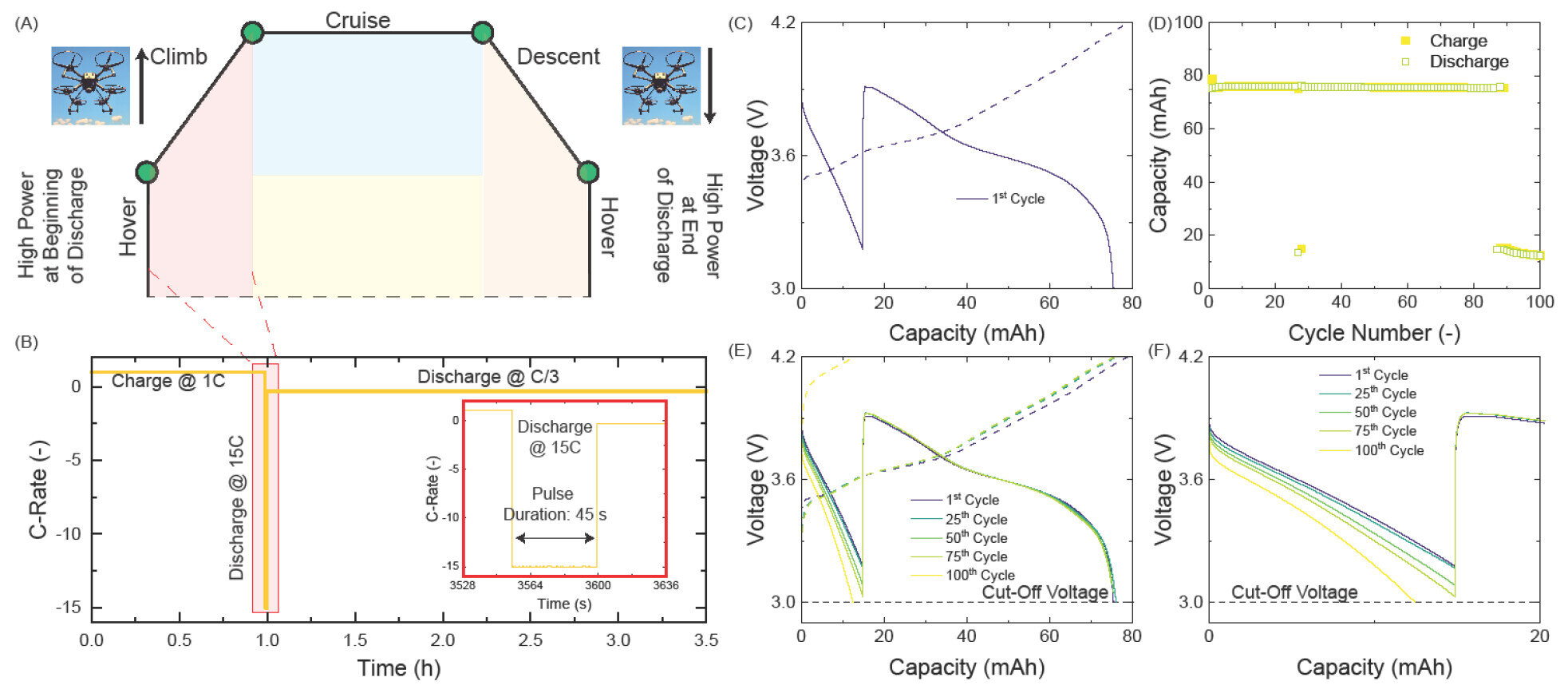
High power requirements in eVTOL load profiles and electrochemical behavior of lithium-ion batteries under simulated takeoff step. (A) Schematic diagram showing major segments of an eVTOL mission profile and the corresponding power requirements. We are interested in evaluating the behavior of lithium-ion batteries within the initial high-power segment of takeoff. (B) Current profile for the testing carried out in this study. Cells are charged at a nominal 1C rate until a full state-of-charge is achieved (4.2 V cutoff). At the beginning of discharge, a current pulse equivalent to 15C is applied for 45 s. Subsequent discharge is carried out at a nominal C/3 current. For the batteries investigated here, 1C corresponds to ∼0.08 A, and 15C corresponds to roughly 1.2 A. (C) First charge–discharge cycle polarization curve with the dotted line showing the charge cycle and solid line depicting the discharge cycle. (D) Capacity retention of the cell over extended cycling under the simulated climb step discharge protocol. (E) Complete polarization curves and (F) zoomed in plot of the polarizations within the 15C discharge pulse segment for the 1st, 25th, 50th, 75th, and 100th cycles. The cut-off voltage of 3 V is identified by a dashed line in (E) and (F). Credit: ACS Energy Letters (2024). DOI: 10.1021/acsenergylett.3c02385

Taking flight can be stressful—especially for a lithium-ion battery that powers a drone. Too much strain on these cells causes damage and shortens a device’s overall lifespan. Research in ACS Energy Letters shows the potential to improve batteries in aerial electric vehicles that take off and land vertically. The team developed a new electrolyte to address these challenges and said the “stressed out” batteries could also have second lives in less strenuous applications.

Lithium-ion batteries (LiBs) have exploded in popularity thanks to their ability to pack a large amount of power in a relatively small and light package. But they aren’t perfect, especially when a lot of that power needs to be drawn from the battery cell in a short amount of time.

For example, drones put a high strain on their batteries during takeoff. While hobby drones traditionally use lithium-ion polymer batteries instead of LiBs, the latter’s high energy density is better suited for heavier-duty drones, such as those that deliver cargo to remote locations. To better understand how high-strain events like liftoff can affect LiB stability, Ilias Belharouak, Marm Dixit, and colleagues “stressed out” a set of LiBs and investigated how their performance changed.

The researchers manufactured a set of LiB cells containing a specially designed, fast-charging, and discharging electrolyte. Then, they drained 15 times the battery’s optimal capacity, the total amount of energy it could store, for 45 seconds. This process simulated the rapid, high-power draw, also known as a discharge, needed during vertical takeoff.

After the initial discharge pulse, the cells were further drained at a more normal discharge rate and then recharged. The team found that none of the tested cells lasted more than 100 cycles under these high-stress conditions, with most starting to show decreased performance around 85 cycles.

After being “stressed,” the researchers subjected the LiB cells to a more normal, lower-rate power draw. In this experiment, they observed that the cells partially retained their capacities under low-rate conditions but failed quickly when put under rapid current drain conditions again.

These results indicate that the LiBs typically used in drones might not have the characteristics necessary for long-term, high-stress usages, but they could be retired and meet more typical power demands in other applications, such as battery back-ups for power supplies and energy-grid storage. The researchers say that more work is needed to develop alternative battery technologies that are better suited for vertical takeoff and other high-power-demand applications.

More information:
Marm Dixit et al, Lithium-Ion Battery Power Performance Assessment for the Climb Step of an Electric Vertical Takeoff and Landing (eVTOL) Application, ACS Energy Letters (2024). DOI: 10.1021/acsenergylett.3c02385

Provided by
American Chemical Society


Read the full article here

Related Articles

Neutron scattering study points the way to more powerful lithium batteries

Green Innovations April 16, 2024

Researchers can help shipowners achieve ambitious climate targets

Green Innovations April 16, 2024

Solar energy can uplift rural Ethiopians, but is hard to come by

Green Innovations April 16, 2024

A timer can shorten your shower even when you have no incentive to save water

Green Innovations April 16, 2024

High electric bills threaten California’s clean future: This plan could help

Green Innovations April 16, 2024

New insight about the working principles of bipolar membranes could guide future fuel cell design

Green Innovations April 16, 2024
Add A Comment
Leave A Reply Cancel Reply

Copyright © 2026. Innovation & Industry. All Rights Reserved.
  • Privacy Policy
  • Terms of use
  • Press Release
  • Advertise
  • Contact

Type above and press Enter to search. Press Esc to cancel.

Sign In or Register

Welcome Back!

Login to your account below.

Lost password?