


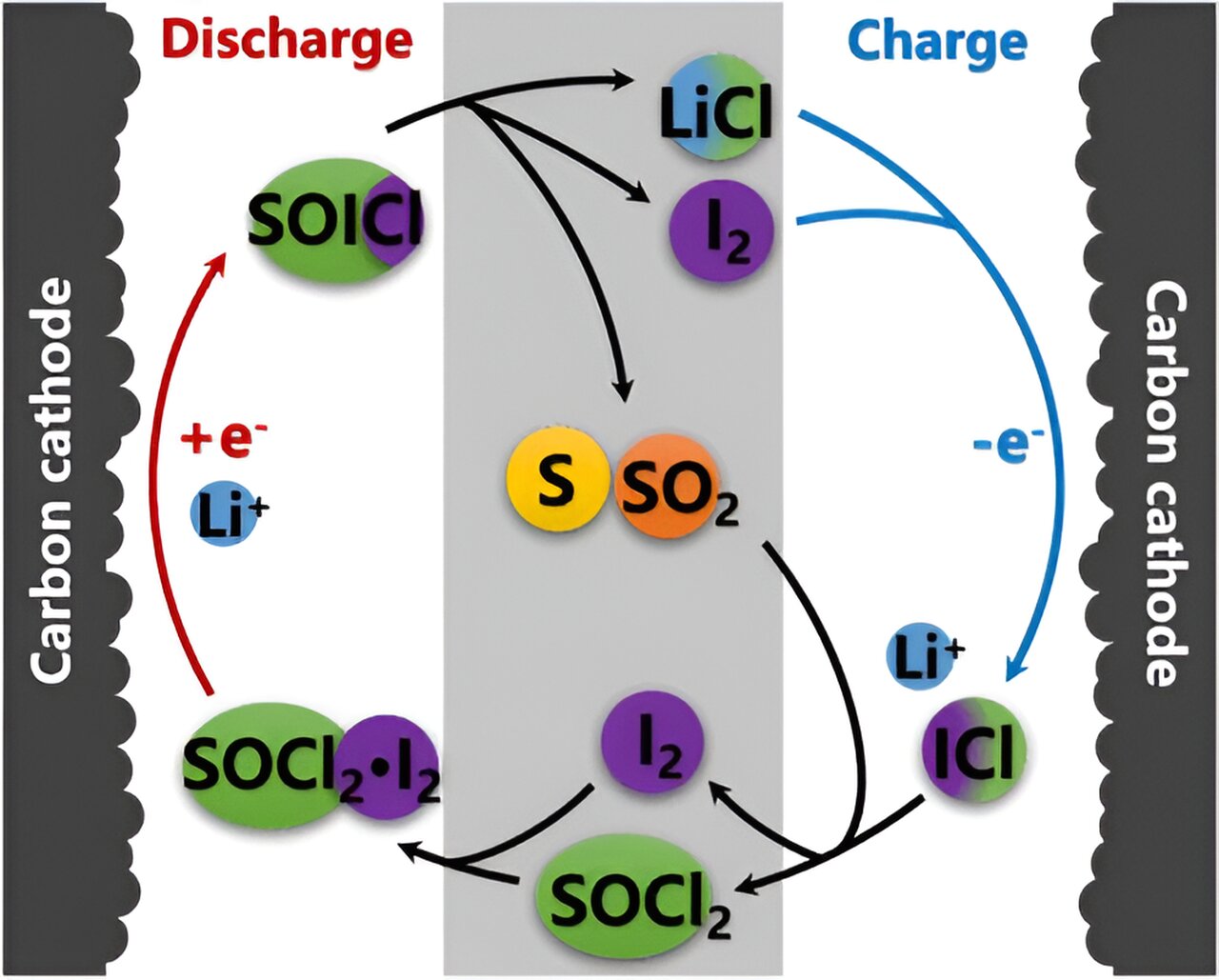
Lithium thionyl chloride (Li-SOCl2) batteries use a liquid thionyl chloride (SOCl2) electrolyte to give the battery superior energy density and stability, long life and low levels of energy loss during storage.
Despite these advantages, Li-SOCl2 batteries can only be used in devices requiring low rates of energy discharge and cannot be recharged.
Researchers from the Qingdao Institute of Bioenergy and Bioprocess Technology (QIBEBT) of the Chinese Academy of Sciences (CAS) have revealed that incorporating molecular iodine (I2) into the SOCl2 battery electrolyte not only increases the rate of energy discharge but also allows the battery to be efficiently recharged, increasing the practicality of Li-SOCl2 batteries for routine energy storage.
The study was published in Journal of the American Chemical Society.
The researchers found that I2 in a SOCl2-based electrolyte could serve as a dual-function molecular catalyst and save the Li-SOCl2 system from its primary deficiencies by generating new redox couples as intermediates for both the discharge and charge processes.
“I2 can speed electron transfer and improve energy charge and discharge rates while maintaining the high energy density associated with Li-SOCl2 batteries,” said Prof. Dong Shanmu from QIBEBT, co-corresponding author of the study.
Specifically, a redox couple is an atom or molecule that can donate an electron to an electrode, making the atom or molecule oxidized. This transfer of energy, through the donating and receiving of electrons, forms the fundamental basis of battery energy storage and release. By improving the kinetics of energy transfer with I2, the team not only improved the rate of energy release but also made Li-SOCl2 batteries rechargeable.
“Our work successfully sets the precedent of using one catalyst to alter the intermediates for two processes, both discharge and charge, which is a new method that realizes reversible SOCl2 chemistry during cycling,” said Prof. Cui Guanglei from QIBEBT, co-corresponding author of the study.
The research team looks forward to applying their insights to create more rechargeable battery systems to meet the power demands of the future.
“In the next phase of development, we will focus on developing new redox mediators or catalysts that efficiently improve battery charging and discharging and obtaining an in-depth analysis of the reaction mechanisms and limiting factors in charging batteries without additives,” said Chen Guodong from QIBEBT, first author of the study.
“In the end, our goal is to develop a rechargeable battery with a wide temperature operating range as well as high-energy and high-power density.”
More information:
Guodong Chen et al, Transforming a Primary Li-SOCl2 Battery into a High-Power Rechargeable System via Molecular Catalysis, Journal of the American Chemical Society (2023). DOI: 10.1021/jacs.3c07927
Chinese Academy of Sciences
Read the full article here


