


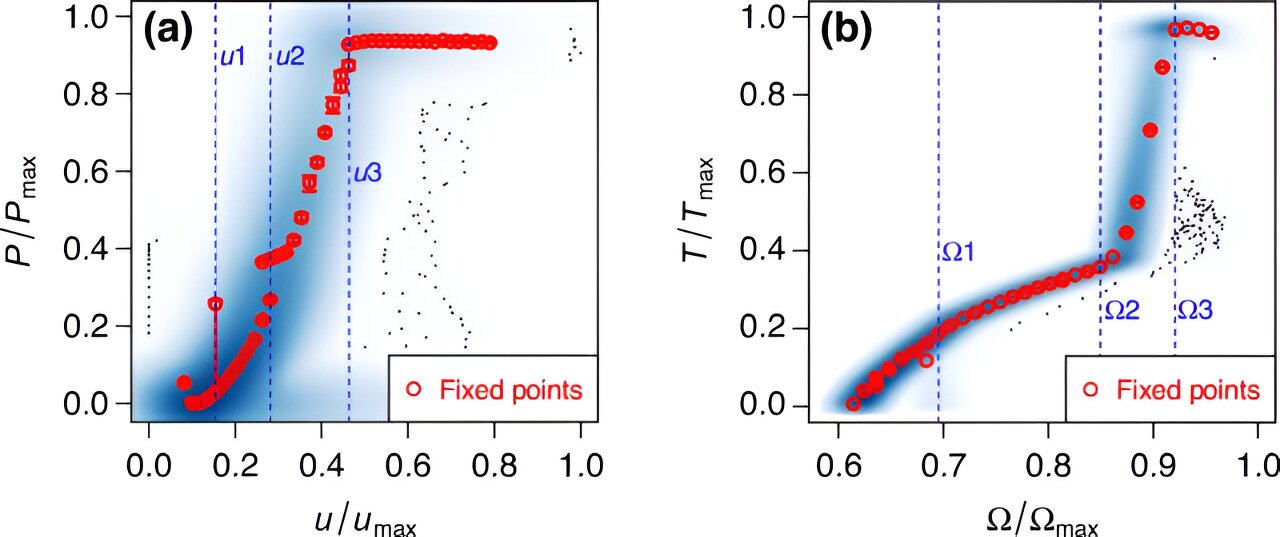
The output of wind turbines can rise or fall by 50% in a matter of seconds. Such fluctuations in the megawatt range put a strain on both power grids and the turbines themselves. A new study by researchers from the University of Oldenburg and the Sharif University of Technology in Tehran presents a new stochastic method that could help to mitigate these sudden swings and achieve a more consistent electricity production.
According to the study, it is the control systems of wind turbines that are mainly responsible for short-term fluctuations in electrical output. The research results also point to how these systems can be optimized to ensure that the turbines’ energy output is more consistent. The study was published in the science journal PRX Energy.
The research team led by lead author Dr. Pyei Phyo Lin from the University of Oldenburg analyzed data from several turbines in a wind farm. “Because wind turbines operate under turbulent wind conditions—similar to a plane landing in strong winds—all the measured data display multiple fluctuations and no clear signal can be detected. We refer to this as ‘noise,'” Lin explained. The physics engineer and his colleagues applied stochastic methods to analyze time series of the wind speed, the electrical output of the turbines and the rotational speed of the generator.
Using this innovative mathematical approach, they were able to disentangle the noise in the data and separate it into two different components, one of which one is caused by the wind while the other results from the reactions of the turbine’s control system. “Noise is often considered an unpleasant effect that interferes with measurements,” said Lin. “Now the noise provides us with new information about the system—that’s a new quality,” added co-author Dr. Matthias Wächter, who heads the Stochastic Analysis research group at the University of Oldenburg.
As the team explains, the results of the study indicate that the reactions of wind turbine control systems to abrupt wind fluctuations are often suboptimal; these systems tend to switch control strategies, which can lead to the observed strong fluctuations in electrical output. The new findings pave the way for turbulent wind phenomena to be decoupled from the control systems’ reactions.
“In this way, it will be possible to refine the control systems to ensure that wind turbines generate power more consistently,” said turbulence expert Professor Dr. Joachim Peinke from the University of Oldenburg, who was also involved in the study. This would also boost the efficiency of wind turbines and extend their lifespans, he added.
More information:
Pyei Phyo Lin et al, Discontinuous Jump Behavior of the Energy Conversion in Wind Energy Systems, PRX Energy (2023). DOI: 10.1103/PRXEnergy.2.033009
Provided by
Carl von Ossietzky-Universität Oldenburg
Read the full article here


