

Close Menu
  • Home
  • News
  • Startups
  • Innovation
  • Industry
  • Business
  • Green Innovations
  • Venture Capital
  • Market Data
    • Economic Calendar
    • Stocks
    • Commodities
    • Crypto
    • Forex
Facebook X (Twitter) Instagram
[gtranslate]
Facebook X (Twitter) Instagram YouTube
Innovation & Industry
Banner
  • Home
  • News
  • Startups
  • Innovation
  • Industry
  • Business
  • Green Innovations
  • Venture Capital
  • Market Data
    • Economic Calendar
    • Stocks
    • Commodities
    • Crypto
    • Forex
Login
Innovation & Industry
Green Innovations

How to optimize EV charging locations

News RoomNews RoomJanuary 3, 2024No Comments2 Mins Read
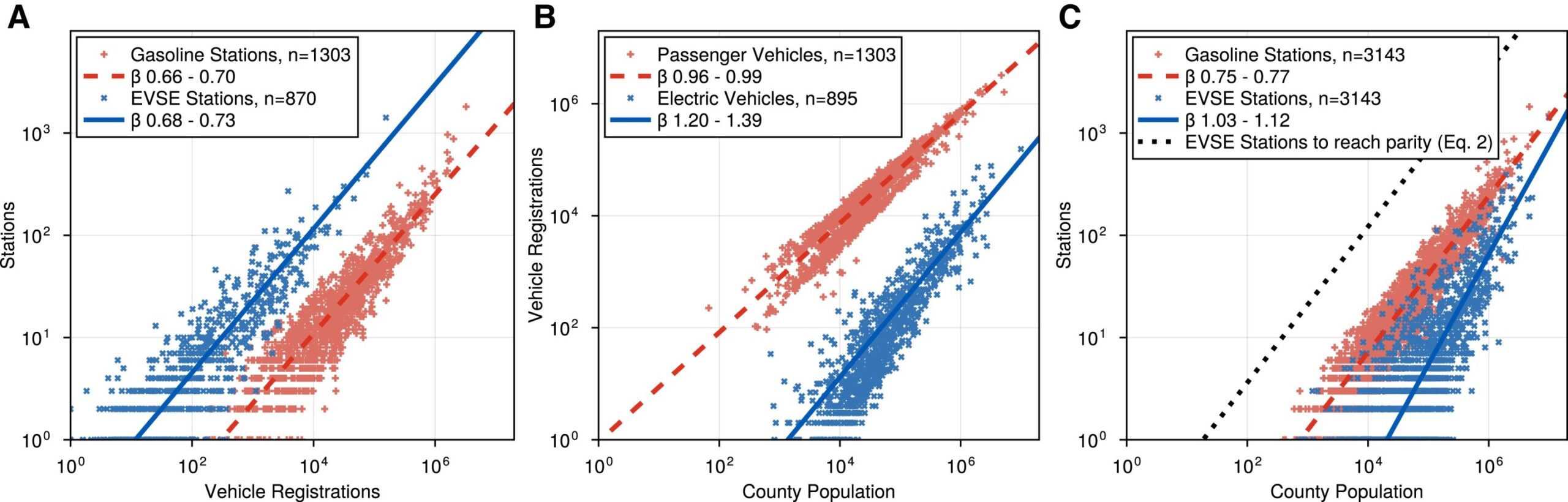
EVSE and gasoline stations scaling applied to different populations. a) EVSE and gas stations scale sub-linearly, following economies of scale, with their respective vehicle registrations per county. b) Passenger vehicle registrations scale linearly with the county population, while EV registration scales super linearly with the county population. c) Gasoline stations scale sub-linearly with the county population, while EVSE scale super-linearly with the county population; suggesting the influence of wealth/social interactions. Credit: PNAS Nexus (2023). DOI: 10.1093/pnasnexus/pgad341

Consumer interest in electric vehicles (EVs) is rising, but the lack of charging stations is a continuing concern to potential customers. No U.S. counties currently have a charging infrastructure that can deliver power equal to gasoline stations; many counties have no public EV charging infrastructure at all.

To equal the power of the existing gasoline network, the U.S. would need 1.8 million charging stations. But where should they be built? A recent paper titled “Scaling behavior for electric vehicle chargers and road map to addressing the infrastructure gap” published in PNAS Nexus provides a possible road map.

SFI’s Christopher Kempes and co-authors used scaling theory to forecast future charging station needs. Their work relies on the infrastructure efficiency achieved for areas with higher population density and fewer stations per capita, and shows that areas with a lower population currently have a bigger charging-station gap.

So, using simple population data to plan future charging stations could result in excess urban infrastructure and underserved rural communities. Prioritizing charging development using scaling analysis could help guide the distribution of charging stations needed for the widespread adoption of electric vehicles.

More information:
Alexius Wadell et al, Scaling behavior for electric vehicle chargers and road map to addressing the infrastructure gap, PNAS Nexus (2023). DOI: 10.1093/pnasnexus/pgad341

Provided by
Santa Fe Institute


Read the full article here

Related Articles

Neutron scattering study points the way to more powerful lithium batteries

Green Innovations April 16, 2024

Researchers can help shipowners achieve ambitious climate targets

Green Innovations April 16, 2024

Solar energy can uplift rural Ethiopians, but is hard to come by

Green Innovations April 16, 2024

A timer can shorten your shower even when you have no incentive to save water

Green Innovations April 16, 2024

High electric bills threaten California’s clean future: This plan could help

Green Innovations April 16, 2024

New insight about the working principles of bipolar membranes could guide future fuel cell design

Green Innovations April 16, 2024
Add A Comment
Leave A Reply Cancel Reply

Copyright © 2026. Innovation & Industry. All Rights Reserved.
  • Privacy Policy
  • Terms of use
  • Press Release
  • Advertise
  • Contact

Type above and press Enter to search. Press Esc to cancel.

Sign In or Register

Welcome Back!

Login to your account below.

Lost password?