


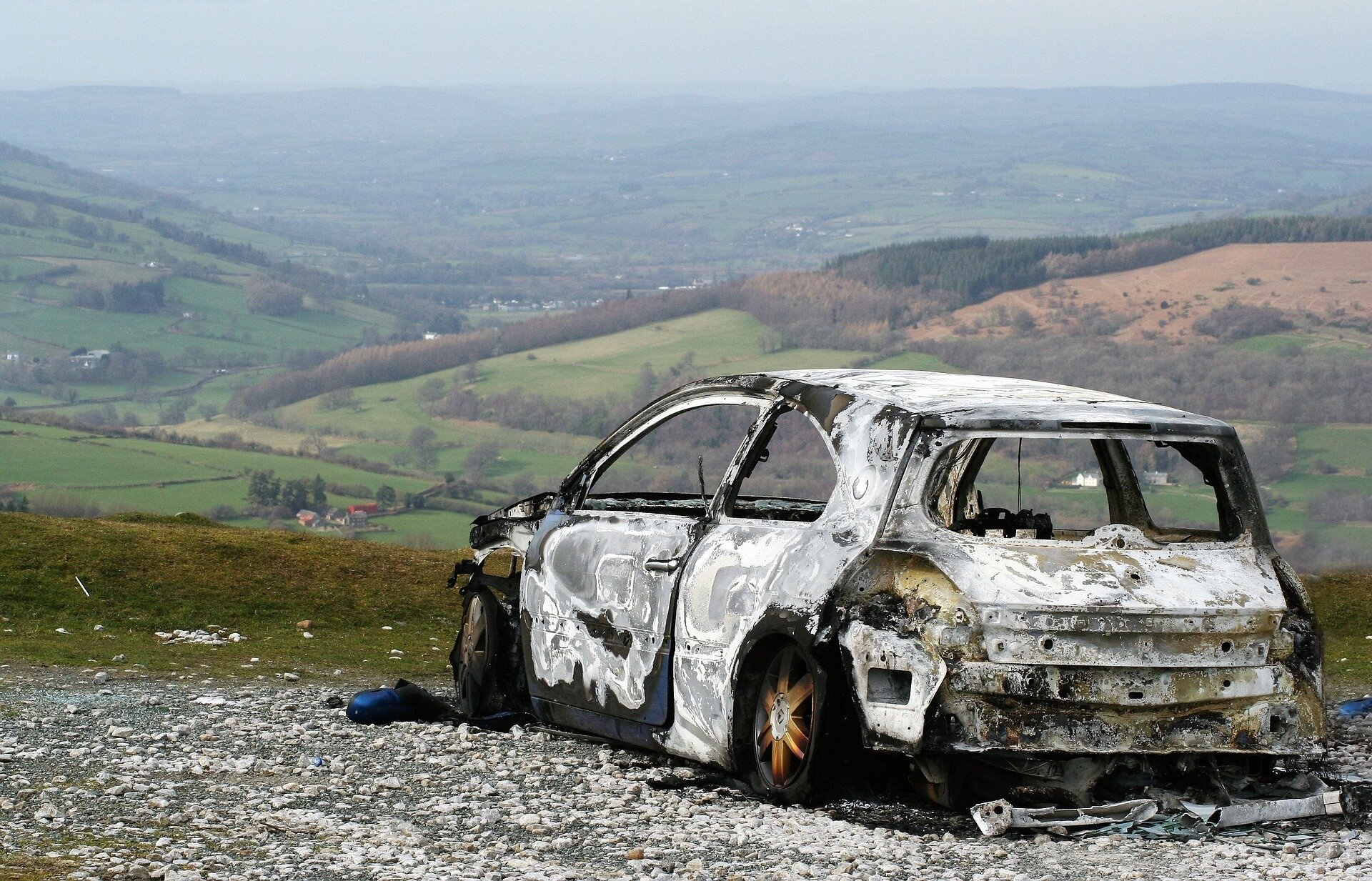
Over 2,700 cars on the cargo vessel Fremantle Highway that caught fire on 26 July have been so badly damaged that they cannot be sold. Can we recycle these cars? Arnold Tukker, Professor of Industrial Ecology, explains.
“There’s always something you can reuse,” says Tukker. “But it’s guesswork trying to work out from a distance what’s possible, and how. It may be that even the cars that are still intact will ultimately be written off because the manufacturers can no longer guarantee the quality of their product. In that case, it’s logical that individual components that are still working, such as engines or batteries, will be reused.”
If a component is going to be reused, obviously it first has to be checked. A battery is a good example, according to Tukker. “Once a battery has a maximum charge capacity of only 80% or less, it’s no longer suitable for driving. But it can still be used for other purposes, such as a stationary power supply, for years to come.”
Recycling burnt cars
The burnt cars from the Fremantle Highway, too, can be recycled. “A car is made primarily of steel and that’s a material that’s easy to reuse: you put it in the shredder and the steel granules you are left with can be reused as steel. The steel has to be clean, of course, and can’t have been mangled by the fire into a difficult to separate metallic mixture of batteries and other components.”
A damaged car battery is a lot more difficult to recycle, partly because of the many different materials that make up the battery. “I’m not an expert, but there [are] companies that are able to separate these difficult kinds of waste flows using special techniques. Incidentally, a battery will always be checked first to see if it can still be repaired. Just one broken cell in a series can cause problems, but if you replace that cell, the battery often works well again afterwards.”
Circular design for the future
It’s essential that in the future more techniques are developed for recycling batteries, not least because more and more of them will be produced. Tukker says, “In the present energy transition we are making sustainable alternatives for fossil energy, such as solar cells, wind turbines and electric cars. But we have no idea what we will have to do with them once they reach the end of their useful life.”
The Institute of Environmental Sciences is therefore collaborating with a number of different technical partners on such questions as: What are the biggest material flows? When are they released? How do we extend their lifespan? How do we ensure components and materials are reused? “Ultimately, you want all products coming onto the market from now on to be designed from a circular perspective,” says Tukker. “That way we can avoid being stuck with a huge mountain of waste in 20 years’ time that we can do nothing with.”
Leiden University
Read the full article here


